UNDERSTANDING THE CARTOON CRISIS
See Assimilation
EU Drafts 'Non-Emotive' Terror
Dictionary
Gareth Harding Apr 13, 2006
BRUSSELS, (UPI) -- The European Union is drawing up a lexicon of politically
correct language to use when describing terrorists who claim to act in the
name of Islam.
The idea was first aired in the EU's counter-terrorism strategy, which was
adopted by interior ministers in December. As part of its efforts to combat
radicalization and terrorist recruitment, the paper said the Union's 25 member
states have to do more to "correct unfair or inaccurate perceptions of Islam
and Muslims." It also called on EU officials to draft a "non-emotive lexicon
for discussing the issues in order to avoid linking Islam to terrorism."
Diplomats in Brussels are currently working on the handbook, which is
expected to be adopted by ministers in June.
The issue of how to discuss the link between radical Islamist groups and
terrorism has shot to the top of the political agenda since the riots by
immigrant offspring in French suburbs last November and the publication of
caricatures of the Prophet Mohammed in European newspapers earlier this year.
The decision to reprint images of the prophet, which is outlawed by Islam, was
denounced as a provocation by Muslim leaders and more than 50 demonstrators
died in violent clashes across the Islamic world.
"There is a simplistic portrayal in the Western media of Muslims as
fanatics, terrorists and extremists," says Shada Islam, Brussels correspondent
for a number of Asian and Middle East papers. "There is this picture of Muslim
women as all tied to the kitchen sink, wearing hijabs (veils) and totally
dominated by men. Every single TV program on Islam states starts with a shot
of camels in the desert and every radio show begins with the Muezzin (call to
prayer.) The finer points of what Islam is about and the fact that there is an
internal struggle going on within the religion are being ignored."
Arzu Donmezer, a political assistant of Turkish origin in the European
Parliament and a graduate in Islamic sciences, agrees that discrimination
against Muslims has intensified since the Sept. 11, 2001, terrorist attacks
against the United States. "When you say you are a Muslim, people take a step
back and ask if you know any terrorists. For many Europeans, being a Muslim is
the same as being a terrorist -- which means they are putting people like me
in the same box as radical Islamists. If I'm being pushed away by the very
people I want to belong to, where am I supposed to go?"
EU officials admit that there is a great deal of ignorance about Islam.
"This is all part of Western society getting to know the Islamic religion a
bit better," says Friso Roscam Abbing, a spokesman for European Commission
Vice-President Franco Frattini. For example, the term 'jihad,' which most
Europeans and Americans associate with the violent armed struggle against
Western "infidels," has largely positive connotations in the Muslim world,
where the term means overcoming a personal struggle.
"We want to avoid emotional wording which could hurt people or make a
direct link between certain religions and terrorism," said one EU official,
speaking on condition of anonymity. "Giving the impression that one community
or one religion is under the control of terrorists is no way to fight
terrorism."
The guidelines, which will be non-binding and aimed at public officials
rather than journalists, are likely to advise against using the term "Islamic
terrorism." Roscam Abbing said his EU commissioner, who is the rough
equivalent of the U.S. homeland security chief, prefers to talk about "those
who have an abusive interpretation of Islam," rather than Islamists or Muslim
fundamentalists. "The idea is not to use the terms Islam and Muslim in
connection to something negative," added the spokesman.
The initiative was welcomed by Islam, the Brussels-based journalist, who
notes that people never refer to the IRA or ETA as Christian terrorist groups.
"Words are not just empty shells; they carry cultural weight. For example,
when EU ministers use the same vocabulary to talk about immigrants, asylum
seekers and terrorists, they create the impression that if you're an immigrant
or asylum seeker then obviously you are a terrorist. So I think a certain
amount of political correctness is necessary when talking about such explosive
and sensitive issues. If anything can help defuse the current tensions, why
not?"
By David Rennie
LONDON DAILY TELEGRAPH
Published April 12, 2006
BRUSSELS -- European governments should shun the phrase "Islamic terrorism"
in favor of "terrorists who abusively invoke Islam," say guidelines from EU
officials.
Backed by diplomats and civil servants from the 25 members of the European
Union, the officials are drafting a "non-emotive lexicon for discussing
radicalization" to be submitted to British Prime Minister Tony Blair and other
leaders in June.
The Brussels officials hope the new lexicon, which would not be legally
binding, would be adopted by governments and other EU institutions, such as
the European Commission and European Parliament.
An EU official said: "The basic idea behind it is to avoid the use of
improper words that would cause frustration among Muslims and increase the
risk of radicalization."
Along with civil servants from the British Home Office, the officials have
reviewed the effect of terms such as Islamist, fundamentalist and jihad when
describing acts of terrorism and murder.
"Jihad means something for you and me; it means something else for a
Muslim," said EU officials at a Berlin conference on radicalization. "Jihad is
a perfectly positive concept of trying to fight evil within yourself."
Though British officials have been involved in drawing up the lexicon,
Whitehall sources indicated that the government was unlikely to adopt it
wholesale or heed any call to ban the term "Islamic terrorist."
The lexicon is seen in London as more likely to be of use to continental
governments with limited exposure to Muslims. A Home Office spokesman said:
"We believe there is a balance to be struck between raising awareness of the
impact that language can have and not letting extremism go unchallenged."
The lexicon is being discussed only at a "working group level" but has the
support of Gijs de Vries, the EU counterterrorism coordinator.
Annan stresses on freedoms of speech and worship
United Nations:
Observing that the recent crisis over caricatures of Prophet Mohammad
reflected a trend towards extremism in
Islamic and Western societies, U N Secretary General Kofi Annan
has advocated increased emphasis on freedoms of
worship and speech to
counter the phenomenon.
"To counter it, we must all speak up for freedom of worship and for freedom of
speech," Annan told the
meeting of the Organization of the Islamic
Conference (OIC) in Istanbul today in a message delivered by
Mohamed Sahnoun, his special adviser on Africa.
He also affirmed the importance of basic freedoms as well as the need for
sensitivity towards other cultures.
To stop extremism and boost inter-cultural relations, he renewed his appeal
for dialogue between civilizations and cultural sensitivity.
"We must
stress that rights carry with them an inherent responsibility,
and should not be used to degrade, humiliate or insult any group or
individual," he said.
Annan also talked about the sectarian rifts in Iraq, economic progress in
Afghanistan and the conflict between Israelis and Palestinians.
"The OIC, as the leading multilateral Islamic organization, has a key role to
play in addressing these and other challenges," Annan said.
April 13, 2006
www.newkerala.com
Danish Muslims sue newspaper that printed prophet cartoons
3/30/2006 www.usatoday.com
COPENHAGEN, Denmark (AP) — A group of 27 Danish Muslim organizations have
filed a defamation lawsuit against the newspaper that first published the
carricatures of Islam's Prophet Muhammad, their lawyer said Thursday.
The lawsuit was filed Wednesday, two weeks after
Denmark's top prosecutor declined to press criminal charges, saying the
drawings that sparked a firestorm in the Muslim world did not violate laws
against racism or blasphemy.
Michael Christiani Havemann, a lawyer representing the
Muslim groups, said lawsuit sought $16,100 in damages from Jyllands-Posten
Editor in Chief Carsten Juste and Culture Editor Flemming Rose, who supervised
the cartoon project.
"We're seeking judgment for both the text and the
drawings which were gratuitously defamatory and injurious," Havemann said.
The lawsuit was filed in the western city of Aarhus,
where Jyllands-Posten is based.
The newspaper published the 12 cartoons on Sept. 30,
saying it was challenging self-censorship among artists afraid to offend
Islam. The drawings were later reprinted in other Western media, mostly in
Europe, in the name of free speech and news value.
The Danish newspaper apologized for offending Muslims
after violent protests erupted throughout the Islamic world, but stood by its
decision to print the drawings, citing freedom of speech.
OIC calls to fight racial prejudice
Habib Shaikh Khaleej Times -
Dubai,United Arab Emirates 22 March 2006
JEDDAH — The Organisation of
Islamic Conference (OIC) has urged the international community to strengthen
cooperation to fight racial discrimination, xenophobia and related
intolerances on the bases of culture, religion, nationality, race or
language.
It called for the
effective implementation of all international treaties and instruments,
which forbid such policies in order to ensure the prevalence of human
rights, greater harmony and tolerance. In a statement issued on the 40th
anniversary of the proclamation of the International Day for the Elimination
of Racial Discrimination, which fell on Monday, the OIC Secretary General
Ekmeleddin Ihsanogul said the Organisation calls upon the international
community to intensify their efforts to promote understanding between
different civilisations and cultures.
He said there should be
joint efforts to counter attempts at cultural and racial domination.
The secretary general
lamented that despite 40 years of relentless efforts exerted by the
international community to combat the scourge of racism, racial
discrimination, xenophobia and related intolerances were gaining ground. He
added that contemporary forms and manifestations of racism were trying to
gain moral, political or legal recognition through subtle means, under the
guise of freedom of expression.
The blasphemous and
derogatory cartoons in the Danish newspaper Jyllands-Posten were a case in
point.
EU, OIC urged to draft joint resolution on cartoons
March 11, 2006 SALZBURG, Austria (Reuters) - European Union foreign policy
chiefs urged the bloc on Friday to work with Islamic states on a joint U.N.
resolution to help ease tensions caused by a row over cartoons of the Prophet
Mohammad.
The call came as the head of the Organisation of the Islamic Conference (OIC)
criticised the EU for not doing enough to heal wounds with Muslims caused by
the affair.
Controversy over the cartoons first published last year in a Danish
newspaper and since reprinted in other European media sparked worldwide
protests by Muslims who believe it is blasphemous to depict the Prophet. At
least 50 people were killed in violent protests.
The 25 EU foreign ministers discussed ways of rebuilding trust with the
Islamic world.
EU foreign policy chief Javier Solana and European External Relations
Commissioner Benita Ferrero-Waldner suggested in a joint paper that the EU and
the OIC could draft a joint resolution at the United Nations promoting
religious tolerance.
The EU and the OIC previously presented two competing resolutions to the
U.N. General Assembly, but EU countries voted against the OIC text because it
focused too narrowly on discrimination against Islam, an EU official said.
Danish Foreign Minister Per Stig Moeller told reporters he was not sure EU
and OIC countries could agree on a joint text.
“It may be true that a law cannot make a man love
me, but it can keep him from lynching me, and that’s pretty important”
Reverend Martin Luther King, Jr.
Neo-Nazis threaten violence
Wednesday, 22 March, 2006 - La Repubblica
ROME: The World Cup in Germany is set to become a
battleground between fascists and Muslims, an Italian member of a new European
neo-Nazi movement warned yesterday.
In a statement published by Italian daily La Repubblica, the member of AS
Roma’s notorious hooligan group claims neo-Nazis across Europe met in Braunau
in Austria to plan attacks against supporters from Muslim countries during the
World Cup in Germany from June 9 to July 9.
“We are united. For the first time we are talking and planning together, with
the English, the Germans, the Dutch, the Spanish, everyone with the same
objective.
“At the World Cup there will be a massacre,” said the Italian.
“We will all be in Germany and there will be Turks, Algerians and Tunisians.
The Turks, we can’t stand them. In our country (Italy) there are not many, but
in Germany, there are many of those guys there. They are terrorists.
“We will attack them. They are all enemies that need to be eliminated, just
like the police.
“If we make the Roman greeting (the fascist salute) they put us in prison. We
will be tens of thousands. Nothing but the English are feared.”
– AFP
OIC envoys assured of steps against blasphemy
By Qudssia Akhlaque
March 11, 2006
ISLAMABAD, March 10: The UN High Commissioner for Human Rights has assured OIC
ambassadors in Geneva that her Office was taking necessary steps to combat
defamation of religions, create a culture of tolerance, explore and elaborate
legal framework for respect of religions as well as freedom of expression to
address the situation created by the publication of blasphemous cartoons.
UN High Commissioner for Human Rights Louis Arbour held out the assurance to a
delegation of 14 Muslim envoys who met her this week to express Islamic
world’s deep concerns on publication of defamatory caricatures in Danish
newspaper Jyllands Posten and their reprinting in several European newspapers,
the Foreign Office said on Friday.
The OIC ambassadors sought UN High Commissioner’s help to address the concerns
of Muslim countries to redress legal deficits in regard to respect for
religions and mobilize human rights machinery to stem recurrence of such
outrage, the Foreign Office said.
Ms Arbour’s view was that when freedom of expression hurt dignity and
religious sensitivities, as in the case of publication of cartoons, the
situation could not be addressed merely by laws. The viable course, she
maintained, was to effectively combat the trend and promote culture of
tolerance and sound political judgment.
The delegation, led by Pakistan’s Permanent Representative Masood Khan, the
OIC coordinator on human rights and humanitarian issues in Geneva, proposed
that as the UN High Commissioner she take concrete measures such as sending a
fact-finding mission and asking the Special Rapporteurs to carry out legal
analysis of the questions surrounding the caricatures issue.
The OIC ambassadors also suggested hosting of dialogues to address
cross-cutting legal, political and cultural issues. They advocated
inter-cultural and inter-religious dialogues for promoting peace, harmony and
understanding.
The UN High Commissioner told the delegation that substantive efforts were
being made by her office to raise awareness in this regard through
publication, information campaigns, seminars and conferences.
The OIC envoys conveyed to the High Commissioner that the publication of the
caricature and their reprinting in the media could not be justified in the
name of freedom of expression. It was a deliberate act of provocation.
OIC criticises EU response to cartoons
Published: Saturday, 11 March, 2006, 10:44 AM Doha Time
LONDON: The leader of the world’s
largest Muslim body yesterday criticised the European Union for its
‘unsatisfactory response’ to the furor over the publication of cartoons of the
Prophet Muhammad.
Ekmeleddin Ihsanoglu, Secretary General of the Organisation
of the Islamic Conference (OIC), said that by simply regretting that Muslims
found the cartoons offensive, EU foreign ministers had not gone far enough at
a meeting in Brussels last week.
"We expected the EU to address the issue of cartoons in a
more fair way," Ihsanoglu told a news conference in London.
"I must say that we are not satisfied with the result of
last week’s meeting in Brussels. The conclusion published by the European
Union fell short of our expectations." – AFP
Cartoon politics
Monday, March 27, 2006 Turkish Daily News
The controversy over the Danish caricatures of Prophet Mohammed, and the
perception of Islam that resurfaced in some European circles in the name of
freedom of expression, has turned into a global wave of violent protests
throughout the 'Muslim world.' Demonstrations turned into ransacking of
diplomatic missions and violent clashes with human casualties. However, there
was a parallel agenda of the protests besides religion per se, that is less
recognized by those who find it expedient to rely on the thesis of 'clash of
civilizations.'
DOĞU ERGİL
The controversy over the Danish caricatures of Prophet Mohammed, and the
perception of Islam that resurfaced in some European circles in the name of
freedom of expression, has turned into a global wave of violent protests
throughout the “Muslim world.” Demonstrations turned into ransacking of
diplomatic missions and violent clashes with human casualties. However, there
was a parallel agenda of the protests besides religion per se, that is less
recognized by those who find it expedient to rely on the thesis of “clash of
civilizations.” This thesis foresees a bifurcated world where the civilized,
progressive and affluent side of the world lives the way they do because they
deserve it by way of their superiority. The remaining part of the world that
is not civilized may live in its squalor, backwardness and tyranny of
ignorance by their own choice, and because they also deserve it. The first
world feels no responsibility for the second, and hence expends no effort to
understand why its sentiments and view of the first does not match their
naiveté and irresponsibility.
First of all, what is crudely called the “Muslim world” has been the
hunting ground of Western colonialism and expansionism in the previous
centuries that left behind a legacy of exploitation, impoverishment and a
wounded psyche, at the core of which is resentment, humiliation and feeling of
inferiority. This is an explosive mixture in that if the culprit or former
oppressor does not extend its hand and heart in the post-colonial era to its
former colonized subjects, and does not help to repair the damage done during
many centuries of domination and humiliation, the national identities in the
former colonies become nothing but renouncement of anything associated with
their former colonizers. The West seems never to grasp this reality because it
is a hard and bitter pill to swallow. Because of this, it becomes all the more
difficult to understand the real reasons and local agendas that have
aggravated this crisis, which fundamentally is a mechanism to vent the
reservoir of pre-existing resentment towards the West.
The Egyptian demonstrators condemn the insolence of the West. With a
strong group in parliament, the Muslim Brothers is a challenge to the secular
government of Mr. Hosni Mubarak. Besides the West, they want to direct their
protest against the regime they strive to replace, and the incumbent
government in turn feels the need to show that they are also capable of
playing on popular sentiments, so that there is no need for a more radical
group to be in power. These internal tensions are easily channeled against a
common target. The Iraqi demonstrators want the withdrawal of Danish troops,
and Afghan tribesman that have links with the old (dis)order want NATO
soldiers out of their country. What better excuse is there for these groups to
express their political agenda in a public forum when there is so little
legitimate opportunity to do so otherwise? Iran, Syria and the pro-Syrian
Lebanese Sunnis are undoubtedly unhappy with Western pressure on them. They do
not want to see Western dominance once again on their home soil. With the
example American invasion of Iraq, which they see as a revival of western
imperialism, anti-western and anti-American sentiment has reached boiling
point.
Despite these facts, in most of the Western media the ongoing dispute has
typically been treated as a further sign of the fanaticism of Muslims. But the
tempest did not arise out of nowhere. First, it arose out of ignorance of the
local context of these conflicts, which are mostly not about religion as much
as they are about power struggles within Muslim societies. Secondly, religious
nationalism exacerbated by the Bush administration's decision to invade Iraq
has raised suspicions that it can do the same all over the region. The ensuing
turmoil that threatens almost every party in the Middle East and the Muslim
World interprets this as an aggression to their being (identity, territory and
sovereignty). It is not just about the cartoons.
After the cartoons were published on Sept. 30, Danish Prime Minister
Anders Fogh Rasmussen refused to meet with ambassadors from Muslim countries
and lectured Muslims on their need to tolerate the caricatures. This attitude
was exactly what the Muslims (or anyone outside the Western political reality)
abhorred: encroachment and disrespect of the liberty to define yourself rather
than being defined by the imperial West. This is exactly the source of
bitterness in their collective memory that is still remembered vividly in the
form of Christian missionaries preaching to local people exactly how barbaric
they thought the Muslim faith was. Or signs hanging on the doors of European
clubs in India only a century ago that said, "Dogs and Indians not allowed."
In short, the overly critical opinion of the Muslim crowds has little to do
with piety and more to do with history and its lingering legacy.
The whole affair is a cost-free bandwagon on which everyone can jump on
in search of greater legitimacy among Muslim publics. There is no downside in
the Muslim world to defending Prophet Mohammed from Western insults.
Pro-Western politicians can use it to burnish their nationalist image, while
others use it to show how respectful they are to religion to cover their
weaker flank against the religious political parties who are threatening their
ruling positions.
If the conservative, Christian West shows no ability (or willingness) to
respect conservative Muslims' need to value his or her own beliefs, the West
will find itself less able to speak to the Muslim world, and less able to
defend freedom of expression. What will be the end result? Clash of faiths and
values started by those who dread it most!
UN
High Commissioner conveyed concern at blasphemous cartoons
GENEVA, March 10 : A delegation of 14 OIC Ambassadors in
Geneva met the High Commissioner to express Islamic world’s deep concerns on
publication of defamatory caricatures in Danish newspaper Jyllands Posten and
their reprinting in several European newspapers, Pakistani mission said.
The delegation was led by Ambassador Masood Khan, who is the
OIC Coordinator on Human Rights and Humanitarian issues in Geneva.
The Ambassadors urged the United Nations High Commissioner for
Human Rights to help address the concerns of Muslim countries to redress legal
deficits in regard to respect for religions, and mobilize human rights
machinery to stem recurrence of such outrage. They said that such deliberate
acts are disruptive and counter productive.
The OIC delegation told the High Commissioner that the
caricatures had seriously hurt the sensibilities of Islamic nations and
peoples all over the world. They emphasized that publication of the caricature
and their reprinting in the media could not be justified in the name of
freedom of expression. It was a deliberate act of provocation and not an act
of negligence.
The delegation advised the High Commissioner, that in view of
her leading role in human rights, concrete measures by her office would
greatly contribute to promoting respect of religions and their prophets and in
avoiding future recurrence of such defamatory acts.
They suggested that such measures may include sending a fact
finding mission and asking the Special Rapporteurs to carry out legal analysis
of the questions surrounding the caricatures issue.
The OIC Ambassadors also urged the High Commissioner to host a
dialogue to bring out complimentarily between freedom of expression and
respect of religions and to address cross-cutting legal, political and
cultural issues. In this regard, they expressed that intercultural and
inter-religious dialogues could make useful contributions in promoting peace,
harmony and understanding.
The High Commissioner assured the Ambassadors about her
commitment to combating defamation of religions and building a culture of
tolerance and understanding. She told the delegation that her office was
devoting substantive efforts to raise awareness in this area through
publication information campaigns, seminars and conferences.
She expressed the view that when freedom of expression hurt
dignity and religious sensitivities, such as in the case of publication of
caricatures, the situation could not be addressed by laws alone. The viable
course was to effectively combat this trend and promote culture of tolerance
and sound political judgment.
She drew the attention of the delegation to the recent
statement by the UN Secretary General in Doha in which he said “All of us now
join to renew our call for restraint, and for an immediate end to the present
atmosphere, which threatens to sow deep discord between communities, societies
and countries. We deeply regret the offence given by the caricatures, as well
as the loss of life and damage to property in several countries”.
www.pakistanlink.com
Muslims strong reaction sensitizes EU
www.kashar.net
ISLAMABAD, March 11 (SANA): Minister for Religious Affairs Ejazul Haq has said
that the strong reaction of Muslims to the issue of blasphemous caricatures
has sensitized the European Union about delicacy of the problem.
He was addressing a news conference in Islamabad on Saturday after his return
from Brussels where he led a parliamentary delegation to apprise the EU
officials about sensitivity of the issue.
The Minister was confident that the Western media too would demonstrate
responsible attitude towards such matters.
He, however, was of the view that the violent protests have damaged our cause.
He cautioned that some elements were engaged in conspiracies against Muslims
and we must not indulge in acts that could amount to advancing their
objectives.
The Minister said the parliamentary delegation demanded of the European Union
to cooperate for the passage of the OIC resolution at the United Nations. He
said the EU, in principle, supports the resolution but also wants introduction
of some amendments to enlarge the scope of the document. The EU wants that
instead of only Islam, other religions and faith should also be included in
the resolution.
He said the delegation also met Brussels-based ambassadors of the Islamic
countries. They were of the view that there was need to activate the OIC. It
was also felt that the OIC should have its office in Brussels. The Muslim
ambassadors appreciated efforts of Pakistan and said it was the only Islamic
country that has sent a parliamentary delegation to Belgium on the issue of
blasphemous caricatures and engaged into a direct dialogue with the European
Union.
Replying to a question the Minister for Religious Affairs said he would soon
visit Jeddah to brief the OIC about the outcome of the delegation's visit to
Brussels.
He told a questioner that more delegations would be sent to other capitals as
well and hoped that the opposition would form part of those delegation.
Ihsanoglu Slams Western "Double
Standards"
 |
|
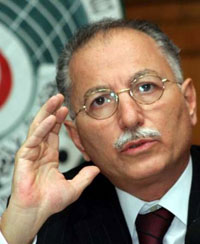
"This is a Western and
European problem which should be addressed properly," said Ihsanoglu.
(Reuters)
|
LONDON, March 11, 2006 (IslamOnline.net & News
Agencies) - The head of the Organization of the Islamic Conference (OIC)
blasted Friday, March 10, Western governments' "double standards" which he
said were exploited by extremists.
"What is going on in Guantanamo and Abu Ghraib
and Basra, this is obviously seen as double standards," said OIC Secretary
General Ekmeleddin Ihsanoglu at a press conference in London, reported Agence
France-Presse (AFP).
He was referring to the notorious US prisons in
Cuba and Iraq, where prisoners have been tortured and sexually abused,
according to US media reports and leaked photos.
"This is a Western and European problem which
should be addressed properly," he stressed, adding that global tensions could
be eased if Western nations applied their professed values universally.
"If we are talking about human rights as
universal, how can one say there are islands on which human rights are not
applied? We have a problem here," Ekmeleddin fumed.
He went on: "Their defense of freedom of
expression and human rights were undermined by the US prison camp at
Guantanamo Bay, Cuba, the US-led occupation of Iraq and Israel's occupation of
Palestine."
Last year, British Prime Minister Tony Blair
said that the world must make progress on issues used by terrorists as a
reason for violence such as the Middle East conflict, admitting that the Iraq
war was used to recruit terrorists.
David Clark, a former British government
adviser, wrote in a Guardian piece that the world should take
"legitimate" Arab grievances seriously if it wanted to defeat terrorism.
Extremism
The chief of the pan-Muslim body said such
double standards are fanning up extremism and help recruit terrorists,
stressing that extremists did not represent the true nature of the Muslim
faith.
"Why are some people supporting them? Because
they tell them: 'There are double standards -- look what is taking place in
Palestine, look what is taking place in Iraq'.
"They ask the people: 'Do you like this?' and
they say 'No, we don't like it', and then they get the support, financial,
spiritual and moral," he added.
Ekmeleddin, a Turk, further described as
inexplicable the July 7 bomb attacks in London in which four presumed Muslims
set off bombs on London Underground trains and a bus, killing themselves and
52 commuters.
He urged moderate Muslim leaders to speak out
against radicals who praise the bombers, adding: "Nothing can justify this
(attack) in the name of any religion, any ideology, any belief."
A statement issued by over forty leading mosque
imams, muftis and scholars representing all sections of Muslims in Britain
condemned the attacks and stressed that the four Muslim bombers can not
consider themselves martyrs.
Unfair EU
 |
|
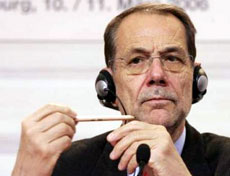
Solana suggested that the EU
and the OIC could draft a joint resolution at the UN promoting religious
tolerance. (Reuters)
|
Ekmeleddin also criticized the European Union
for what he described as an unsatisfactory response to the furor over the
publication of Danish cartoons that lampooned Prophet Muhammad (peace and
blessing be upon him).
"We expected the EU to address the issue of
cartoons in a more fair way," Reuters quoted Ihsanoglu as saying.
By simply regretting that Muslims found the
cartoons offensive, EU foreign ministers had not gone far enough at their
meeting in Brussels, he added.
"I must say that we are not satisfied with the
result of last week's meeting in Brussels. The conclusion published by the
European Union fell short of our expectations."
EU foreign ministers issued a strong
condemnation of attacks on EU citizens and property.
Pundits said the statement was more critical of
the Muslim reaction than of the cartoons themselves.
The 12 cartoons, which Ihsanoglu described as
"insulting, ugly and uncivilized", were first published by a Danish newspaper
and then reprinted by papers across Europe.
The furor exposed a gulf of misunderstanding
between the West, which defended the publication by citing the right of free
speech, and Muslims who saw it as an attack on their beliefs.
Muslim scholars and preachers demanded the
Danish government anew on Friday, March 10, at a Copenhagen conference
apologize for the publication of the cartoons and renewed calls for an
international law banning blasphemy.
EU foreign policy chief Javier Solana and
European External Relations Commissioner Benita Ferrero-Waldner in Salzburg,
Austria, suggested on Friday in a joint paper that the EU and the OIC could
draft a joint resolution at the United Nations promoting religious tolerance.
Danish Foreign Minister Per Stig Moeller,
however, told reporters he was not sure EU and OIC countries could agree on a
joint text.
World Muslim body criticizes EU over cartoons
By Gideon Long
LONDON, March 10 2006 (Reuters) - The leader of the world's largest Muslim
body criticised the European Union on Friday for what he described as an
unsatisfactory response to the furore over the publication of cartoons of the
Prophet Mohammad.
Ekmeleddin Ihsanoglu, Secretary General of the Organisation of the Islamic
Conference (OIC), said that by simply regretting that Muslims found the
cartoons offensive, EU foreign ministers had not gone far enough at a meeting
in Brussels last week.
"We expected the EU to address the issue of cartoons in a more fair way,"
Ihsanoglu told a news conference in London.
"I must say that we are not satisfied with the result of last week's
meeting in Brussels. The conclusion published by the European Union fell short
of our expectations."
The 12 cartoons, which Ihsanoglu described as "insulting, ugly and
uncivilised", were first published by a Danish newspaper and then reprinted by
papers across Europe.
They sparked indignation and violence in the Muslim world, where images of
the prophet are deemed blasphemous. At least 50 people were killed in
anti-Western protests and three Danish embassies were attacked.
The furore exposed a gulf of misunderstanding between the West, which
defended the publication by citing the right of free speech, and Muslims who
saw it as an attack on their beliefs.
In their Feb. 27 statement, EU foreign ministers issued a strong
condemnation of attacks on EU citizens and property.
Diplomats noted the statement was more critical of the Muslim reaction than
one issued days earlier by the United Nations, the Arab League and the OIC, an
umbrella group of 57 predominantly Muslim nations.
BRITISH INTEGRATION
Ihsanoglu, the first OIC secretary general to visit Britain since the
body's foundation 37 years ago, praised the level of integration between
Britain's Muslims and non-Muslims.
"I think the situation of Muslims here with all honesty is much better than
the situation of Muslims elsewhere in Europe," he said. "That shows that the
British model is more successful than other models."
Britain's tradition of multiculturalism has been called into question since
last year's London suicide bombings, perpetrated by British-born Muslims.
Critics of it say the British should be more forceful in persuading its
immigrant communities to abandon their ethnic roots and conform to British
traditions.
Ihsanoglu, an Egyptian-born Turk, said he had discussed the bombings and
their impact on Britain's 1.6 million Muslims with British Foreign Minister
Jack Straw and Home Secretary Charles Clarke during his visit.
"(Muslims) feel they are all under suspicion," he said. "The Muslim
community in its entirety should not be held responsible (for the bombings)."
Pakistan, OIC, EU to move resolution in UN to stonewall recurrence of
sacrilegious cartoons like incidents
Sunday March 12, 2006
ISLAMABAD: Terming his recently concluded Brussels visit highly
successful, federal minister for religious affairs Ijaz-ul-Haq has held out
assurances that Pakistan, OIC and European Union will jointly table a
resolution in the United Nations in a bid to stonewall recurrence of tragic
incidents like publication of sacrilegious caricatures.
"Freedom of expression has some limitations and we will
take action against Denmark’s dailies in line with Copenhagen established
rules and regulations," flanked by Asad Murtaza Gillani and Mushtaq victor,
Ijaz-ul-Haq expressed these views at a press conference on Saturday.
The European Union in this connection was awaiting our
visit anxiously but had the opposition joined us than the visit would have
far-reaching positive impact, he regretted.
The publication of blasphemous caricatures is the issue
of all Muslims, he said adding however, he would in future extend invitation
to the opposition to join them in such visits.
He vowed that under section 140A and 267B of Denmark
laws, the issue of cartoons publication would be taken to the Denmark courts
with the cooperation of Copenhagen Muslim community.
He however, regretted that torching of some western
embassies in Islamic countries in this connection had affected the image of
Muslim.
"We should lodge peaceful protest. We should not create
law and order," he concluded.
Western Double Standard Fueled Anger Over
Controversial Cartoons
Arab News, Associated Press
LONDON, 11 March 2006 —
Western double standards demonstrated by the detentions
at the US prison camp in Guantanamo Bay fueled anger that led to violent
protests over cartoons of the Prophet Muhammad (peace be upon him), the head
of the world’s largest Muslim group said yesterday.
Ekmeleddin Ihsanoglu, secretary-general of the 57-nation
Organization of the Islamic Conference, said that in many areas of policy,
Western nations held themselves to one standard and Muslim countries to
another.
He cited the detention without charge of hundreds of
suspects at Guantanamo, prisoner abuses at the US-run Abu Ghraib prison in
Iraq and the printing by some European newspapers of cartoons of the Prophet.
“Behind this (anger) there are so many other factors.
Treating issues with different approaches, yardsticks, is the main problem. If
we are talking about human rights, no one can say there are islands where
human rights do not apply,” he said, referring to the Guantanamo camp.
Ihsanoglu has condemned both the cartoons and the
violent protests against them.
Muslims don’t object to freedom of speech, but only want
Europeans and Americans to treat Islam with respect, he said.
“They really have no issue with the freedom of opinion
or expression,” he said. “Everyone is for freedom of expression, but we know
that ... freedom goes hand in hand with responsibility. There is no absolute
freedom.”
Scholars Urge Dialogue, Call on Denmark to Apologize
In Copenhagen, Muslim and Christian scholars and clerics
agreed at a conference yesterday that the West and Islam must use dialogue to
repair ties frayed by the crisis over the Prophet Muhammad (peace be upon him)
cartoons.
However, the Muslim panelists accused the Danish
government of mishandling the crisis and said it must apologize to the Muslim
world if wants an Arab boycott on Danish goods to be lifted.
“We request an official apology from your government to
the Muslim nation and to the Muslims in Denmark,” said Tariq Al-Suweidan, an
Islamic scholar from Kuwait. He also demanded that the European Union enact a
law “that forbids the insult to religious figures.”
Jyllands-Posten has apologized for offending Muslims,
but stands by its decision to print the drawings, citing the freedom of
speech.
Some Islamic leaders have criticized the Muslim
panelists for coming to Denmark, saying there could be no dialogue without an
official apology from the Nordic country.
OIC-Delegation OIC ambassadors
call on UN High Commissiner for Human Rights in Geneva
Tariq Bashir 'Pakistan Times' Foreign Correspondent
GENEVA (Switzerland): A delegation of 14
OIC ambassadors Friday held a meeting with United Nations High Commissioner
for Human Rights here to express Islamic world's deep concerns over
publication of defamatory caricatures in Danish newspaper and their reprinting
in several European newspapers.
The delegation was led by Ambassador Masood Khan, who is the OIC Coordinator
on Human Rights and Humanitarian issues in Geneva.
The ambassadors urged the United Nations High Commissioner for Human Rights to
help Muslim countries to redress legal deficits in regard to respect for
religions, and mobilize human rights machinery to stem recurrence of such
outrage.
They said that such deliberate acts are disruptive and counter productive.
The OIC delegation told the High Commissioner that the caricatures had
seriously hurt the sensibilities of Islamic nations and peoples all over the
world.
They emphasized that publication of the caricature and their reprinting in the
media could not be justified in the name of freedom of expression. It was a
deliberate act of provocation and not an act of negligence.
Call for Concrete Measures
The delegation asked the High Commissioner to take concrete measures by her
office to contribute in promoting respect of religions and their prophets and
in avoiding future recurrence of
such defamatory acts.
They suggested that such measures may include sending a fact finding mission
and asking the Special Rapporteurs to carry out legal analysis of the
questions surrounding the caricatures issue.
The OIC ambassadors also urged the High Commissioner to host a dialogue to
bring out complimentarily between freedom of expression and respect of
religions and to address cross-cutting
legal, political and cultural issues.
In this regard, they expressed that intercultural and
inter-religious dialogues could make useful contributions in promoting peace,
harmony and understanding.
The High Commissioner assured the ambassadors about her commitment to
combating defamation of religions and building a culture of tolerance and
understanding.
She told the delegation that her office was devoting substantive efforts to
raise awareness in this area through publication information campaigns,
seminars and conferences.
She expressed the view that when freedom of expression hurt dignity and
religious sensitivities, such as in the case of publication of caricatures,
the situation could not be addressed by laws alone.
The viable course was to effectively combat this trend and promote culture of
tolerance and sound political judgment.
http://pakistantimes.net
Even in the West, Free Speech is not an Absolute Right
By Maura Jane Farrelly
New York
06 March 2006
VOICE OF AMERICA
http://www.voanews.com/english/AmericanLife/2006-03-06-voa48.cfm
Freedom of speech has been a hot topic in the news lately. It is one of the
pillars of Western society, but, as newspaper editors in Europe recently
learned, free speech is a concept some people in the world believe ought to be
limited.
Riots in predominantly Muslim countries over the publication of religiously
offensive cartoons have caused some to assert that the debate is one of "The
West versus The Rest." But even in Western societies, the right to express
oneself is not absolute.
Next month, for example, America's Public Broadcasting system, or "PBS,"
will air a documentary called "The Armenian Genocide." It will explore the
circumstances surrounding the deaths of an estimated 1.2 million Armenians who
lived in the Ottoman Empire during and after World War I.
The overwhelming consensus among Western scholars is that these deaths
constitute the first genocide of the 20th century. But the
disputes that conclusion, saying the deaths were not
the result of state-sponsored extermination, and cannot, therefore, be called
"genocide."
Following the documentary, PBS plans to air a 25-minute panel discussion
that includes two scholars who embrace the widely dismissed view of the
Turkish government.
"We're certainly concerned about this, and we feel this program really has
no place on public television," says Elizabeth Chouldjian of the Armenian
, which has called on PBS not to broadcast
the panel discussion. "Just as one would not give equal time to Holocaust
deniers to get up on PBS and talk about their incorrect views," Chouldjian
says, "similarly one shouldn't cloud the issue and misguide viewers by
bringing known genocide deniers to this type of equation."
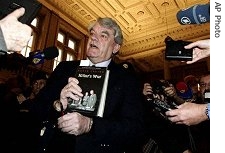 |
| British historian David Irving holds his book
"Hitler's War" when arriving at a court in Vienna, on Monday, Feb. 20,
2006. |
PBS did not respond to VOA's requests for an interview. But Elizabeth
Chouldjian's assertion that the network would never give airtime to deniers of
the Jewish Holocaust has captured some people's attention, particularly in
light of the recent conviction of David Irving, the British historian who was
sentenced in Vienna to three years' jail-time for breaking an Austrian law
that forbids denial of the Holocaust.
According to Robert Kahn, a professor at Brooklyn Law School who has
written extensively about laws governing Holocaust denial, free speech in the
West is not an absolute right. It is tempered, Kahn says, by a complex system
of legal and self-imposed censorship that's almost always derived from a
society's history.
 |
| Brooklyn law professor Robert Kahn
specializes on legal restrictions on holocaust denial |
"The countries that tend to have the laws that specifically ban Holocaust
denial -- France, Germany, and Austria --- either participated in the
Holocaust or had serious problems with collaboration," he says. "Even though
the United States and Canada have large Jewish communities, and have survivors
and people who experienced the Holocaust, it's not the same type of thing."
It is not illegal in the United States to deny the Holocaust, just
exceedingly undiplomatic, given the number of survivors who came to this
country after the war, and no one who wants to enjoy mainstream credibility
would ever do it. That does not mean, though, that speech in America is
without any legal restrictions. Robert Kahn says there are a number of
state and federal laws that limit expression.
"There are some types of speech, like cross burning, which, when done to
intimidate, are illegal," Kahn says. "In a lot of states, particularly in the
U.S. South, you're not allowed to demonstrate while wearing a mask. These
rules are basically connected up with the role of the (Ku Klux) Klan in
American history, and tend to show that societies are very concerned about
speech that talks about prior acts of racism…they have committed."
But it is not just negative, or "ugly" history that causes some
western societies to impose official and unofficial limits on free speech.
Professor Kahn points to the fact that no major American newspapers chose to
publish the cartoons of Mohammed that generated controversy when they were
distributed throughout Europe. "The United States is a religious country and
understands the idea of respecting or disrespecting someone else's religion,"
he says. "Whereas you could make an argument that Europe is much more secular,
and that therefore the idea that you would run something that profanes the
Prophet is not as big a deal."
Meanwhile, PBS has not announced any plans to cancel its broadcast of the
panel discussion, which was taped in early February, and is scheduled to air
on April 17th.
OIC Tourism and Cultural Centre proposed
By HAMISAH HAMID
March 6 2006
The proposed RM70 million Centre could enhance tourist arrivals by as much
as 10 per cent in each of the OIC member countries
THE Malaysia Organisation of the Islamic Conference (OIC) Trade Chamber (MOTC)
has proposed to set up a RM70 million OIC Tourism and Cultural Centre in
Malaysia to boost tourism in the 57-nation body.

MOTC
president Datuk Dr Raja Mohamad Abdullah said the tourism centre could
enhance tourist arrivals by as much as 10 per cent in each of the OIC member
countries.
"We have spoken to Negeri Sembilan state Government and they are keen about
the proposal. The setting up of the OIC Tourism Centre at Port Dickson will
make Malaysia a hub for tourism within the Islamic World," he said in an
interview in Kuala Lumpur last week.
Raja Mohamed said other OIC member countries as well as the financial arm of
the OIC, the Islamic Development Bank, are also aware of the proposal.
The project, to be built on an 8ha land in Port Dickson, is expected to take
off this year and will be completed in three years.
The state Government would provide land, while construction will be done by
a Malaysian company, either on its own or jointly with contractors from
other OIC nations.
The centre will be a platform to disseminate information about Islamic
countries, their cultures, values and languages among others.
"The idea is to bring all the OIC countries under one roof. Most of the OIC
members are poor and we want to help them by encouraging the rich countries
to visit the poor," he said.
Poor OIC nations have many tourist attractions but lack of funds for
promotions.
"Every country will rent a space at the centre and Malaysia will help
promote tourism in these countries such as publishing brochures and others,"
he said.
There will be 57 lots within the centre, with a minimum of 2,000 sq ft area
for each OIC country.
MOTC had earlier proposed to set up a RM400 million OIC Trade Centre on
24-ha land in Negeri Sembilan. That centre will be operational in as early
as two years.
The trade centre, which will showcase products from OIC countries, will also
house among others, an export centre, warehouse, mini expo and conference
centre.
"We are working with IDB and Kuwait Finance House on the financial aspects,
while the construction of the centre will be done by a Malaysian company,"
he said.
Support Urged for Dialogue Between Cultures
Arab News
www.arabnews.com
DOHA, 1 March 2006 — The UN-sponsored Alliance of Civilizations conference
ended here yesterday after three days of deliberations on a host of issues to
bring about rapprochement and co-existence of different cultures and religions
and overcome fanaticism, the Qatari news agency QNA reported.
Participants of the conference stressed that ignorance breeds conflict
between civilizations and that extremism was present all over the world and in
all cultures.
Addressing a press conference at the end of the meeting, former UNESCO
director Federico Mayor Zaragoza called on the UN, the EU and the Organization
of the Islamic Conference (OIC) to support the dialogue between cultures and
civilizations by taking actions to deal with political and religious issues
such as the recent publication in Western papers of blasphemous cartoons that
have caused uproar in the Muslim world.
Zaragoza said just 3 percent of Muslims protested against the cartoons
angrily whereas the reactions of over 97 percent were peaceful. He said he
regretted that the media had chosen to highlight only violent protests. “There
is a need to present balanced visions in media and support the communication
between religions, cultures and nations,” said Mayor Zaragoza.
Turkish State Minister Mohammad Eddin urged all religious and political
figures worldwide to work with a spirit of tolerance to change the status quo
and put an end to inter-fighting and killing. He said the freedom of
expression is important but it is more important to protect the religious
freedom and maintain respect to religious beliefs.
The Alliance of Civilizations was launched in response to a request from
Turkish Prime Minister Recep Tayyip Erdogan and Spanish Prime Minister Jose
Luis Rodriguez Zapatero to overcome misperceptions between cultures,
especially the Muslim world and the West.
Turkey to mediate for E.U. in cartoon row
BRUSSELS, Feb. 21 (UPI) -- The European Union has called on Turkey to
mediate in the cartoon conflict with the Muslim world, saying intercultural
dialogue could mend the differences.
The Austrian presidency of the EU has asked Turkish Foreign Minister
Abdullah Gul to present his ideas for long-term solutions to the row between
European countries and the Muslim world over the publication of Mohammed
cartoons, Danish daily Politiken reported Tuesday.
Gul will meet with foreign ministers of the 25 member states at a meeting
in March where he is expected to push for the creation of an Alliance of
Civilizations. The initiative, which aims at linking Arab and Western
civilizations through dialogue about cultural and religious differences, was
launched by the Turkish and Spanish premiers in cooperation with U.N.
Secretary General Kofi Annan.
The Austrian Foreign Minister also supported the U.N. initiative, saying it
would be one of the best ways to strengthen the dialogue between Europe and
the Arab world.
Turkey is the only Muslim country queuing up to join the European Union.
Alliance of Civilizations
meeting goes on without EU representation
There was no representation from the European Union (EU) countries at the
Alliance of Civilizations meeting in the Qatari capital of Doha this weekend.
The meeting focused on the recent caricature crisis stemming from caricatures of
Mohammed published in the Danish Jyllands-Post newspaper.
Coming together at the invitation of UN General Secretary Kofi Annan, high level
foreign ministry officials from many countries were in attendance, though
without attendance by EU High Commissioner Javier Solana, one important side of
the crisis was left without representation. An unnamed official from the Turkish
Foreign Ministry said "The West has not shown that it understands the
sensitivity attached to these caricatures, nor has it made actions to show it is
sorry."
Monday, February 27, 2006
www.hurriyet.com.tr
World Needs Alliance Of Civilizations, Aydin
DOHA - Turkish State Minister Mehmet Aydin said on Sunday that the world
needed projects like the Alliance of Civilizations, noting that the West and the
Islam world should see the reasons that led to the cartoon crisis.
Addressing the opening session of the second meeting of High Level Group for
the Alliance of Civilizations in Doha, Qatar; Aydin said that the initiative
turned into an useful international medium to sort out critical issues by a
moral and rational point of view.
Referring to the complicated essence of the cartoon crisis, Aydin compared
the tension to icebergs. ''What lies beneath the first iceberg is prejudice and
growing Islamphobic views (in the West). And there are many other factors under
the second iceberg like unfair political and economic structures and past
negative colonial experiences which cause alienation, frustration and anger
among people (in the Islamic world),'' Aydin commented.
''Not only NGOs, but also leaders and institutions of the Western and the
Islamic world should see these icebergs and they should develop and reform
themselves to overcome the problems,'' Aydin said.
Aydin said that the High Level Group would form a concrete action plan within
seven months and they believed it would contribute to formation of a deeper and
broader respect and understanding.
Published: 2/26/2006
www.anatoliantimes.com
Gül to go to Doha for UN meeting
Friday, February 24, 2006
ANKARA - Turkish Daily News
The U.N. secretary-general has extended an invitation to Foreign Minister
Abdullah Gül to attend a meeting in Qatar where over the weekend Annan will
publicly address issues raised by the Prophet Mohammed caricatures and emphasize
his opposition to violent outbursts and the need for tolerance.
Annan unexpectedly announced this week that he would take part in a
high-level meeting of the U.N.-led Alliance of Civilizations in Doha.
The secretary-general decided to hold a separate meeting in Doha to address
the issue together with leaders from both Europe and the Islamic world.
In addition to Gül he extended invitations to Austrian Foreign Minister
Ursula Plassnik, Spanish Foreign Minister Miguel Angel Moratinos, European
Union's Common Foreign and Security Policy chief Javier Solana, Organization of
the Islamic Conference (OIC) Secretary-General Ekmeleddin Ihsanoglu, Arab League
Secretary-General Amr Moussa and Sheik Hamad bin Jassem bin Jabr Al Thani,
Qatar's foreign minister.
© 2005 Dogan Daily News Inc. www.turkishdailynews.com.tr
OIC urges equal legal protection for Muslims, Jews
Wednesday, February 22, 2006
ANKARA - Turkish Daily News
The Turkish secretary-general of the Organization of the Islamic Conference
(OIC) requested on Tuesday that Muslims be given the same legal safeguards that
Jews have against offense.
OIC Secretary-General Ekmeleddin İhsanoğlu reiterated his call to European
countries to pass laws banning blasphemy. “We need the same protection from
European law,” he told reporters referring to an OIC campaign to have European
Union countries legislate to prevent newspapers from publishing artists'
impressions of the Prophet Mohammed.
“We want to be assured that ... there will be no double standards,” he
said, noting that right-wing historian David Irving had been sentenced to three
years in prison by an Austrian court for challenging the historical record that
6 million Jews were killed by the Nazis during World War II.
Seeking a way out of the crisis like the other international bodies are
doing, the European Union decided to debate the concept of the Alliance of
Civilizations during an informal meeting of EU foreign ministers next month in
Salzburg.
As the representative of the first and only mainly Muslim country seeking
EU membership, Foreign Minister Abdullah Gül will give the opening speech at the
meeting in Salzburg at the invitation of EU term president Austria.
“When the issue is the Alliance of Civilizations, Turkey is almost the only
country in Europe that has the right to speak in the name of mediating because
it is both predominantly Muslim and an EU candidate,” said Nikola Doning,
spokesman for the Austrian EU presidency, in reference to a U.N.-led initiative
co-sponsored by Spain and Turkey.
© 2005 Dogan Daily News Inc. www.turkishdailynews.com.tr
Gül backs OIC’s idea of legal safeguards for Muslims
Thursday, February 23, 2006
The foreign minister highlights the need for legal
tools to prevent consequences of Islamophobia, which has been superseding
anti-Semitic feelings in the Western world in the wake of the cartoon crisis
ANKARA - TDN Parliament Bureau
The drawings of the Prophet Mohammed sparked harsh reactions after being
reprinted in several European dailies in defense of free speech, but not when
they were first printed in a Danish daily in late September, Foreign Minister
Abdullah Gül emphasized on Wednesday during a meeting with the parliamentary
Human Rights Commission.
Yet the crisis could have been prevented where it first started, in Europe,
if the politicians concerned had acted prudently, like some of the politicians
and intellectuals in the rest of the bloc, Gül said.
What those prudent politicians and intellectuals did was to say, “Yes, we
have freedom of press, but this doesn't mean we have the right to insult others'
faiths,” Gül said, and added that reactions in those countries faded without
turning into violence because of such prudence, without elaborating on the names
of countries or politicians.
Stemming from the ongoing reactions there are currently many risks around
the world and precautions that need to be taken in order to minimize these
risks, Gül said. Turkey is focusing on this point, is currently working on legal
precautions and is in contact with the Organization of the Islamic Conference (OIC),
he added. “Universal values are respect for human rights, belief in democracy,
freedom of religion and respect for the identity of all. Within this framework,
Turkey is doing its best.”
© 2005 Dogan Daily News Inc.
www.turkishdailynews.com.tr
Cartoon issue to be raised in Bush-Musharraf
meeting
UN resolution proposed for respect of all religions and religious beliefs
ISLAMABAD www.onlinenews.com.pk
Foreign Minister Khurshid Mehmood Kasuri on Wednesday said issue of publication
of sacrilegious caricatures would be raised on President Bush’s visit to
Pakistan.
In a press conference at the Foreign Office, he informed that President
General Pervez Musharraf told the national security council in the meeting that
President Bush who is the head of state of the sole super power and is the
leader of the western world, would be asked to play his role in bridging the gap
between East and West that has widened due to the publication fo blasphemous
caricatures crisis.
Mr Kasuri said OIC, UN and European Union would bring a resolution that will
stress respect of all religions and religious beliefs and will prevent such
future incidents.
We have asked our mission in New York to bring forward a strong resolution in
the United Nations General Assembly, he mentioned.
Aguirre: Alliance of Civilizations might be helpful
Spain Herald February 23, 2006
US ambassador to Spain Eduardo Aguirre said yesterday that the
Bush administration's decision
to support prime minister Zapatero's Alliance of Civilizations initiative is due
to the fact that the Alliance does not conflict with any American plans being
put into effect. For example, Aguirre said that Zapatero's project might
contribute "a grain of sand" to the resolution of the current crisis caused by
the Muslim reaction to the Mohammed cartoons published in Denmark.
Aguirre told Television Española that the Bush administration has "studied"
Zapatero's plan, which he proposed in September 2004 at the UN General
Assembly. Aguirre said, "We think it might be complementary to two or three
organizations," such as the Greater Middle East initiative proposed by the
G-8.
Aguirre added, "Civilization implies respect for others, though without
sacrificing the freedom of the press and of expression, which are fundamental
principles of democracy." He added that this has not been the case regarding
the Mohammed cartoons, which touched off a violence he called "unjustifiable."
On relations between the US and Spain, Aguirre said they were "very fluid,
because there is now a very progressive conversation, permitting the two
nations to overcome their differences." He added that the Iraq question of two
years ago had been left behind in the past, and "now Madrid and Washington are
thinking about Iraq within two years. We want to see a free and sovereign Iraq
with internal security." Regarding a possible meeting between Zapatero and
Bush, Aguirre repeated that Bush's agenda is not among his responsibilities.
Rice expresses US interest in Alliance of Civilizations
Spain Herald Friday, February 17, 2006
US secretary of state Condoleezza Rice sent a letter to
Spanish foreign minister Moratinos expressing for the first time the United
States's interest in participating in prime minister Zapatero's proposed
Alliance of Civilizations. Rice, in her letter, said she had received "hopeful
information" on this UN initiative, co-sponsored by Zapatero and Turkish prime
minister Recep Tayyip Erdogan.
"I'm looking forward to the High Level Group's final report and the
application of its proposals so that we can identify specific projects to
which the US can make a contribution," said Rice, leaving the door open to
eventual financial contributions. Rice also expressed the Bush
administration's wish to "collaborate" with Spain and participate in this
"vital work" of dialogue between civilizations, and hoped that the
initiative would help promote and foment greater understanding of
"democratic reform, peace, and stability" in the Middle East. "We hope to
support a series of concrete Alliance projects that will be compatible
with our own programs and goals for the Middle East region," she said.
Rice made five concrete suggestions: an increase in understanding among
different cultures, especially at the school level, the promotion of links
between universities, students, media outlets, and civil society in order
to promote multiculturalism, an increase in facilities for Internet use
among youths and marginal groups, and regional conferences to promote
interaction between experts from different cultures.
Spanish diplomatic sources indicated that Rice's letter is the result of
her telephone conversation last Monday with Moratinos, in which she
brought up the crisis of the caricatures of Mohammed, which caused
violence in several Muslim countries. Moratinos called the letter "very
positive," and called on the PP to support the initiative. He said that
Washington's support for the Alliance of Civilizations "is not a novelty,"
since the initiative received the support of the entire international
community at the UN General Assembly in September. Zapatero and Erdogan
began meetings of the UN High Level Group created for the purpose in
Mallorca last November.
Moratinos added that the letter confirms what he had discussed with Rice
"recently," and stressed that the United States has expressed "explicitly"
that it wants to "participate in and support" the project, which
"reinforces it even more. And if a political party in Spain does not
support it, that's its problem."
Text of the letter sent by Condoleezza Rice to Moratinos
Dear Mr. Minister:
I have heard encouraging reports about last November's meeting in
Majorca of the high level group of experts tasked by un secretary-general
Annan with drawing up a work plan for the alliance of civilizations. This
initiative, in concert with the forum for the future, promises to encourage
greater understanding and promote democratic reform, peace, and stability in
the broader middle east.
We expect to support selected alliance project compatible with our own
program goals for the middle east regios in area such as: (1) furthering
understanding between cultures; (2)promoting understanding of different
cultures in schools; (3) developing links among universities, individual
scholars, media, and civil society groups interested in promoting
intercultural understanding; (4) enhancing the ability to reach out to youth
and marginalized groups using the internet and other means; and (5)
developing regional conferences and workshops to promote interactions
between experts from diverse backgrorunds and cultures.
I eagerly anticipate the higt level group,s final report and the
implementation of its proposed work plan so that we can identify specific
project to which the united states could make a contribution. I look forward
to collaborating with you as we proceed with this vital work.
Sincerely,
Condolezza Rice
OIC rejects EU response to its proposal on Human Rights Council
UNITED NATIONS, Feb 16 (KUNA)
www.kuna.net.kw
The Organisation of Islamic Conference (OIC) troika -
Yemen, Turkey and Azerbaijan - on Thursday rejected a European Union (EU)
response to their proposed amendments to a General Assembly resolution draft
that calls for establishing a Human Rights Council.
Yemeni envoy Abdullah Al-Saidi told KUNA following the troika meeting with EU
chairman, Austria, that the EU response "did not meet our demands," adding
that the issue will be further discussed by OIC members in a plenary meeting
on Friday.
The amendments were introduced in response to the wave of demonstrations in
the Arab and Muslim world as well as within the Muslim communities worldwide,
against the depiction of Prophet Mohammed (PBUH) in cartoons published lately
by Danish and European newspapers.
The OIC amendments to the draft resolution mainly note that "defamation of
religions and prophets is inconsistent with the right for freedom of
expression and is among the causes of social disharmony that leads to
violations of human rights and fundamental freedoms." Another amendment
stresses that "states, religious bodies and the media have responsibility in
promoting tolerance and respect for religious and cultural values of all
states and societies." Finally, the OIC called for promotion of universal
respect for all religious and cultural values and prevent instances of
intolerance, discrimination, incitement of hatred and violence arising from
any action against religions, prophets and beliefs which threaten the
enjoyment of fundamental freedoms. A European official said the EU response
was merely to encourage dialogue. The proposed Human Rights Council is meant
to replace the current Human Rights Commission.
OIC calls for UN move to prohibit blasphemy
From Habib Shaikh 16 February 2006
JEDDAH — Saudi Arabia has urged
all countries and governments to respect sanctities of all religions and
join hands in the efforts to ensure peaceful coexistence of civilisations,
according to the Saudi Press Agency (SPA).
The Organisation of the
Islamic Conference (OIC) has called for joint efforts with the European
Union to adopt United Nations resolution to prohibit blasphemy of all
religions. European Union foreign policy chief Javier Solana agreed to play
a proactive role on the issue.
Solana, who was in Jeddah
on a fence-mending visit after the outrage in the Muslim world over
inflammatory cartoons that appeared in Denmark and some other European
countries, assured that such things would never happen again. “Be sure we
are going to do our utmost for this not to happen again...,” he said. SPA
said that the Council of Ministers, chaired by Custodian of the Two Holy
Mosques King Abdullah bin Abdulaziz, at Al Yamamah Palace in Riyadh on
Monday, also opposed violence while protesting blasphemous cartoons.
Culture and Information
Minister Iyad Madani said the Cabinet made the comment while discussing
repercussions caused by the publication of the insulting cartoons in Danish
and other European dailies that have triggered a wave of protests across the
world.
“Saudi Arabia expects that
all countries, governments and private organisations stand one in respecting
nations’ sanctities, support coexistence of civilisations and understand
special attributes of other cultures,” the Cabinet statement said.
Riyadh commended all
governments who had taken a positive stand on this issue, condemning the
provocative cartoons. “The Islamic world is able to protect its sanctities,
its identity and special attributes as it did in the past, without causing
any harm to others or violating their honours,” it added.
Addressing a joint Press
conference with OIC Secretary General Ekmeleddin Ihsanoglu, Solana said that
the purpose of his visit to the Kingdom was to rebuild bridges, renew
dialogue and reconstruct relationship. “Your values we share, and like to
have a real solid relationship with you,” he said adding that “we will work
to deepen our relationship. The world needs these types of relationships,”
he added.
Solana agreed with
Ihsanoglu’s suggestion that the EU and the OIC should jointly make efforts
to adopt a UN resolution on the lines of the existing Resolution No. 60/150,
which calls for combating defamation of religions.
Ihsanoglu said that the
statute of the new Human Rights Council presently being negotiated should
include operative provision prohibiting blasphemy. “There is a need to cater
to Islamophobia in legislations,” he said.
He said Muslims were
starting to feel this was a new September 11 against them. Ihsanoglu asked
for adopting a code of conduct for the European media. “The code of conduct
should take into account the sensitivities of the Muslims and defamation in
any form or manifestation and the core beliefs of the religions including
mocking and criticising the Prophets, and it should be considered an ethical
offence in the European media code,” he said. “We have decided to work
together to overcome the consequences of the present crisis,” said Solana.
Pakistan-OIC urge UN to implement conducive checks for
blasphemy
ISLAMABAD, February 22
www.paktribune.com
Pakistan and OIC have jointly demanded United Nations for implementation of
more conducive and effective laws to check and contain issues of blasphemy.
Such laws would prohibit and contain unscrupulous and nefarious elements to
hurt the religious sentiments of various religions, by taking cover behind the
shield of "Freedom of Press and speech".
A joint statement by OIC Secretary General, Kamaluddin Ehsan Ogloo and
Pakistan’s Foreign Minister Khurshid Mahmood Kasuri, condemned the publication
of cartoons of The Holy Prophet (PBUH), and demanded unconditional and prompt
apology by the editors.
Addressing a joint press conference, the two dignitaries announced that
they have demanded UN for implementation of more effective and conducive laws,
even if it effects current regulations and resolutions. Even an extra, new
protocol or convention in this regard was welcome and imperative.
They also expressed their dislike and dismay over the stubborn attitude of
the European publications responsible for publications of the blasphemous
caricatures. Because, unless they don’t the Muslim countries would remain
quite uncomfortable about the issue.
They, however expressed their dismay at the events of arson, looting and
killings in the recent worldwide rallies held by various Muslim countries,
which in no way to resolve anything, except further aggravate the impression
of Muslim Ummah in the already bigoted West.
They also refuted the edict of Ulema and religious scholars, which (in
accordance with Shariat) recommends killing the blasphemer.
Replying to a question about boycotting the Dutch goods the OIC Secretary
General said that every sovereign Islamic country has its own right of doing
so. He as the Secretary General of OIC cannot stress this collectively.
They announced that they would be meeting UN General Secretary Kofi Anan
and Javier Solana, next week to discuss any further implementations of
protocols and legislation about blasphemy.
Mushahid deplores publication of blasphemous
cartoons
Senator Mushahid Hussain Sayed, Chairman Senate Foreign Relations Committee
deploring the publication of blasphemous cartoons in Danish and other
newspapers has observed that it greatly hurt the sentiments of the Muslim
world.
He said that there seems to be a general perception, rightly or wrongly,
that Muslims are victims at the hands of the West and that some European
countries are following double standards.
Mushahid Hussain made these observations while speaking at a banquet hosted
in honour of the visiting British Muslim Parliamentarians here last night.
Mushahid called upon the Muslim elected representatives of UK and other
European countries to use their influence and contribute to creating an
awareness about the true Islamic values and to avert any possibility of clash
of civilizations.
He pointed out that most of the European countries were opposed to racist
prejudices and religious discrimination.
He said that Islam is a religion of peace and calls its followers to
respect the sentiments of the people belonging to other religions. This
aspect, added Mr. Mushahid, needs to be projected and highlighted so as to
initiate Europe-Islam dialogue and to defeat the nefarious designs of those
elements who intend to pave the way for the clash of civilizations.
He said that we, the Pakistanis, value the Western values respecting the
sentiments of the people and expect reciprocity that they would too respect
the sanctity of our Holy Prophet (PBUH).
Lord Amir Bhatia, Leader of the British Muslim Parliamentarians’ team
stated that two million Muslims are residing in UK peacefully and that no
discrimination is being meted out to them on religious traits.
He said that as West lacked knowledge about Islam, there seems to be a
clash of ignorance instead of civilizations. Mr. Shahid Malik, MP, Mr. Khalid
Mehmood, Norwegian MP and Mr. M.P. Bhandara, MNA also spoke on the occasion.
They underlined the need to show respect to the religious beliefs of others.
Turkish PM sends letter to world leaders to ease cartoon
crisis (full text)
Dear Colleague,
In the face of recent developments instigated by the publication of a series of
caricatures depicting Prophet Mohammed, I felt it necessary to write to you this
letter and share with you my views in the hope of preventing the present
situation from escalating to a point where it could further threaten
international peace and stability. These unfortunate events have created tension
almost bounding to a polarization between the East and the West, and between the
Islamic and Christian worlds as never seen before in recent times. For the sake
of global peace and safeguarding of our commonly held values, I believe it has
now become essential that the statesmen and politicians act with wisdom and
common sense and display leadership in taking the joint actions expected from
them.
Firstly, we all should try to understand the underlying reasons behind the
latest incidents. Muslims, as a rule, pay due respect to all prophets. Despite
their deep respect for Prophet Mohammed and their strong belief in the Islamic
teachings, they would listen to all well-meaning criticisms. They cannot,
however, be expected to tolerate so-called criticisms which evidently transgress
the boundaries of genuine criticism and which are, in fact, outright insults and
degradation of Prophet Mohammed.
We have observed that certain parts of the media saw this whole series of
unfortunate events as a test-case for freedom of expression. We have also
observed an inclination to make use of the situation to probe the patience of
the Islamic world and their conceptualization of freedom. Such cultural
arrogance on the part of any culture or civilization cannot be justified. No
culture has a given right to insult the sensitivities of other cultures. The
minimum prerequisite of harmonious coexistence is that different civilizations
and traditions recognize and mutually respect each others’ cultural differences
that are perfectly in keeping with the commonly shared values on which our
modern democratic experience is founded. This is also a requirement of the
modern pluralist approach that understands the need to preserve and respect
differences as enriching elements instead of abandoning them to be exploited to
create enmity and hatred.
We have been strongly advocating that unless we replace the thesis of the “Clash
of Civilizations” and the culture of violence and confrontation with an
“Alliance of Civilizations”, conflicts will continue to rise. The recent events
have unfortunately vindicated us.
Freedom of press and expression of this freedom through all available channels
is an indispensable element of democracy. However, this freedom should be
applied with a sense of moral responsibility. There is no freedom on earth that
can be used to degrade and insult beliefs, values and sacred symbols. We need to
reflect on such fundamentally sensitive issues.
On the other hand, those who resort to violence in their dismay, and those who
incite or provoke violence actually undermine their own cause and forfeit their
righteousness. Islam is the religion of peace and calls for the protection of
the life, property and dignity of everyone living in Islamic countries. Defense
of Islam and the Muslims cannot be achieved by methods which run counter, in the
first place, to the teachings of Islam.
Turkey supports all genuine efforts geared for enriched dialogue, reconciliation
and integration. Our ultimate goal is to bring our own unique contributions to
the humankind’s ideal of achieving “unity in diversity”. The Alliance of
Civilizations initiative and our determined steps to become a full-member of the
European Union all aim to the fulfillment of this noble ideal.
I strongly believe that civilizations hold common values, norms and principles
that can allow them to give a joint fight against the many problems that beset
the world today. I also believe that the great majority, in fact, long for
embracing the other and meet them around this commonality, thereby rejecting the
theories of a looming confrontation. It is in this context that we must all
refrain from policies that can cause “Islamophobia” to take deeper roots in the
Western societies. It is paramount that we act with common sense and a
heightened sense of responsibility at this critical juncture. Our common
historical experiences and values show us the way. We must not only demonstrate
a common resolve, but we must also ensure that we do use all available means and
mechanisms at our disposal to defuse the present tensions.
02.10.2006 www.abhaber.com
Turkish PM sends letters to world leaders on cartoon crisis
2006-02-11 01:05:44
www.chinaview.cn
ANKARA, Feb. 10 (Xinhuanet) -- Turkish Prime Minister Recep Tayyip
Erdogan on Friday sent a letter to member countries of the United Nations, the
Organization of the Islamic Conference (OIC) and NATO, in an effort to
overcome the cartoon crisis.
In his letter which were also sent to the leaders of the countries with
Turkish embassies, Erdogan said, "in the face of recent developments instigated
by the publication of a series of caricatures depicting the Prophet Mohammad, it
is necessary to write to you and share with you my views in the hope of
preventing the present situation from escalating to a point where it could
further threaten international peace and stability."
"These unfortunate events have created tension almost bounding to a
polarization between the East and the West and between the Islamic and Christian
worlds as never seen before in recent times," said the letter.
"We should try to understand the underlying reasons behind the latest
incidents. Muslims, as a rule, pay due respect to all prophets. Despite their
deep respect for the Prophet Mohammad and their strong belief in the Islamic
teachings, they would listen to all well-meaning criticisms," he emphasized.
"The Muslims cannot, however, be expected to tolerate so-called
criticisms which evidently transgress the boundaries of genuine criticism and
which are, in fact, outright insults and degradation of the Prophet Mohammad,"
he said.
Erdogan noted that "certain parts of the media saw this whole series of
unfortunate events as a test-case for freedom of expression. There is an
inclination to make use of the situation to probe the patience of the Islamic
world and their conceptualization of freedom. Such cultural arrogance on the
part of any culture or civilization cannot be justified," he added.
"No culture has a given right to insult the sensitivities of other
cultures," he said, stressing that "there is no freedom on earth that can be
used to degrade and insult beliefs, values and sacred symbols."
Erdogan added that Turkey supported all genuine efforts geared for
enriched dialogue, reconciliation and integration,
The controversial cartoons, which were first published by Danish daily
Jyllands-Poste last September and later reprinted in other European press, were
deemed as blasphemous by most Muslims.
Over the past few weeks, many Muslim countries have seen violent protests
against Western diplomatic missions and a boycott of Danish goods.
Turkey, a Muslim-dominated but secular country, has been calling for
dialogue between western countries and the Islamic world to resolve the cartoon
row.
Malaysian P.M. says mistrust, fear of Islam growing,
proposes dialogue
(AP) Feb 24 2006
www.thenewanatolian.com
Malaysian P.M. says mistrust, fear of Islam growing, proposes dialogue
Mistrust and fear of Islam is growing every day in the West, Malaysia's leader
warned Monday, and called for a high-level dialogue between the two sides to
prevent disputes such as the one over Prophet Muhammad's cartoons.
Malaysia, which currently heads the Organization of the Islamic Conference, is
willing to host annual round-table discussions between Muslims and Westerners to
kick-start the dialogue, Prime Minister Abdullah Ahmad Badawi told The
Associated Press in an interview.
"Bring anybody. We are not saying you shouldn't come, or you shouldn't come.
Let's talk. There is a genuine need to see that there is a mutual respect
between peoples," said Abdullah, the OIC chairman and a respected Islamic
scholar.
However, the OIC, the world's biggest Islamic grouping with 57 members, has not
considered holding such a confidence-building dialogue with the European Union,
saidAbdullah.
Malaysia - a multiethnic nation of 26 million people, most of them Muslims - is
hailed as a model of a progressive, wealthy Islamic nation. Three protests
against the cartoons in Malaysia have been peaceful, unlike demonstrations that
have turned violent and deadly in other countries.
As an important U.S. ally in the fight against terrorism, it is also respected
by both sides of the religious divide, but has not played a role of peacemaker
between Muslims and Westerners.
The two sides have been deeply polarized by the publication of 12 cartoons in a
Danish newspaper in September, showing Islam's prophet with his turban shaped as
a bomb.
Depiction of the prophet in any form is considered blasphemous in Islam.
Abdullah said the reprinting of the cartoons by some European newspapers in the
name of freedom of press was grave provocation, especially when the Muslim world
is gripped with a sense of injustice over the U.S. invasion of Iraq and the
Israeli occupation of Palestinian territories.
Asked if the cartoon controversy indicates that Europe is becoming xenophobic
and anti-Islam, Abdullah said: "I fear that this feeling towards Islam is
deteriorating today, and that is a very sad thing. We never know where it's
going to lead to unless all of us resolve to stop it and do something about it."
"We must deal with it not only by handling the specific issue of the
caricatures, but we have to look at the entire spectrum that are causing these
problems."
Abdullah, however, expressed the hope that the damage caused by the caricatures
to relations between the West and Islam is not irrevocable.
"We must not allow us to believe that nothing can be done to stop it, nothing
can be done to create ... a new sense of mutual confidence," he said.
Abdullah blamed the media for the fear of Islam in the West. The media fail to
report the moderate voices in Islam, instead focusing on terrorists such as
Osama bin Laden, he said.
"When you do things moderately, it doesn't create a bang. There is no bang,
there is no violence, there is no fire burning, there are no people dying. Media
is not interested (because) there is no news," said Abdullah.
"But one has to remember that extremists are never a majority in any society,"
he said. "The majority speak for peace, they practice mutual respect, tolerance.
That's the silent majority. But silence is no news. Bang is news."
German, Turkish papers in joint plea over cartoons
BERLIN - The biggest-selling newspapers in Germany and Turkey, Bild and
Hurriyet, on Thursday published a joint plea for mutual respect and moderation
over the cartoons of the Prophet Mohammed.
In an editorial entitled "We are friends!", the editors of the two papers,
Kai Diekmann and Ertugrul Ozkok, said: "The Islamic and Christian worlds share
values.
"For a Muslim and for a Christian, the most important values are charity and
mercy.
"Together, we call on all Muslims and Christians to join together.
"We call on everyone to show respect for the feelings of others, to avoid
offence, humiliation and malice and to build a genuine alliance of cultures."
The editorial was also published in Hurriyet on Thursday.
Germany is home to three million Turks, but has seen no protests over the
cartoons first published in a Danish newspaper, including one featuring Mohammed
with a bomb tucked into his turban.
Protests have raged across the Muslim world, with the most violent in
Lebanon, Syria, Iran, the West Bank and Afghanistan.
02/09/2006 www.anatoliantimes.com
City News
Caricature of Prophet (SM): 37 eminent persons condemn
cartoons,urge restraint
By Staff Reporter
9 Feb 2006, 10:41:00 From New Nation Online Edition
Thirtyseven eminent persons in a joint statement yesterday condemned the
cartoon caricature of Prophet Muhammad (SM) in a section of the Western media
but said while protesting this none should take law to their hands.
The eminent persons who included former Chief Advisor, Justice Latifur Rahman,
former Chief Election Commissioner. Justice Abdur Rouf, Prof Emajuddin Ahmed, Dr
Shamsher Ali and Dr. Mahbub Ullah said, the satirical caricature of the great
Prophet by Danish newspaper Glands Posten shocked the entire Muslim world.
Muslims all over the world are hurt and aggrieved today. What compounded their
sense of resentment is the fact that newspapers of France, Germany, Norway,
Holland, Switzerland, Hungary and Iceland reprinted the cartoons one after
another.
They said, it seems a section of the western world is deliberately doing all
this to fuel the socalled clash of civilization. This particular quarter is
perhaps trying to instigate the crusade of the 21st century. This conspiracy is
a challenge to what mankind has achieved - multiculturalism, religious
tolerance, higher human values - over the last one thousand years.
We are extremely upset to see that a section of the western world is trying to
defend these highly provocative and objectionable cartoons in the name of
freedom of speech and independence of the media. Printing of the cartoons and
then reprinting them in about a dozen of European newspapers cannot be justified
in the name of freedom of speech. Rather it is the part of a far-reaching
conspiracy against the Muslims.
"We are condemning this from the core of our hearts. We demand that the
governments of the countries, where these blasphemous cartoons were printed,
will seek unconditional apology to mitigate tension that is now raging all over
the Muslim world. We also demand that the governments will also take appropriate
steps to make sure such acts are not repeated in future. We expect the people
with conscience of these countries will sympathize with our grievances. We hope
OIC will get rid of its inertia and undertake diplomatic initiatives to protest
the provocative act on behalf of the Muslim brotherhood.
Bangladesh today is going through a sensitive phase. A vested group is active to
tarnish Bangladeshis image as a liberal democratic country. We fear that this
group may take advantage of the fierce hatred and anger that have been created
by these offensive cartoons.
"All those who are wounded and shocked by these highly objectionable cartoons
must be thus aware against any attempts aimed to instigate a law and order
situation and create anarchy in the society," they added.
Signatories to the statement also included newspaper editors, senior
journalists, poets, columnists and university teachers, according to a press
release. © Copyright 2003 by
www.ittefaq.com

A call for respect and calm
Recep Tayyip Erdogan and José
Luis Rodríguez Zapatero International Herald Tribune
SUNDAY, FEBRUARY 5, 2006
With growing concern, we are witnessing the
escalation in disturbing tensions provoked by the publication, in European
newspapers, of caricatures of the Prophet Muhammad that Muslims consider
deeply offensive. We shall all be the losers if we fail to immediately
defuse this situation, which can only leave a trail of mistrust and
misunderstanding between both sides in its wake. Therefore, it is necessary
to make an appeal for respect and calm, and let the voice of reason be
heard.
Last year, when the heads of government of Turkey and Spain presided over
the launching of work on the Alliance of Civilizations Project, we
did so based on a firm belief: that we needed initiatives and instruments to
stop the spiral of hatred and obfuscation that, in itself, constitutes a
threat to international peace and security.
The unfortunate events that we are seeing now only reaffirm our diagnosis
and our commitment to seek even more support for this cause.
Historically, Spain and Turkey have been at crossroads between East and
West. Therefore, we are very aware that the way in which close contact
between different cultures is handled can be enormously enriching, but it
can also set off destructive contentions.
In a globalized world, in which the relationships and exchanges amongst
different civilizations continue to multiply, and in which a local incident
may have worldwide repercussions, it is vital that we cultivate the values
of respect, tolerance and peaceful coexistence.
Freedom of expression is one of the cornerstones of our democratic systems
and we shall never relinquish it. But there are no rights without
responsibility and respect for different sensibilities. The publication of
these caricatures may be perfectly legal, but it is not indifferent and thus
ought to be rejected from a moral and political standpoint.
In the end, all of this lends itself to misunderstandings and
misrepresentations of cultural differences that are perfectly in harmony
with our commonly shared values. Ignoring this fact usually paves the way
for mistrust, alienation and anger, all of which may result in undesirable
consequences that we all have to work hard to avoid.
The only way for us to build a more just international system is through
maximum respect for the beliefs of both sides. We are fully committed to
observing the norms of international law and to the defense of the
international organizations that embody it. But neither laws nor
institutions are enough to ensure peace in the world.
We need to cultivate peaceful coexistence, which is only possible when there
is interest in understanding the other side's point of view, and respect for
that which it holds most sacred. These are the basic premises and main goals
of the Alliance of Civilizations promoted by Spain and Turkey.
(Recep Tayyip Erdogan is the prime minister of Turkey. José Luis
Rodríguez Zapatero is the prime minister of Spain. )
Erdogan And Zapatero Call For Respect And Calm In Cartoon Crisis
PARIS - Turkish Prime Minister Recep Tayyip Erdogan and Spanish Prime
Minister Jose Luis Rodriguez Zapatero made a joint plea for respect and calm
on Monday as many Muslims express anger about caricatures offending Muslim
world that have been published in European newspapers.
Erdogan and Zapatero said in an article in the International Herald
Tribune that they were increasingly concerned by the rise in tension
provoked by the cartoons.
''With growing concern, we are witnessing the escalation in disturbing
tensions provoked by the publication, in European newspapers, of caricatures
of the Prophet Muhammad that Muslims consider deeply offensive. We shall all
be the losers if we fail to immediately defuse this situation, which can
only leave a trail of mistrust and misunderstanding between both sides in
its wake. Therefore, it is necessary to make an appeal for respect and calm,
and let the voice of reason be heard,'' noted Erdogan and Zapatero.
The two premiers said in the article, ''last year, when the heads of
government of Turkey and Spain presided over the launching of work on the
Alliance of Civilizations Project, we did so based on a firm belief: that we
needed initiatives and instruments to stop the spiral of hatred and
obfuscation that, in itself, constitutes a threat to international peace and
security.''
''Historically, Spain and Turkey have been at crossroads between East and
West. Therefore, we are very aware that the way in which close contact
between different cultures is handled can be enormously enriching, but it
can also set off destructive contentions, ''Erdogan and Zapatero
underscored.
The two premiers indicated, ''in a globalized world, in which the
relationships and exchanges among different civilizations continue to
multiply, and in which a local incident may have worldwide repercussions, it
is vital that we cultivate the values of respect, tolerance and peaceful
coexistence.''
''Freedom of expression is one of the cornerstones of our democratic
systems and we shall never relinquish it. But there are no rights without
responsibility and respect for different sensibilities. The publication of
these caricatures may be perfectly legal, but it is not indifferent and thus
ought to be rejected from a moral and political standpoint,'' they stated.
Turkish and Spanish premiers stressed, ''in the end, all of this lends
itself to misunderstandings and misrepresentations of cultural differences
that are perfectly in harmony with our commonly shared values. Ignoring this
fact usually paves the way for mistrust, alienation and anger, all of which
may result in undesirable consequences that we all have to work hard to
avoid.''
''The only way for us to build a more just international system is
through maximum respect for the beliefs of both sides. We are fully
committed to observing the norms of international law and to the defense of
the international organizations that embody it. But neither laws nor
institutions are enough to ensure peace in the world,'' the two prime
ministers said.
Erdogan and Zapatero added, ''we need to cultivate peaceful coexistence,
which is only possible when there is interest in understanding the other
side's point of view, and respect for that which it holds most sacred. These
are the basic premises and main goals of the Alliance of Civilizations
promoted by Spain and Turkey.''
Published: 2/6/2006
www.anatoliantimes.com
Turkey, Spain urge calm to defuse cartoon tension
Tuesday, February 7, 2006
Erdoğan and Zapatero issue a joinjt
Muslim-Christian appeal to defuse escalating tension over publication in
European newspapers of caricatures of the Prophet Mohammed
ANKARA - Turkish Daily News
In a joint Muslim-Christian appeal for calm, Prime Minister Recep
Tayyip Erdoğan and his Spanish counterpart, Jose Luis Rodriguez Zapatero,
said all sides would lose if mounting tension sparked by publication of
caricatures of the Prophet Mohammed in European newspapers is not
immediately defused.
“With growing concern, we are witnessing the escalation in disturbing
tension provoked by the publication, in European newspapers, of caricatures
of the Prophet Mohammed that Muslims consider deeply offensive,” Erdoğan and
Zapatero said in an article in the International Herald Tribune.
Foreign Minister Abdullah Gül said Turkey was engaged in diplomatic
efforts to find ways to calm tension and warned Muslim protestors against
undermining their rightful cause.
The foreign minister also warned the West and said hostility against
Muslims was replacing anti-Semitism in some countries there.
The mounting anger in the Muslim world over caricatures coincided with
the killing of a Catholic priest in Turkey's Black Sea province of Trabzon
by a teenage gunman, raising concerns that the murder could be linked to the
caricature protests.
Gül downplayed the possibility of a link between the murder and the
cartoons. “We really think they are not linked,” he told reporters
yesterday. “We believe it is entirely an individual act, but we don't know
the reason behind it or who encouraged it.” The murder drew strong
condemnation in both Turkey and in Europe.
© 2005 Dogan Daily News Inc.
www.turkishdailynews.com.tr
Erdoğan urges calm in cartoon row, reveals diplomacy as way out
‘Guns cannot be a solution; it [violence] is what those aiming for a
clash of civilizations wishes for. As Turkey, we never want to be trapped
by such discrimination,’ the prime minister says
ANKARA - Turkish Daily News
The Turkish leadership is insistently trying to keep public calm
regarding the publication in European newspapers of cartoons of the
Prophet Muhammad, despite describing its publication as a “provocation.”
Speaking at a meeting of his ruling Justice and Development Party (AKP)
held in Istanbul yesterday, Prime Minister Recep Tayyip Erdoğan condemned
violence as a way of reacting, saying that the way out from recent tension
sparked by the publication of the cartoons should be diplomacy.
“Guns cannot be a solution; it [violence] is what those aiming for a
clash of civilizations wishes for. As Turkey, we never want to be trapped
by such discrimination,” Erdoğan said. He also said that the Turkish
people and administration would not tolerate humiliation of any celestial
prophets as they would not tolerate the humiliation of Prophet Muhammad.
He then called on Western politicians to take a firm stance against
insults to Islam. “Otherwise, a shadow will be cast over the alliance of
civilizations,” he added, referring to a United Nations-led initiative
called “Alliance of Civilizations.”
The initiative was set in motion last November at a ceremony attended
by Erdoğan and his Spanish counterpart, José Luis Rodriguez Zapatero.
Turkey and Spain are co-sponsors of the initiative designed to unite
Western and Muslim states to fight radical Islam and “close the gap”
between the Western and Islamic worlds.
Earlier in the weekend, Erdoğan announced that he penned an open
letter with Zapatero, to be published today in the European press as part
of the joint Turkish-Spanish initiative.
“We said [in the letter] that this [the cartoons] should be rejected,
both ethically and politically,” Erdoğan said on Saturday. “This has no
acceptable, no tolerable side,” he said. “It cannot be considered as part
of freedoms either.”
Turkey, a strictly secular Muslim nation seeking to join the European
Union, sees itself as a bridge between East and West and has undertaken a
number of initiatives to bring the two sides closer.
Foreign Minister Abdullah Gül also termed the cartoons as a
“provocation” and “irresponsible behavior” that has harmed efforts for
reconciliation.
“Of course, freedom of press should exist everywhere but people's
values should be respected,” he said. “These almost amount to provocations
-- either inadvertent or deliberate on the part of some. I hope this
affair will be closed without further escalation and everybody will see
the mistakes they have made,” he added.
Erdoğan cautions Muslims to avoid falling into ‘trap’ of violence
Wednesday, February 8, 2006
ANKARA - Turkish Daily News
Prime Minister Recep Tayyip Erdoğan has called on Muslims around the
world to show restraint over the publication in European newspapers of
caricatures of the Prophet Mohammed while describing the publications as a
“trap” aimed at portraying Islam as violent.
The cartoons are “an open provocation, a trap ... [that aim] to show
the world pictures of violence from the Muslim world,” Erdoğan said on
Tuesday as he was addressing a parliamentary group meeting of his ruling
Justice and Development Party (AKP).
“Neither Turkey nor the Muslim world should fall into this trap,”
Erdogan said. “The Muslim world must demonstrate that it has the reason,
the common sense and the maturity to fend off such provocations.”
The prime minister emphasized that Turkey would remain a land of
religious tolerance and urged Turkish society to “not be fooled by
provocation.”
Erdoğan expressed hope that Turkey's eventual membership in the
European Union would help efforts to reconcile people from different
cultures and religions.
“We have argued in favor of that [Turkey's EU membership] as an
antidote for the culture of confrontation that threatens global peace,” he
said. “And because we believe in that, we will stick to our EU target and
continue to advocate our project for the alliance of civilizations with an
ever stronger voice.”
Turkey wants EU Troika meeting:
On Monday night Erdoğan told reporters that he would ask the EU to
hold a Troika meeting on the issue. He said he would also send separate
messages to all global leaders, including prime ministers of EU member
states and the leaders of Muslim countries. He didn't elaborate on the
context of the messages, but he is expected to portray Turkey's stance
favoring the alliance of civilizations.
On the same day Erdoğan addressed AKP deputies, main opposition
Republican People's Party (CHP) leader Deniz Baykal also addressed his
parliamentary group and touched on the issue of the Prophet cartoons.
Baykal said Parliament should convene a plenary session and thoroughly
discuss the crisis that has appeared in the wake of the cartoons'
publication.
“We expect the government to make a serious attempt,” Baykal said.
“We should all know that this issue [the crisis in the wake of publication
of cartoons] is a time bomb that could hurl the world in a state of alarm
and confusion.” He also urged the Danish Prime Minister Anders Fogh
Rasmussen to apologize to the Muslim world.
The drawings, first published in Denmark's Jyllands-Posten newspaper
and reprinted in Norway, France and other European countries, include a
portrayal of the Prophet Muhammad wearing a bomb-shaped turban and one
showing him as a knife-wielding nomad flanked by two women shrouded in
black.
Baykal, whose CHP is a member of the Socialist International (SI)
association of left-wing political parties, said he recently had a
telephone conversation with Greek politician George Papandreou (the
recently elected president of the SI). He made a proposal to Papandreou
that the SI should take the initiative on the issue and should call for
common sense.
© 2005 Dogan Daily News Inc. www.turkishdailynews.com.tr
Zapatero condemns caricatures, calls for "Alliance of Civilizations"
Spain Herald February 07, 2006
Spanish Socialist prime minister Jose Luis Rodríguez
Zapatero yesterday published a letter to the
International Herald Tribune, in which he made "a call for respect and
calm," while "morally and politically rejecting" the publication of the
controversial cartoons depicting Mohammed. Zapatero called for an "Alliance
of Civilizations" to "stop hate," and weakly defended the freedom of
expression by saying, "There are no rights without responsibility and
respect for different sensitivities." Zapatero's letter was also signed by
Turkish prime minister Recep Tayyip Erdogan.
In the letter, Zapatero and Erdogan said, "Initiatives and instruments to
put an end to this spiral of hate and obfuscation that threatens
international peace and security are needed." Along with Iranian prime
minister Khatami, Zapatero and Erdogan are two of the sponsors of the
"Alliance of Civilizations" project, proposed by Zapatero at the UN in
2004. After the "unfortunate events" of the last several days, the two
leaders reaffirmed their commitment "to the search for more support for
this goal. Spain and Turkey have traditionally represented two decisive
points in the East and the West. We are sure that contacts among different
cultures can be enormously enriching, though at the same time they can set
off destructive controversies."
Said the letter, "In a world in which interchanges among civilizations are
multiplying, the cultivation of the values of respect, tolerance, and
peaceful coexistence are highly important." It continued, "We must build a
more just international system through maximum respect for the beliefs of
both parties. We need to cultivate peaceful coexistence, which is only
possible if there is interest in and understanding for the point of view
of the other and respect for what it considers sacred. These are the basic
premises and the main objectives of the Alliance of Civilizations,
promoted by Spain and Turkey."
People's Party president Mariano Rajoy called on Zapatero to "take into
account" the rioting that is sweeping the Middle East when he calls for an
"Alliance of Civilizations," and defended the freedom of speech as a
Western value. "I think these things the prime minister says about the
Alliance of Civilizations are very nice, but he should take some of the
things that are happening into account," he said, Rajoy expressed his
"solidarity" with all those who exercise the freedom of speech, "even if I
don't like what they say and write about me, even if they go against
me." He also expressed his solidarity with the citizens whose embassies
have been sacked and burned. "It is possible that there are people who do
not understand, but the West has principles and values, and freedom of
expression forms part of them. It is a value we must preserve, whose limit
is the law," he said. Rajoy reminded his listeners that one of the
supporters of the Alliance of Civilizations is Iran.
The Iranian embassy in Spain said, "The action by some European newspapers
of publishing caricatures and being disrespectful to the prophet of Islam,
as well as their republishing by some Spanish newspapers, is ugly and
offensive." The embassy said, "It is necessary that those who committed
these actions apologize to the Muslims of the world." It expressed
its "indignation," and asked media outlets to "stop the repetition of
similar actions, whose result will be nothing else but distancing between
peoples. It is surprising and sad to observe that the Europe that brags of
its civilizations authorizes offending the faith and the belief of others.
Under no concept are these unworthy actions, and the offense to the
beliefs of more than one billion Muslims, acceptable."
Spanish national police director Victor Garcia Hidalgo said yesterday that
the crisis has forced the government to declare a state of "maximum alert"
in all Spanish embassies and consulates in Islamic countries. He added,
"It's very difficult to increase security since it has always been at a
high level." The Spanish foreign ministry said yesterday that it is in
"permanent contact" with Spanish diplomats and that it is following the
conflict "very closely." Ministry sources said that "for the moment" no
Spanish embassies have suffered any sort of problems, with the only
incident being the burning of Spanish flags in Iraq.
UN, EU, OIC Issue Joint Statement to Overcome
Crisis
By Suleyman Kurt, Ankara
Published: Wednesday, February 08, 2006
zaman.com
United Nations Secretary-General Kofi
Annan, Secretary-General of the Organization for the Islamic Conference (OIC)
Ekmeleddin Ihsanoglu, and European Union High Representative for Common
Foreign and Security Policy (CFSP) Javier Solana have issued a joint
statement calling for dialogue in order to overcome the caricature crisis
causing tension between the Muslim World and the West.
The trio defining the caricatures as "offensive" in the joint statement
they issued yesterday said, "We understand the deep hurt and widespread
indignation felt in the Muslim World."
Annan, Ihsanoglu and Solana said the cartoon events make the need for
renewed dialogue, among and between communities of different faiths and
authorities of different countries, all the more urgent and called for
restraint and calm, "in the spirit of friendship and mutual respect".
The text, prepared as a result of frequent diplomatic contacts,
includes the following declaration:
"The anguish in the Muslim World at the publication of these offensive
caricatures is shared by all individuals and communities who recognize the
sensitivity of deeply held religious belief. In all societies there is a
need to show sensitivity and responsibility in treating issues of special
significance for the adherents of any particular faith, even by those who
do not share the belief in question. We fully uphold the right of free
speech. But we understand the deep hurt and widespread indignation felt in
the Muslim World. We believe freedom of the press entails responsibility
and discretion, and should respect the beliefs and tenets of all
religions. But we also believe the recent violent acts surpass the limits
of peaceful protest."
The statement strongly condemned the violent acts that took place
during the international protests and it underlined that these kinds of
attacks will only damage the image of a peaceful Islam. "These events make
the need for renewed dialogue, among and between communities of different
faiths and authorities of different countries, all the more urgent," the
statement read.
EU, OIC could meet to quell cartoon furor
The New Anatolian / Ankara
www.thenewanatolian.com
Turkish FM Gul talks with Austrian counterpart Plassnik and OIC
secretary-general, asking for support to convene EU-OIC ministerial troika
'In principle all sides are showing willingness to come together and we're
working on details,' says Turkish diplomat. Ankara suggests hosting
meeting in Istanbul
Turkish PM Erdogan criticizes published cartoons, saying, 'This is open
provocation; a trap. We shouldn't be deceived by this trap.' Erdogan warns
cartoon protesters not to use violence
The New Anatolian / Ankara
The European Union and the Organization of the Islamic Conference (OIC)
yesterday positively responded to Turkey's proposal for a high-level
meeting between the two organizations with the aim of calming down the
cartoon controversy.
Turkish Foreign Minister Abdullah Gul yesterday talked with his Austrian
counterpart Ursula Plassnik, representing the EU term presidency, and
asked for support for the meeting to be convened as soon as possible.
Gul also had talks with OIC Secretary-General Ekmeleddin Ihsanoglu and
Yemeni Foreign Minister Abu Bakr al-Qerbi.
"In principle all sides are showing willingness to come together and we're
working on the details," a Turkish diplomat told The New Anatolian
yesterday. He said that Ankara has suggested hosting the meeting in
Istanbul as soon as possible but also added that Turkish side is flexible
and ready to meet at any other agreed place.
Turkey's initiative aims to bring the EU-OIC ministerial troika together
and issue a joint statement to calm down the cartoon controversy.
Diplomats are still in discussions over the details with their
interlocutors, Turkish sources said yesterday.
EU's Solana to travel to Muslim states over cartoon row
Wed Feb 8, 2006
BRUSSELS (Reuters) - The European Union's foreign policy chief plans to
travel to Arab and Muslim countries in an attempt to calm anger over the
publication in Europe of cartoons of the Prophet Mohammad, an EU official
said on Wednesday.
Javier Solana's trip, dates and details of which are still being
finalised, will include a visit to the Organisation of the Islamic
Conference (OIC) in Saudi Arabia, the EU's Austrian presidency said.
Austria asked Solana "to explore with the OIC how best (it) can help
reduce the tensions", a presidency statement said.
Solana joined U.N. Secretary-General Kofi Annan and OIC head Ekmelettin
Ihsanoglu in a joint statement on Tuesday deploring violent protests
against the cartoons and urging governments to guard embassies and
foreigners from attack.
"We believe freedom of the press entails responsibility and discretion,
and should respect the beliefs and tenets of all religions. But we also
believe the recent violent acts surpass the limits of peaceful protest,"
the three leaders said.
Solana's trip is part of a drive by EU leaders to seek cooperation with
moderate leaders in the Islamic world in overcoming the clash of values
between Europeans and many Muslims exacerbated by the cartoons.
Depicting the Prophet Mohammad is prohibited by Islam. One of the
cartoons first published in a Danish newspaper and then in several
European newspapers showed him with a turban resembling a bomb.
Protesters have attacked Danish missions in Syria, Lebanon and Iran as
well as the Gaza office of the EU. An Iranian newspaper has launched a
competition to find the best cartoon about the Holocaust in response to
the cartoon of the Prophet.
Austria's Chancellor Wolfgang Schuessel called for an end to the
"spiral of mutual provocations and insults."
"Neither cartoons that vilify Prophet Mohammad nor denying the
Holocaust or joking about the Holocaust fit into a world in which cultures
and religions should live together with mutual respect," he said.
EU officials have said Solana was also in touch with the Arab League
and the Gulf Cooperation Council to seek assistance.
On Monday, Austria instructed its embassies in 19 countries of the
Middle East, Asia and Africa to demand increased security measures for
European citizens and premises after a wave of anti-European violence by
angry Muslim protesters.
Turkey takes initiative to ease cartoon crisis
www.chinaview.cn 2006-02-09 02:27:34
ANKARA, Feb. 8 (Xinhuanet) -- Turkish Foreign Ministry Spokesman
Namik Tan said on Wednesday that Turkey continued to take the initiative
in preventing escalation of the cartoon crisis.
Speaking at a weekly news conference, Tan said that the reaction of
some Muslim countries to the caricatures of the Prophet Mohammad was
tough.
"Public opinion in Muslim countries considered the printing of the
caricatures as an attack on the sacred values of Islam, on the other hand
the issue was taken from a freedom of press and expression perspective in
European countries," he said.
Tan stressed that lack of dialogue between the West and the Muslim
world was being manipulated by fanatics at both sides.
"Freedom of expression is one of the basic principles of democracy.
But one should act responsibly while exercising that right. On the other
hand Turkey can in no way approve acts of violence," Tan added.
On whether the diplomatic missions of European countries in Turkey
requested additional protection, Tan said that Turkey attached great
importance to their security and the security forces were taking extensive
measures in that regard.
Danish daily Jyllands-Poste first published 12 cartoons of the
Prophet Mohammad last September, one of which depicted him wearing a
bomb-shaped turban.
The cartoons, which were reprinted in some other European press,
have provoked widespread protests and boycott of Danish products in the
Muslim world. Enditem
UN Secretary General : Annan appeals to
Muslims to accept apology over cartoons
(DPA)
www.khaleejtimes.com
6 February 2006
DUBAI - UN Secretary
General Kofi Annan called on Muslims Monday to accept apologies offered
over the recent publication of cartoons depicting the Prophet Mohammed (PBUH)
in European newspapers.
The
appeal came in a speech in Dubai, where he was acknowledging receipt of
the Zayed International Prize for Global Leadership on the Environment.
“I can
think of no better place than here, in the heart of the Middle East, to
add a few words about the anger felt by many Muslims about the recent
publication of caricatures which they see as insulting to their
religion,” Annan said.
“I
understand, and share, their anguish. But it cannot justify violence,
least of all attacks on innocent people.
“Once
again, I appeal to Muslims to accept the apology that has been offered,
and to act as I am sure Almighty God, who is compassionate and merciful,
would wish them to do - that is, to act with calm and dignity, to
forgive the wrong they have suffered, and to seek peace rather than
conflict.”
He
also urged all with authority or influence in different communities,
both religious and secular, and men and women of goodwill in all faiths
and communities, to engage in dialogue and build a true alliance of
civilizations, founded on mutual respect.
ARAB LEAGUE CALLS FOR CALM
Cairo, 6 Feb. (AKI) - As violent Muslim protests against cartoons
depicting the prophet Mohammed continue to spread, the Arab League has
made an appeal for calm. As well as expressing concern "for the violence
which has erupted in the region and which has overflown into the assault
on diplomatic missions of Denmark and Norway", the secretary general of
the league, Amr Moussa, has invited Muslims to exercise self-control,
despite "the publication of images that insult Mohammed, the prophet of
Islam."
In a statement, the secretary general underlined how dialogue must have
the upper hand over violence but calls for "an end to the defamation of
Islam and insults towards our Islamic brothers." Muslims are encouraged
to refrain from reactions which would only make dialogue more difficult.
League of Arab States urges protesters to keep from violence
www.itar-tass.com
CAIRO, February 6 (Itar-Tass) -- The League of Arab States on Monday
addressed a call to Moslems the world over to show calm and restraint.
The statement circulated by the general secretariat of the biggest
inter-Arab organization says dialogue must prevail over violence,
despite Muslims indignation over the publication of insulting cartoons
on Prophet Mohammad.
At the same time the statement points to the impermissibility of the
insult to Islam and Muslims, which may adversely affect that dialogue.
The League of Arab States deplores the events in the Syrian and
Lebanese capitals past weekend. Considerable damage was done to the
Danish and Norwegian embassies during massive actions of Muslims in
Damascus on Saturday. Crowds of protesters enraged with the publication
of satirical cartoons burst the police cordon, seized the buildings of
the diplomatic missions and set them on fire. The Danish consulate in
Beirut was similarly attacked on Sunday and was gutted almost completely
by flames. The Lebanese authorities had to send army units into the
streets to disperse thousands of protesters.
European Union presses Muslim states to ensure security
BRUSSELS: The European Union stepped up pressure
on Arab and
Muslim countries to control protests over cartoons of
the Prophet Mohammad, reminding 19 nations of their treaty obligation to
protect diplomatic missions.
In a strongly worded statement issued late yesterday, EU president Austria
said it had instructed its embassies in the Middle East, Asian and African
countries to demand increased security measures for European citizens and
premises after a
wave of anti-European
violence by angry Muslim protesters.
Austrian Foreign Minister Ursula Plassnik said national authorities must
take the necessary steps to ensure security.
''The authorities in Egypt, Algeria, Ethiopia, Iran, Jordan, Indonesia,
Kuwait, Lebanon, Libya, Malaysia, Morocco, Oman, Pakistan, Saudi Arabia,
Syria, Tunisia,
Turkey, United Arab Emirates and the Palestinian
Territories were also reminded of their obligations under the Vienna
Convention on Diplomatic Relations to protect the diplomatic missions of
the EU Member States,'' the statement said.
It followed the torching of Danish diplomatic missions in Damascus and
Beirut at the weekend, attacks on the EU office in Gaza last week and the
petrol bombing of the Danish embassy in Tehran yesytday.
EU ambassadors held emergency talks yesterday to discuss a response to the
violence triggered by the republication in several European
newspapers of cartoons first
published by a local Danish daily last September.
Depicting the Prophet Mohammad is prohibited by
Islam. One of the cartoons showed the Prophet with a
turban resembling a bomb.
''Following the violence of the last few days, Austria's diplomatic
representatives in Damascus, Ramallah and Beirut have also protested to
the governments concerned,'' the statement said.
''In the name of the EU, they have demanded that protection for European
citizens be ensured and further acts of violence prevented under all
circumstances.'' Austria also summoned the representative of the country
chairing the Organisation of the Islamic Conference and ''the concerns of
the EU were once again clearly expressed to the member countries of the
OIC'', the Austrian statement added.
An EU official said EU foreign policy chief Javier Solana was
in
touch with the main international organisations in the
Muslim world -- the OIC, the Arab League and the Gulf Cooperation Council
-- to urge them to help restore calm.
The official said EU institutions should focus on trying to get Arab and
Muslim states to control their streets and rein in violence rather than
engaging in a divisive debate over the limits of freedom of speech and
respect for
religion.
www.newkerala.com
OIC urges UN watchdog to defuse tension
Wednesday, February 08, 2006 Staff Report
www.dailytimes.com.pk
ISLAMABAD: The Organisation of Islamic Conference (OIC) has urged the
United Nations High Commissioner for Human Rights (UNHCHR) to include the
Danish government and representatives of Danish civil society in the
ongoing debate on the publication of caricatures of the Holy Prophet
Muhammad (pbuh) to defuse mounting tension over the issue.
The OIC contact group on Human Rights and Humanitarian Issues has written
to the UNHCHR, Lousie Arbour. In the letter, the group has asked the
UNHCHR to help diffuse the outrage caused by the Danish newspaper's
printing of the drawings of the Holy Prophet (pbuh).
Ambassador Masood Khan, coordinator of the Geneva-based group, in the
letter, requested that the UNHCHR plead with the Danish government and
relevant actors of civil society to contain the damage caused by the
publication of the caricatures
"The Holy Prophet Muhammad (pbuh) is not just an icon. He lives in the
hearts and minds of Muslims all over the world and is revered as a divine
messenger, a lawgiver and a spiritual leader. To distort his message and
persona is to insult the 1.3 billion Muslims living in the world today."
Masood urged the High Commissioner to play a role in resolving the
situation in accordance with the Commission on Human Rights' resolution to
combat defamation of religions.
Cartoon row a 'global crisis'
Tuesday
07 February 2006 8:05 PM GMT
http://english.aljazeera.net
Violent protests over cartoons of Prophet
Muhammad are being fanned by extremists and risk spinning out of control,
Denmark's prime minister has said.
"We're facing a growing global crisis that has the
potential to escalate beyond the control of governments and other
authorities," Anders Fogh Rasmussen said as anti-Danish protests spread in
the Middle East, Asia and Africa.
The cartoons first appeared in a Danish newspaper last
year, but have since been republished in several papers across Europe, as
well as some in the Middle East.
Accusing "radicals, extremists and fanatics" of fanning the flames of
Muslim wrath to "push forward their own agenda", he repeated a call for
dialogue with offended Muslims.
"I want to appeal and reach out to all people and countries in the
Muslim world. Let us work together in the spirit of mutual respect and
tolerance," he said.
Rasmussen received a call of support from George Bush, the US
president, and the backing of European Union allies, but there was no sign
of the row abating.
Growing outrage
Protests in Muslim countries over the offending cartoons have led to
violent clashes, resulting in the deaths of at least 10 people in
Afghanistan, Lebanon and Somalia.
UN peacekeepers from Norway, which has also attracted Muslim wrath
after a Norwegian paper reproduced the cartoons, were attacked by mob in
Afghanistan, while people and buildings from other European nations were
also attacked.
Rasmussem said this showed that "this is not a matter between the
Muslim world and Denmark alone", but it was above all Danish embassies and
flags being stoned and burnt by Muslims.
After Denmark's Iranian embassy was attacked for a second day, Per Stig
Moeller, the Danish foreign minister, called on Tehran to protect foreign
diplomats. The prime minister warned Iran that it could be blocked from
joining the World Trade Organisation if it carried out a threatened Danish
trade boycott.
Danish newspaper Jyllands-Posten has apologised for the cartoons
published last September and the Danish government has tried to mollify
Muslims without apologising for the newspaper.
The cartoonists have gone into hiding with police protection.
Some Danes fear the row has heightened the risk of a terrorist attack in
Denmark, which has 530 troops in Iraq.
Danish fears
In a poll by Epinion for Danish radio, about four in 10 people said
publication of the cartoons meant that there was now a serious risk of an
attack. More than half said the gap between Muslim and non-Muslim Danes
had widened because of the cartoons.
The cartoon row raised concerns for the safety of Danish troops in
Afghanistan and in Iraq, though there are no plans to pull out.
Soren Gade, the defence minister, said: "We have to change the patterns
of how they patrol and take precautions to make sure we don't put them in
danger." As well as troops in Iraq, Demark plans to double its 178-strong
Afghan mission this year.
Gade also said Danish troops on UN peacekeeping missions in Muslim
countries had changed into uniforms without the Danish flag for their own
safety and aid workers in Pakistan had also removed the Danish flag from
their camp.
Cancelled trips
Heeding security advice from their government, thousands of Danes
cancelled plans to travel to the Middle East and Indonesia. Arla, a large
Danish dairy company, has sent some workers home because of the Middle
East boycott.
Fie Sandfeld of travel agency Star Tour said a dozen clients were being
evacuated from Bali and about 3000 Danes had cancelled trips to Egypt, but
most of those already abroad wanted to stay.
"We currently have 500 guests in Egypt and 200 in Morocco. We have
offered to bring them home, but the vast majority are staying," Sandfeld
said. "Only four from Egypt want to come home, otherwise we are hearing
that things are calm and that they are not affected by the conflict."
Turkey, Spain call for calm in cartoon crisis
Reuters 06 Feb 2006
MADRID, Feb 6 (Reuters) - The prime ministers of Turkey and Spain made
a joint plea for respect and calm on Monday after violent Muslim protests
at the weekend against the publication of cartoons of the Prophet
Mohammad.
Turkey's Tayyip Erdogan and Spain's Jose Luis Rodriguez Zapatero said
in an article in the International Herald Tribune that they were
increasingly concerned by the rise in tension provoked by the cartoons.
"We shall all be the losers if we fail to immediately defuse this
situation, which can only leave a trail of mistrust and misunderstanding
between both sides in its wake," they wrote.
"Therefore, it is necessary to make an appeal for respect and calm, and
let the voice of reason be heard," they added.
Muslim protesters set ablaze the Danish consulate in Beirut on Sunday,
a day after Syrians set fire to the Danish and Norwegian embassies in
Damascus and tried to storm the French mission in the Syrian capital.
Protests against the cartoons flared in Afghanistan on Monday and one
person was killed and two were wounded when shooting erupted in an eastern
town, police said.
Islam prohibits any depiction of the Prophet Mohammad.
In November, Zapatero and Erdogan launched the "Alliance of
Civilizations" initiative to promote greater understanding between the
Western and Arab worlds, citing Spain and Turkey's positions as historic
crossroads between East and West.
"The unfortunate events that we are seeing now only reaffirm our
diagnosis and our commitment to seek even more support for this cause,"
they said in the letter.
The publication of the cartoons in newspapers in a dozen countries,
mainly European, has turned into a clash between press freedom and
religious respect. The images, one showing the Prophet with a turban
resembling a bomb, first appeared in the Danish daily Jyllands-Posten.
Zapatero and Erdogan said that in a globalised world, a local incident
can have worldwide repercussions.
"Freedom of expression is one of the cornerstones of our democratic
systems and we shall never relinquish it. But there are no rights without
responsibility and respect for different sensibilities.
"The publication of these caricatures may be perfectly legal, but it is
not indifferent and thus ought to be rejected from a moral and political
standpoint," they wrote.
Bush Calls for Halt to Violent Protests Over
Cartoon
Feb. 8 (Bloomberg) -- President George W. Bush said governments in
Islamic countries must halt the violence sparked by cartoons mocking the
prophet Muhammad and said press freedoms also mean the responsibility ``to
be thoughtful about others.''
``I call upon the governments around the world to stop the violence, to
be respectful, to protect property, protect the lives of innocent
diplomats who are serving their countries overseas,'' Bush said during a
meeting in the Oval Office with King Abdullah II of Jordan.
The king reinforced his criticism of the images while calling for
peaceful protests. ``With all respect to press freedoms, obviously,
anything that vilifies the prophet Mohammed, peace be upon him, or attacks
Muslim sensibilities needs to be condemned,'' Abdullah said. ``I hope
lessons can be learned from this regretful issue.''
Calls for peace were ignored as four more protesters were shot dead
during rioting in Afghanistan, Agence France-Presse reported, bringing the
global death toll to 13. Eleven demonstrators have been killed since
Friday in Afghanistan, with one death each in Somalia and Lebanon, the
news agency said.
Warnings
Violence erupted in Muslim countries after a Danish newspaper printed
cartoons depicting Islam's holiest figure, the prophet Muhammad. The
cartoons also were published in other countries, including Austria,
France, Germany, Hungary, Italy, Switzerland and the U.S. European
embassies have been attacked and the Danish government told its citizens
to leave Indonesia, Lebanon and Syria and warned them against travel
through most of the Middle East.
United Nations Secretary General Kofi Annan joined with representatives
of the Organization of the Islamic Conference and the European Union
issued a joint statement calling for calm and for a recognition of the
``sensitivity of deeply held religious beliefs.''
Separately, U.S. Secretary of State Condoleezza Rice accused the
governments of Iran and Syria of encouraging the violence.
``I don't have any doubt that given the control of the Syrian
government in Syria and given the control of the Iranian government, which
by the way hasn't even hidden its hand in this, that Iran and Syria have
gone out of their way to inflame sentiments and to use this to their own
purposes,'' Rice said in Washington.
Expressions of Protest
Bush said the U.S. rejects the use of violence ``to express discontent
with what may be printed in a free press.''
``Islam, like Christianity and Judaism is a religion of peace,''
Abdullah said. Rather than tolerance, ``the word that we should be talking
about is acceptance.''
People who protest should do it thoughtfully, articulately and
peacefully, he said.
``When we see a protest, when we see destruction, when we see violence,
especially if it ends up taking the lives of innocent people, is
completely unacceptable,'' the king said.
Some European newspapers have reprinted the cartoons to assert freedom
of speech, and a French satirical weekly published a new Muhammad cartoon
on its cover today and printed the 12 Danish cartoons on inside pages, a
step that may inflame the issue.
Bush yesterday called Prime Minister Anders Fogh Rasmussen of Denmark
to express U.S. ``support and solidarity'' in the wake of violence,
according to White House spokesman Scott McClellan.
Bush and Abdullah dined at the White House last night, along with some
members of Congress, and Bush said they also conferred on Iraq, Iran and
the Palestinians. Abdullah also met with U.S. Senate leaders today.
Bush asks governments stop violence over cartoons
By Tabassum Zakaria Reuters 08 Feb 2006
(Bush, Abdullah comments)
WASHINGTON, Feb 8 (Reuters) - President George W. Bush on Wednesday
said governments around the world should protect the lives and property of
diplomats against the violence that has erupted over published cartoons of
the Prophet Mohammad.
Bush said he and Jordan's King Abdullah discussed the Muslim reaction
to the cartoons that he called "a topic that requires a lot of discussion
and a lot of sensitive thought."
"We believe in a free press, and also recognize that with freedom comes
responsibilities. With freedom comes the responsibility to be thoughtful
about others," Bush said.
But, he added: "We reject violence as a way to express discontent with
what may be printed in a free press."
Violence has flared around the Muslim world after caricatures of the
Prophet Mohammad were first published in a Danish daily, and then
reprinted across Europe. Muslims view the portrayal as blasphemous.
An Iranian newspaper in retaliation has launched a competition calling
for cartoons about the Holocaust.
As he sat with King Abdullah after the two met in the Oval Office, Bush
said, "I call upon the governments around the world to stop the violence,
to be respectful, to protect property, to protect the lives of innocent
diplomats who are serving their countries overseas."
Abdullah condemned the cartoons, but said protests should be conducted
peacefully.
"With all respect to press freedoms, obviously anything that vilifies
the Prophet Mohammad, peace be upon him, or attacks Muslim sensibilities I
believe needs to be condemned," Abdullah said.
Respecting both free speech and Muslims' faith can bring peace
We must resolve the cartoon conflict through respectful dialogue.
Turkey's Recep Tayyip Erdogan and Spain's José Luis Rodríguez Zapatero
By Helena Cobban
February 09, 2006 edition www.csmonitor.com
CHARLOTTESVILLE, VA. - From northern Europe
to Afghanistan and beyond, the row over the publication of cartoons
depicting the prophet Muhammad has escalated. Four anticartoon
demonstrators were killed in Afghanistan, Monday; others have died in
Lebanon and Somalia. Protesters in Syria and Lebanon burned the embassies
of Denmark and Norway. Feelings of fear and victimization on this issue
remain raw.
How welcome, then, is a call for calm issued jointly by the prime
ministers of predominantly Christian Spain and predominantly Muslim
Turkey, Feb. 5.
Turkey's Recep Tayyip Erdogan and Spain's José Luis Rodríguez Zapatero
wrote in the Paris-based International Herald Tribune that, "We shall all
be the losers if we fail to immediately defuse this situation....
Therefore, it is necessary to make an appeal for respect and calm, and let
the voice of reason be heard."
The two men - one a socialist, the other the leader of a moderate
Islamist party - pointed out quite rightly that in today's interconnected
world, "a local incident may have worldwide repercussions." Recalling the
role their countries historically played at the "crossroads between East
and West," they have called for strengthening the Alliance of
Civilizations project that was established last year.
Because of the huge escalatory potential of this issue, it's helpful to
step back a bit and recall how the current situation developed. We also
need to "unpack" what is at stake for advocates of the different
viewpoints.
The cartoons in question were published last September by Denmark's
largest daily newspaper. The newspaper's cultural editor had invited
cartoonists to submit for publication drawings of the prophet Muhammad. He
knew full well that nearly all the world's 1.3 billion Muslims consider
pictorial representations of the prophet sacrilegious - but he wanted to
test the social limits, in ultra-liberal Denmark, around that taboo.
Twelve cartoonists submitted pictures, and all were published. At least
one represented the prophet (and, by extension, his followers) as a very
violent personality.
Denmark's small Muslim community protested immediately. In addition,
the ambassadors of a dozen Muslim countries and members of other Muslim
groups wrote to Prime Minister Anders Fogh Rasmussen explaining how
offended they felt by the images and asking him both to demand an apology
from the paper and to apologize himself, on Denmark's behalf. Mr.
Rasmussen said he would not intervene but advised them to sue the paper
under Denmark's antiblasphemy laws. They reportedly did so, but, between
October and today, reports of the Danish paper's sacrilege and the prime
minister's refusal to apologize have circulated ever more broadly through
the Muslim world. Rasmussen still has not apologized, though in a recent
satellite-TV interview he said he was "deeply distressed that many Muslims
have seen the drawings ... as a defamation of the prophet Muhammad," which
falls short of an apology. In the meantime, more newspapers in Europe have
taken up what they claim is a fight purely "for free speech," and have
republished the images.
So isn't this really an issue of "freedom of speech" clashing with the
desire to protect the sacred? And as the world's cultures interact ever
more closely, how can such conflicts be resolved? One ground rule must be
to forswear all use of violence, and to try to resolve these questions
through respectful dialogue. Beyond that, we should reexamine our
definition of violence and inject into our dialogue a discussion of
"sacredness" itself.
Regarding violence, I think it's helpful to consider "symbolic
violence" - that is, attacks against certain very dearly loved symbols of
things - to be a very serious matter. The publication of sacrilegious
images, like the trashing of religious images or the burning of national
flags, might all be seen as acts of such "symbolic violence," and should
surely be forsworn in the interests of nonviolence and mutual respect
among peoples.
Regarding sacredness, many people in the West could constructively join
a reexamination of what sacredness really is, and where it can be found.
Is free speech "sacred" in the same way that a sincere believer's religion
is sacred? (Personally, I don't think so: Even liberal societies accept
constraints on the freedom of speech.)
Where the demands of religion and free speech conflict, how should that
conflict be resolved? We can't even start to figure that out unless we
build a clear, shared understanding of the nature of the sacred -
something many Europeans now find hard to come to.
But most important now, we all, as global citizens, need to deescalate
this crisis and to establish clear and respectful ways of discussing our
concerns. Mr. Erdogan and Mr. Zapatero have led the way. All other world
leaders should follow.
• Helena Cobban is writing a book on violence and its legacies.
Artist says Danish paper refused Jesus cartoons
Thursday, February 9, 2006
COPENHAGEN - Reuters
The Danish newspaper which first published caricatures of the Prophet
Mohammed that have angered Muslims worldwide had previously turned down cartoons
of Jesus as too offensive, the artist said on Wednesday.
Twelve cartoons of the Prophet published last September by Jyllands-Posten
newspaper have outraged Muslims, stoking violent protests in the Middle East,
Africa and Asia.
"My cartoon, which certainly did not offend any Christians I showed it to,
was rejected because the editor felt it would be considered offensive to readers
-- readers in general, not necessarily Christians," said cartoonist Christoffer
Zieler.
Unlike Muslims, who consider depictions of the Prophet to be deeply
offensive, many Christians adorn churches with images and sculptures of Jesus.
But Christian congregations have protested at sacrilegious portrayals,
especially in the cinema.
In an email to Reuters, Zieler said his drawings were rejected by the
newspaper's Sunday edition three years ago. One sequence of his cartoons
published by a Norwegian paper this weekend lampoons the Christian tradition of
Jesus' resurrection.
"This was not the same editor who later chose to publish the caricatures of
Mohammed that offended so many," he added.
The newspaper referred questions to the former Sunday editor who still
works at Jyllands-Posten, but he was not immediately available for comment.
The editor of Jyllands-Posten has apologized for offending Muslims, but
defended his right to print the cartoons in the interests of free speech. Dozens
of newspapers in Europe and elsewhere have reproduced them with the same
justification.
But Zieler said he no longer believed "a discussion of Jyllands-Posten's
lack of judgment" was any longer relevant to the global uproar unleashed by the
cartoons.
"Perhaps explaining my story of three years ago in its proper context at
least won't make matters any worse," he said. "Perhaps ignoring it may be
better."
© 2005 Dogan Daily News Inc
www.turkishdailynews.com.tr
Bloomberg Suspends Muslim Chaplain, but Defends Free
Speech
Published: March 14, 2006
Mayor
Michael R. Bloomberg said today that the
First Amendment protected the right of a Muslim imam who serves as the top
chaplain for the city's Correction Department to make remarks such as ones he
made in a speech last year that "the greatest terrorists in the world occupy
the White House."

Keith Meyers/The New York Times
Umar Abdul-Jamil, an imam employed by the Correction
Department, at his mosque in Harlem on Monday.
But the mayor said the chaplain, Umar Abdul-Jalil, would nevertheless be
suspended for two weeks without pay because he did not make it clear to his
audience of Muslim students in Tucson last year that he was not speaking for
the city.
At a City Hall news conference, the mayor said Mr. Abdul's comments, which
have drawn fire, could not be equated with inciting violence.
"Just because someone criticizes the government does not mean that that
person is an agent of violence or an enemy of the United States," the mayor
said.
"We must permit and demand that our government protect free speech even
when — especially when — that speech criticizes the government itself," he
said. "In fact, that is what the First Amendment is about.
"Take away the right of free speech, and America as we know it would not
exist," Mr. Bloomberg said.
His attorney,
Norman Siegel, said Mr. Abdul-Jalil may
challenge the suspension.
"Any reasonable person would have known he was not there on behalf of the
city and was there as an individual," Mr. Siegel told The Associated Press.
The imam was placed on a two-week paid leave last week when The New York
Post reported comments he made at the conference of Muslim students in April .
The remarks were recorded by a participant, at the request of the
Investigative Project on Terrorism, a private research organization in
Washington.
A transcript of one of Mr. Abdul-Jalil's speeches in Tucson has him urging
American Muslims to stop allowing "the Zionists of the media to dictate what
Islam is to us."
In a longer speech, he criticized the United States, saying it had one of
the highest incarceration rates in the world, and he cited the plight of
Muslims who had been detained indefinitely, without being charged.
"We know that the greatest terrorists in the world occupy the White House,
without a doubt," he said.
He also spoke in that speech about "the draconian Rockefeller drug laws,"
which, the imam said in an interview with The New York Times on Monday, played
a large role in his life.
Mr. Abdul-Jalil, 55, was originally named William Bostick. He said he was
born in Danville, Va., was raised by his grandmother in Scranton, S.C., and
moved to New York City when he was 11.
At age 23, he said, he was arrested for selling cocaine and heroin, and was
sentenced to 15 years to life. According to the State Department of
Correctional Services, he was convicted in Brooklyn on five counts of selling
drugs and one count of possession and was imprisoned from November 1975 to
February 1989, when he was paroled.
Mr. Abdul-Jalil said he embraced Islam soon after entering prison, inspired
by the example of Malcolm X. He later earned two associate degrees from Ulster
County Community College.
The City Correction Department hired Mr. Abdul-Jalil as a chaplain in June
1993 and promoted him in April 2002 to oversee 40 chaplains who provide weekly
and holiday religious services for inmates, counseling for employees, and
death notification.
Two years later he was given a new title, executive director of ministerial
services, and expanded responsibilities, which included overseeing 500
volunteers and coordinating visits by children in the child welfare system to
their incarcerated parents. His annual salary is $76,602. Until he was placed
on paid administrative leave last Thursday, he worked at Rikers Island.
Other clerics, including Catholic, Protestant and Jewish chaplains at the
department, have expressed support for Mr. Abdul-Jalil. Several took part in a
rally for him on Sunday, as did Norman Seabrook, the president of the city's
11,000-member union of correction officers.
Diplomatic initiatives, world leaders, and international organizations seek to
alleviate global crisis
to calm fury over cartoons of the Prophet Muhammad
Leaders to Make a
Call for Calm
By Suleyman Kurt, Ankara
Published: Tuesday, February 07, 2006
zaman.com
 The
United Nations (UN) Secretary-General, Kofi Annan,
Organization of Islamic Conference (OIC) Secretary-General Ekmeleddin
Ihsanoglu and the European Union (EU) Common Foreign Policy and Security
High Representative, Javier Solana, will call on the international community for
"calm" to bring an end to the incidents caused by the publication of cartoons
insulting Islam's Prophet Mohammed.
The
United Nations (UN) Secretary-General, Kofi Annan,
Organization of Islamic Conference (OIC) Secretary-General Ekmeleddin
Ihsanoglu and the European Union (EU) Common Foreign Policy and Security
High Representative, Javier Solana, will call on the international community for
"calm" to bring an end to the incidents caused by the publication of cartoons
insulting Islam's Prophet Mohammed.
Annan, Ihsanoglu, and Solana in a joint declaration will
emphasize the cartoons that insult the beliefs of Muslims cannot be assessed
within the limits of freedom of _expression
The OIC continues its works to overcome the tension. Ihsanoglu
called for an emergency ambassadors meeting on February 14. At the three-party
meeting, a decision for an emergency meeting of foreign ministers will also be
concluded. There has been no written demand so far, but Iranian Foreign Minister
Manucher Mouttaqi conveyed the suggestion to Ihsanoglu a couple days ago. Ankara
on the other hand does not like the idea of an extraordinary gathering at this
stage.
Ambassadors of OIC member countries will also come together
with the ambassadors to the UN today in New York and will work on the
initiatives in the frame of the UN. Islamic countries ambassadors will determine
the status of the prospective Human Rights Council and will ask for the
insertion of a paragraph on "combating discrimination against Islam" into the
Council's by-law. The UN will also be reminded of the decision to remove every
kind of discrimination and intolerance reached on 16 December 2005 at the UN
General Assembly.
UN chief joins with European and Islamic
officials to urge calm on cartoon dispute
7 February 2006 – Responding to an
increasing number of violent attacks in many parts of the world over cartoon
caricatures of the Prophet Mohammed, the Secretary-General of the United Nations
joined today with senior officials from the Islamic world and Europe in calling
for calm and dialogue among communities of different faiths.
In a joint
statement, Kofi Annan, along with the head of the Organization of the
Islamic Conference (OIC) and the European Union’s (EU) senior representative for
foreign and security policy, said there should be a “spirit of friendship and
mutual respect” not only between countries but also between believers of
different religions.
“We are deeply alarmed at the repercussions of the publication in Denmark
several months ago of insulting caricatures of the Prophet Mohammed and their
subsequent republication by some other European newspapers and at the violent
acts that have occurred in reaction to them,” said the statement, which was
endorsed by Mr. Annan and Ekmeleddin Ihsanoglu of the OIC and Javier Solana of
the EU.
“We fully uphold the right of free speech. But we understand the deep hurt
and widespread indignation felt in the Muslim World. We believe freedom of the
press entails responsibility and discretion, and should respect the beliefs and
tenets of all religions.”
The three signatories to the statement went on to say that the “anguish of
the Muslim World” was shared by all individuals and communities who recognize
the sensitivity of deeply held religious belief, but called for an immediate end
to the violence.
“In particular, we strongly condemn the deplorable attacks on diplomatic
missions that have occurred in Damascus, Beirut and elsewhere. Aggression
against life and property can only damage the image of a peaceful Islam. We call
on the authorities of all countries to protect all diplomatic premises and
foreign citizens against unlawful attack.”
Today’s joint statement on the cartoons is the latest move by the
Secretary-General to try and defuse the explosive situation that has led to
protests and concerns in many parts of the world.
In a separate news release, also issued today, the United Nations mission in
Afghanistan (UNAMA) urged “all parties to avoid acts and statements that might
further inflame the current situation.”
“Respect for Afghanistan’s pluralistic culture, values and history, based on
Islam, is a fundamental principle of the work of the international community in
Afghanistan,” UNAMA added.
Joint un, European Union, Islamic conference statement shares ‘anguish’
of muslim world at mohammed caricatures, but condemns violent response
Department of Public Information • News and Media Division • New York
www.un.org
Following is the text of a
joint statement issued today by UN Secretary-General Kofi Annan; the
Secretary-General of the Organization of the Islamic Conference, Ekmeleddin
Ihsanoglu; and the High Representative for Common Foreign and Security
Policy of the European Union, Javier Solana:
We are deeply alarmed at the
repercussions of the publication in Denmark several months ago of insulting
caricatures of the Prophet Mohammed and their subsequent republication by
some other European newspapers and at the violent acts that have occurred in
reaction to them
The anguish in the Muslim
world at the publication of these offensive caricatures is shared by all
individuals and communities who recognize the sensitivity of deeply held
religious belief. In all societies there is a need to show sensitivity and
responsibility in treating issues of special significance for the adherents
of any particular faith, even by those who do not share the belief in
question.
We fully uphold the right of
free speech. But we understand the deep hurt and widespread indignation
felt in the Muslim world. We believe freedom of the press entails
responsibility and discretion, and should respect the beliefs and tenets of
all religions.
But we also believe the
recent violent acts surpass the limits of peaceful protest. In particular,
we strongly condemn the deplorable attacks on diplomatic missions that have
occurred in Damascus, Beirut and elsewhere. Aggression against life and
property can only damage the image of a peaceful Islam. We call on the
authorities of all countries to protect all diplomatic premises and foreign
citizens against unlawful attack.
These events make the need
for renewed dialogue, among and between communities of different faiths and
authorities of different countries, all the more urgent. We call on them to
appeal for restraint and calm, in the spirit of friendship and mutual
respect.
Kofi A. Annan
Ekmeleddin Ihsanoglu
Javier Solana
Global diplomacy to curb Muslim cartoon protests
08.02.2006 - 09:56 CET | By Lisbeth
Kirk www.euobserver.com
In a historical move, leaders of three major international
organisations have deplored the violent protests following the publication of
cartoons of the prophet Mohammed in a Danish newspaper.
The joint statement from the UN, the Organization of the Islamic Conference (OIC)
and the EU also urged governments to guard embassies and foreigners from
attacks.
"We are deeply alarmed at the repercussions of the publication in Denmark
several months ago of insulting caricatures of the prophet Mohammed and their
subsequent republication by some other European newspapers and at the violent
acts that have occurred in reaction to them," said the statement.
The text was endorsed by UN secretary general Kofi Annan, Ekmeleddin Ihsanoglu
of the OIC and Javier Solana of the EU.
"We fully uphold the right of free speech. But we understand the deep hurt and
widespread indignation felt in the muslim world. We believe freedom of the press
entails responsibility and discretion, and should respect the beliefs and tenets
of all religions," they said.
The EU foreign affairs chief Javier Solana is now considering travelling on a
peace mission to a number of muslim countries to mediate in the conflict,
according to Danish daily Berlingske Tidende.
While the US president George W. Bush on Tuesday (7 February) lent his full
support to the Danish government, his Russian counterpart, Vladimir Putin, urged
the Danish government to apologise.
Speaking on a visit to Spain Mr Putin said "One must think twice before
printing, making, or drawing something."
"If a country is not in a position to prevent it, it must at least apologise for
not being able to do so," the Russian president said and expressed the hope that
muslim religious figures and muslim leaders will manage to take control of the
situation.
The European Parliament president Josep Borrel issued a statement together with
members of ten Mediterranean parliaments, including the Syrian, Jordanian and
Lebanese houses.
The joint statement from The Euro-Mediterranean Parliamentary Assembly Bureau (EMPA)
called for "responsible use of the freedom of the press and of expression" and
condemned "any disrespect for religions as well as any attempt to incite
religious hatred, xenophobic or racial remarks."
The use of violence against European diplomatic representations was strongly
condemned in the statement.
EMPA brings together MEPs and their counterparts from ten countries around the
Mediterranean (Algeria, Morocco, Tunisia, Egypt, Israel, Jordan, the Palestinian
Authority, Lebanon, Syria and Turkey) as part of the Euro-Mediterranean
partnership.
Call for editor's resignation
Meanwhile Danish daily Jyllands-Posten has come under growing domestic pressure
with the country’s former foreign minister Uffe Ellemann-Jensen calling for the
resignation of the editor in chief.
The conflict started when Jyllands-Posten in September printed 12 cartoons
depicting the prophet Mohammed in order to test the limits of European freedom
of expression.
"When an editor in chief admits he has made a failure of judgment and says he
would not have done what he did, had he known the consequences, then he ought to
resign," Mr Ellemann writes in a comment printed in Berlingske Tidende (8
February).
Mr Ellemann described the cartoons as an adolescent tantrum and said the Danish
government cannot be held responsible.
But just as all diplomatic efforts are being focused on dampening down the
conflict, French satirical weekly Charlie Hebdo has added fresh fuel to the
fire.
In today's edition it reprints all 12 controversial cartoons plus a new one – on
the front page - depicting a crying prophet burying his face in his hands and
saying "it’s too hard to be loved by fools."
O.I.C. Parliamentary Union To Convene In Turkey In April, Arinc
BURSA - ''The Organization of Islamic Conference (OIC) Parliamentary Union
will convene in Turkey in April,'' Turkish Parliament Speaker Bulent Arinc
said on Monday.
Replying to a question about publication of the caricatures offending
the Islam world, Arinc said OIC Parliamentary Union would convene in April,
stating that, ''I will host the meeting. Those issues will be discussed there.
We will issue an Istanbul declaration to the whole world.''
Arinc remarked that a second saddening incident occurred in Trabzon on
Sunday, and emphasized that, ''this is very saddening as regards to internal
and external repercussions. All our nation condemn this murder. The reason of
the murder should be clarified and the assailants should be punished.''
-MURDER IN TRABZON AND CARICATURE CRISIS-
Arinc said he did not know whether the murder of the priest was linked
to the ''caricature crisis'', stating that the protests should be reasonable
and should not include violence.
Asked, ''this incident incites clash of civilizations. What will Turkey
do?'' Arinc said, ''there are some circles who desire dispute between
religions. However, Turkey, being a point where civilizations meet, esteemed
religions and beliefs throughout its history and considered differences as
wealth. Turkey will again be a leader and the best example at the meeting of
civilizations.''
Arinc said apart from the OIC meeting, there would be a meeting of
European Parliament Speakers, ''the meeting will take place in Denmark. I will
have the opportunity to express Turkey's views as the only Muslim country at
the meeting.''
Erdogan And Zapatero Call For Respect And Calm In Cartoon Crisis
Published: 2/6/2006
 |
|
PARIS -
Turkish Prime Minister Recep Tayyip Erdogan and Spanish Prime
Minister Jose Luis Rodriguez Zapatero made a joint plea for respect and calm
on Monday as many Muslims express anger about caricatures offending Muslim
world that have been published in European newspapers.
Erdogan and Zapatero said in an article in the International Herald
Tribune that they were increasingly concerned by the rise in tension
provoked by the cartoons.
''With growing concern, we are witnessing the escalation in disturbing
tensions provoked by the publication, in European newspapers, of caricatures
of the Prophet Muhammad that Muslims consider deeply offensive. We shall all
be the losers if we fail to immediately defuse this situation, which can
only leave a trail of mistrust and misunderstanding between both sides in
its wake. Therefore, it is necessary to make an appeal for respect and calm,
and let the voice of reason be heard,'' noted Erdogan and Zapatero.
The two premiers said in the article, ''last year, when the heads of
government of Turkey and Spain presided over the launching of work on the
Alliance of Civilizations Project, we did so based on a firm belief: that we
needed initiatives and instruments to stop the spiral of hatred and
obfuscation that, in itself, constitutes a threat to international peace and
security.''
''Historically, Spain and Turkey have been at crossroads between East and
West. Therefore, we are very aware that the way in which close contact
between different cultures is handled can be enormously enriching, but it
can also set off destructive contentions, ''Erdogan and Zapatero
underscored.
The two premiers indicated, ''in a globalized world, in which the
relationships and exchanges among different civilizations continue to
multiply, and in which a local incident may have worldwide repercussions, it
is vital that we cultivate the values of respect, tolerance and peaceful
coexistence.''
''Freedom of expression is one of the cornerstones of our democratic
systems and we shall never relinquish it. But there are no rights without
responsibility and respect for different sensibilities. The publication of
these caricatures may be perfectly legal, but it is not indifferent and thus
ought to be rejected from a moral and political standpoint,'' they stated.
Turkish and Spanish premiers stressed, ''in the end, all of this lends
itself to misunderstandings and misrepresentations of cultural differences
that are perfectly in harmony with our commonly shared values. Ignoring this
fact usually paves the way for mistrust, alienation and anger, all of which
may result in undesirable consequences that we all have to work hard to
avoid.''
''The only way for us to build a more just international system is
through maximum respect for the beliefs of both sides. We are fully
committed to observing the norms of international law and to the defense of
the international organizations that embody it. But neither laws nor
institutions are enough to ensure peace in the world,'' the two prime
ministers said.
Erdogan and Zapatero added, ''we need to cultivate peaceful coexistence,
which is only possible when there is interest in understanding the other
side's point of view, and respect for that which it holds most sacred. These
are the basic premises and main goals of the Alliance of Civilizations
promoted by Spain and Turkey.''
Prime Minister Zapatero to meet top Muslim leaders
El Pais Spain | STAFF REPORTER February 9, 2006
www.inadaily.com
Madrid
In an attempt to ensure "mutual understanding and dialogue" with the
Muslim community in the wake of the controversy unleashed by the publication
of cartoons of Prophet Mohammed, Prime Minister José Luis Rodríguez Zapatero
will meet today with the country's most prominent Islamic leaders - the
first time he will meet with representatives of the Islamic community since
he took office in 2004.
NATO, EU Islam anti-cartoon violence
BRUSSELS, Feb. 6 (UPI) -- The European Union and NATO have condemned
weekend violence against Europeans in the Middle East, stressing the
importance of press freedom in democracies.
The Union's foreign affairs chief, Javier Solana, urged local, political
and religious authorities to put an end to the violent demonstrations in the
Muslim world against the publication of 12 caricatures of Mohammed, saying
such acts can only harm the peaceful image of Islam.
"It is now time for everyone to act to calm the situation and to help
consolidate the relationship of friendship and mutual respect sought by all
the governments of the European Union," he said.
NATO's Secretary General Jaap de Hoop Scheffer joined the chorus,
condemning the attacks on Scandinavian embassies in Syria and Lebanon.
"While I understand that many Muslims have been offended by the recently
published editorial cartoons, there is absolutely no justification for this
violence," said the alliance chief, adding: "Nor can the freedom of the press
in our countries ever be called in any way into question."
Iran Urges Islamophobia Meeting
Latin American News Agency
www.plenglish.com
Teheran, Feb 7 (Prensa Latina) Iran has convened Islamic Conference Organization
foreign ministers to an emergency meeting to discuss "Islamophobia."
IRNA news agency said Foreign Minister Manouchehr Mottaki submitted the
request to ICO acting President, Yemenite Abubaker al Qirbi.
“Unfortunately, Islamophobia and Western insults to Islamic values and Muslim
sanctity is currently spreading through Europe in various forms at alarming
speed,” said Al Quirbi.
Iran hosted one of the most violent protests against cartoons featuring
Mohammed in European publications, turning the anti-Islam campaign "the top
challenge on the ICO´s 10-year program," added the Foreign Minister.
"Disrespect for the holy prophet of Islam has been given broad media coverage
like well calculated plots from European states " and some cases even involve
government officials, said Al Quirbi.
Iran calls for OIC emergency session
Iran on Monday called on foreign ministers of the Organization of the Islamic
Conference (OIC) to hold an emergency session to discuss Islamophobia in West.
Iran's Foreign Minister Manouchehr Mottaki made the request in a letter to
Yemen's Foreign Affairs Minister Abubakr al-Qirbi who is rotatory chairman of
the OIC foreign ministers.
"Unfortunately, Islamophobia is currently spreading in Europe in different
forms and at an alarming speed.
"Insult to Islamic values and Muslims' sanctity in the West has been now
turned into a main challenge facing the Islamic nations now. It is vital to
seriously confront this challenge," Mottaki said.
Pointing to the OIC duties, he added, "Campaign against Islamophobia is
among the main priorities of the OIC's 10-year programs. This issue (Islamophobia)
is currently taking place in certain Western states and in certain cases it
involves officials of those states.
"Given the new approach of the OIC towards insult to Muslims' sanctity and
the sensitivity of the issue, I propose foreign ministers of the OIC hold an
emergency session to discuss various aspects of recent aggressions and adopt
an appropriate decision.
Mottaki wrote, "It is hoped that timely action of the OIC and its firm
stance against enemies' Islamophobia will result in their setback and
promotion of Islamic solidarity."
He referred to the blasphemous moves and well-calculated plots hatched by
certain European states against Islamic beliefs and said, "Disrespect for holy
prophet of Islam, which received wide media coverage later, provoked the
outrage and strong sentiments of millions of Muslims."
DEVAM
Hispano-Turco.Com
Copyright ©
2004
Lobicilik.Com
All Rights Reserved. Her Hakkı Saklıdır.