"Why is it acceptable in western countries to draw any caricature of the
prophet Muhammad, yet as soon as there are any questions or doubts raised about
the Holocaust, fines and jail sentences are handed down?" the head of the
Iranian House of Cartoons asked.
Well, it's a fair question. Is our commitment to free speech as strong as we
say it is? The first point to note is that the exhibit opened a week ago, and
there are no reports of riots among Jews, Germans or other aggrieved parties;
nobody is burning Iranian flags or boycotting Iranian products; no Jewish gunmen
have taken over Iranian embassies.
But the parallel the Iranians want us to see is not really there. The Danish
cartoons tended to mock Islam's claim to be a religion of peace while seemingly
producing a disproportionate number of terrorists. Iranian cartoonists might
aptly retort with cartoons highlighting killings by people or nations that
profess Christianity: murders of abortion providers in the US, for example (or,
come to think of it, legalised abortion itself, given Islam's view of abortion),
or US bombings of Muslim countries, or the German killings of Jews. But the
Iranian cartoons do not seem to attack the perpetrators of the Holocaust;
instead they mock its victims or raise doubts about whether it happened. A
parallel might be Danish, or other European, cartoons mocking Muslim victims of
Israeli or US bombs. But we have not seen those.
If the controversy helps the Iranians see the benefits of free speech and a
free press, all well and good. Of course, the test of that will be when they
display not anti-semitic cartoons but the Danish ones - or at least allow
cartoons mocking the ayatollah Khomeini and the Iranian president, Mahmoud
Ahmadinejad, to be exhibited at the House of Cartoons.
Even in the west, too many people think a commitment to free speech somehow
requires that newspapers publish such items as the Danish cartoons. But every
editor makes judgments every day. Sometimes an editor rejects an article or a
cartoon for being badly done, sometimes for not being interesting and sometimes
for being offensive. Free speech does not require editors and publishers to be
deliberately offensive. There are things that decent people do not want to read
or view or publish. And I'd say cartoons mocking the victims of mass murder
would fall into that category.
That's not to say that I would defend the laws in Germany and Austria that
make Holocaust denial a crime. People should exercise good judgment and a decent
respect to the opinions of mankind. But they should not go to jail when they
flout those standards.
Let the Iranians display their vile cartoons. And let westerners mostly avert
their eyes from the vulgar spectacle, as we have been doing for the past week.
And let us hope that our "clash of civilizations" can be played out in duelling
cartoons, not armies and bombs.

Mr Annan said the mediator would work discreetly
|
UN Secretary General Kofi Annan says Israel and Hezbollah have accepted
his offer to mediate in the dispute over two captured Israeli soldiers.
Hezbollah seized the soldiers during a cross-border raid in July, triggering
the recent conflict with Israel.
The group has called for an exchange of prisoners with Israel.
Israel has repeated its view that the soldiers must be freed unconditionally
and has said the UN will assist, rather than mediate, towards this end.
An Israeli spokesman Mark Regev told the BBC that Israel viewed the continued
detention of the two soldiers as a violation of the ceasefire that ended the
fighting, and expected the UN to facilitate their unconditional release.
The BBC's Jill McGivering in Jerusalem says it is politically awkward for
Israel to endorse the idea that the UN is brokering negotiations between Israel
and Hezbollah.
Israel's public position is that it will not negotiate with Hezbollah, which
it regards as a terrorist group.
However, our correspondent says many Israelis accept that a deal - of the
kind struck over prisoners in the past - is likely.
UN resolution
A special mediator will be appointed but Mr Annan intends to keep his or her
name, and the negotiations, secret.

Many areas are in ruins following the conflict
|
Mr Annan's spokesman said both parties had asked for mediation and that he
had agreed "to play a role".
Mr Annan, his spokesman said, "has not only received a green light from the
Israelis but they have also given him a contact point".
But the Israeli government said Mr Annan's announcement was not in line with
its position on the prisoners.
"A mediator is not needed," an official told the Reuters news agency.
"The UN resolution determines that soldiers will be released unconditionally.
The UN secretary general will assist - and not mediate."
In August, the UN Security Council passed a resolution backing the ceasefire
after the month-long war between Israel and Hezbollah.
Resolution 1701 called for "a full cessation of hostilities", and for
UN and Lebanese troops to replace Israeli forces in southern Lebanon.
In an interview with Le Monde, Ehud Olmert says
Israel wants Peacekeepers
An End to the Israel-Lebanon Conflict in Sight?
Saturday August 5, 2006
By Jennifer Brea (with translations from Le Monde)
Le Monde
http://www.lemonde.fr/web/article/0,1-0@2-734511,36-800644,0.html?xtor=RSS-3210
What will be the headline-grabbing quote?
"We are fighting Hezbollah, whose stronghold is in
southern Lebanon. When we succeed, we will leave the region. We want
an international force to take over as soon as possible. The moment that
that force is deployed, we will leave."
Prime Minister Ehud Olmert says that a plan for an
international peacekeeping force to take over in southern Lebanon is currently
being developed in coordination with the United States, France and other
countries.
Israel's Right to Defend Itself
In the interview, Olmert also affirms that "no one can
deprive Israel of the right to defend itself" and says "Israel is in the
process of creating a precedent, of making an example for many other
societies."
Iran and Syria
While Olmert remains tough on Iran and Syria, he affirms that Israel does
not want to go to war with Syria and that Iran could be part
of the peace process if it gave up the hunt for nuclear and ballistic
weapons, something not likely to happen any time soon.
Olmert also gave interviews today to Italian newspaper Corriere Della
Sera, The Financial Times, The Times of London, and Al
Jazeera.
Israel's Relationship with the United States and Great Britain
In the
interview with The Times of London, Olmert said of the
relationship between Israel, the United States and Great Britain:
But it is fair to say that the relations between Israel and America are
much broader than just a staunch support and a deep commitment from the
President himself. Look at the Congress, the House and the Senate.......
It’s not just the President, it’s the United States of America. And you
know what, it’s far beyond even an issue of an immediate interest, it is a
commonality of values. It is precisely that which has been emphasised by
Tony Blair, which is why I think there is such a deep friendship between
America and Great Britain and between these three countries. We all share
the same commitment to the basic values of democracy, of equality, of
tolerance and that we are ready to fight for these principles.
Defending the "Proportionality" of Israel's Response to Hezbollah
Olmert also responds to question from the reporter about "proportionality"
- did Hezbollah's actions warrant Israel's hard-hitting response? Olmert
replies:
I think that you are missing a major part. The war started not only by
killing eight Israeli soldiers and abducting two but by shooting Katyusha
and other rockets on the northern cities of Israel on that same morning.
Indiscriminately.
Now we know that for years Hezbollah - assisted by Iran - built an
infrastructure of a very significant volume in the south part of Lebanon
to be used against Israeli people. The most obvious, simple, way to
describe it to the average British person is: can you imagine seven
million British citizens sitting for 22 days in Manchester, Liverpool,
Birmingham in Newcastle, in Brighton and in other cities? Twenty
two days in shelters because a terrorist organisation was shooting rockets
and missiles on their heads? What would have been the British reaction to
that? Do you know of a country that would have responded to such a brutal
attack on its citizens softer than Israel did? Based on my
knowledge of history no country in Europe would have responded in such a
restrained manner as Israel did.
My Reading of the Tea Leaves
It looks as though Israel is seeking an end to this conflict and expects
that it will wind down soon, its goal of routing Hezbollah out of southern
Lebanon more or less accomplished.
Olmert acknowledges Hezbollah will always have a presence in Lebanon, but
has no intention of broadening the fight to the rest of the country so long
as Hezbollah is not in a position to attack and harm Israeli citizens.
Olmert, in no uncertain terms, believes that he - and Israel - are in the
moral right, and while he regrets the deaths of innocent Lebanese civilians,
affirms Israel will do anything it must to protect itself.
With over 80% of Israelis are in favor of the invasion,
a number that increases to well over 90% when Arab Israelis are excluded,
Olmert has undoubtedly made himself one of the most popular Prime Ministers
in recent history in only a few months' time.
If Israel ends its military campaign soon and an international
peacekeeping force is able to work toward's Israel's ends - keeping
Hezbollah out of southern Lebanon - then my assessment would be that this
conflict was miraculously short.
Was it worth it? Time will tell and clearly opinions will differ. Israel
may have dealt a fatal blow to Hezbollah, long a threat to Israel and
especially Israelis living along the Lebanese border. However, Lebanese
Prime Minister Fouad Siniora has claimed that 900 civilians have
died in Israeli attacks and some human rights groups claim
Israel actually targeted civilians.
Israel On the Frontlines of a "Clash of Civilizations?"
What really gets my goat is this passage here, where Olmert talks about
the "clash of civilizations" and Israel fighting the good fight. (Which I
also discuss
here.)
One thing is for sure. Terrorist, fundamentalist, extremist, and
violent movements, seek to destroy the foundations of Western
civilization. The civilized world has been attacked by terrorist
organizations that have been manipulated by certain countries. Israel is
in the process of creating a precedent, of making an example for many
other societies. Israel decided to say: "Enough is enough!" If Hezbollah
thinks that there are places where we will not go, they are wrong. We can
go wherever. We are in a position to take by surprise, to stun, to hit
hard.
Why? Because if the Cold War taught us anything, it's that reducing
complex conflicts to a simple battle between good and evil tends to obscure
the truth and distort reality. The "good guys" (i.e., the West) do good and
do good everywhere while the "bad guys" (the Communists, the terrorists,
Muslims, or whoever the devil of the hour happens to be) got what they had
coming.
False. In every war, there is good and evil enough to go around. Every
side kills, every side suffers casualties, and every side thinks they are
fighting for something worth fighting for. I am young and I learned about
the Cold War in my history books. I had thought, or rather hoped, that human
beings had gotten over that whole good/evil cowboy thing. Clearly, I was
wrong.
Ehoud Olmert : "Il n'y a pas de limite" à l'offensive israélienne
LE MONDE | 03.08.06 |
Israël est-il en train d'occuper partiellement le Liban ?
Nous n'avons aucune intention d'occuper le moindre morceau de
territoire. Nous combattons le Hezbollah, dont le bastion est au Liban sud.
Le jour venu, nous quitterons la région. Nous voulons que la force
internationale prenne la relève le plus vite possible. Dès la minute où
cette force sera déployée, nous partirons.
Avant qu'elle n'arrive, cela pourrait prendre encore des semaines…
J'espère que cela prendra moins de temps. Une réflexion est menée sur
la façon d'accélérer ce déploiement. J'espère qu'elle portera ses fruits.
Cela se prépare, entre ici, Washington, l'Europe, et d'autres pays.
La France s'oppose à un déploiement international sans cessez-le-feu
et accord politique préalables.
Je pense que l'on peut surmonter ces points de divergence. Je me
souviens d'avoir eu une conversation des plus intéressantes avec le
président Chirac sur le Liban. Ni le président Chirac, ni le premier
ministre de Villepin, ni le ministre des affaires étrangères, Douste-Blazy,
ne veulent que le Hezbollah émerge de cette crise en position de gagnant.
Repoussé et maintenu hors d'un large périmètre de sécurité, le Hezbollah
sera privé de l'avantage qu'il avait de pouvoir frapper à sa guise des
localités israéliennes. C'est ce à quoi nous voulons parvenir, nous, les
Américains, et les Français, et nous y travaillons. Il y a un terrain
d'entente.
Cette campagne militaire a-t-elle pris une dimension à laquelle vous
ne vous attendiez pas ?
Je ne suis pas étonné, pas encore. Personne ne pouvait imaginer
sérieusement qu'elle serait de petite ampleur. Le Hezbollah, qui n'est
qu'un instrument de l'Iran, a mis en place au Liban des infrastructures à
grande échelle, avec des armements sophistiqués. J'avais anticipé dès le
départ que ce serait une bataille difficile. Mais jamais, dans l'histoire
contemporaine, un combat contre une organisation terroriste n'aura été
aussi efficace que le nôtre.
Après le bombardement de Cana, vous êtes-vous senti sur la défensive
?
Nous sommes tristes et désolés de cette terrible tragédie. La
Croix-Rouge a compté 28 corps. Nous sommes désolés pour chacun de ces
28corps. Mais je ne formule pas d'excuses. La raison en est que 150
missiles ont été tirés contre des villes israéliennes à partir de ce
village. Quand le Hezbollah ou les Palestiniens tuent des Israéliens, ils
prennent ça pour un succès. Nous, quand nous frappons des civils, nous
considérons que c'est un échec de notre armée.
Allez-vous continuer à frapper Beyrouth ?
Beyrouth n'est pas une cible. Ce qui l'est, et le restera, c'est un
seul quartier, celui du Hezbollah. Mais nous n'attaquerons pas Beyrouth.
Nous ne combattons pas le gouvernement du Liban. Je n'ai aucun désir de
renverser [le premier ministre libanais] Fouad Siniora. Est-ce que
je veux voir [le secrétaire général du Hezbollah] Nasrallah à sa
place? Certainement pas! Et je n'ai rien contre le peuple libanais. Mais
personne ne peut nier le droit d'Israël de se défendre.
Votre objectif est-il d'atteindre le fleuve Litani? Est-ce la limite
fixée ?
Il n'y a pas de limite. Nous n'allons pas combattre à Beyrouth, je vous
l'ai dit. Quant au reste, je ne pense pas avoir à annoncer mes plans.
Votre décision de vous déployer militairement au Liban sud est-elle
liée au fait qu'aucune force internationale n'acceptera d'y entrer en
combattant ?
C'est une des choses que nous avons prises en considération. Mais
depuis le premier jour, nous visions la partie sud du Liban. Nous savions
que nous allions devoir la nettoyer, car c'était la source des problèmes
depuis longtemps. D'abord, nous avons utilisé la force aérienne d'Israël,
dans la mesure où il est possible de l'utiliser pour "adoucir", pour
préparer l'opération au sol.
Maintenant, le moment est venu de l'opération terrestre. Nous n'avons
pas l'intention d'occuper du territoire. Nous avons assez [d'expérience]
du Liban. Mais nous n'accepterons en rien que la sécurité des habitants
d'Israël soit menacée.
Comment réagissez-vous aux propos de Philippe Douste-Blazy affirmant
que l'Iran joue un rôle stabilisateur au Proche-Orient?
Je crois qu'il a rectifié ces propos. Est-ce vrai ? Lors de mes divers
entretiens avec M.Douste-Blazy, j'ai trouvé que je pouvais facilement
m'entendre avec lui sur… le football, et sur certaines questions
politiques. Il est très charmant. Nous sommes tout à fait d'accord sur
l'importance des biotechnologies.
Mais nous divergeons quelque peu sur le rôle que joue l'Iran. Lorsque
j'entends le président de l'Iran dire qu'il faut rayer Israël de la carte,
et lorsque je vois ses efforts pour obtenir des armes nucléaires, je ne
vois pas très bien la stabilisation qu'il apporte.
L'Iran peut-il être impliqué dans la recherche d'un règlement
durable ?
C'est quelque chose qui doit être abordé avec précaution. Il ne doit
pas y avoir de "troc" entre cette question, et les préoccupations que nous
avons concernant la politique de l'Iran en matière d'armements non
conventionnels, notamment ses efforts pour avoir des missiles balistiques
stratégiques qui pourraient être dirigés contre Israël et certains pays
européens. Il ne peut y avoir de quiproquo. Les Iraniens vont devoir
oublier leurs projets d'enrichissement d'uranium.
Faut-il parler à la Syrie?
Tout le monde sait qu'Israël n'a aucune intention d'entrer en
confrontation violente avec la Syrie. J'espère que les Syriens vont se
comporter de façon responsable, et voir les avantages qu'il y a à cela.
Ils n'en ont pas encore fourni la preuve.
Quelle importance historique accordez-vous à cette guerre?
Une chose est sûre. Des mouvements terroristes, fondamentalistes,
extrémistes, violents, cherchent à détruire les bases de la civilisation
occidentale. Le monde civilisé est attaqué par des organisations
terroristes qui sont manipulées par certains pays. Israël est en train de
créer un précédent, de fournir un exemple pour beaucoup d'autres sociétés.
Israël a décidé de dire : "Assez, c'est assez!" Si le Hezbollah
pense qu'il y a des endroits où nous n'irons pas, il a tort. Nous pouvons
aller n'importe où. Nous sommes en mesure de le prendre par surprise, le
stupéfier, le frapper durement.
The Arab World, the United States, and Justice in War
Tuesday August 1, 2006 By
Jennifer Brea
In an excellent roundup, The Washington Post's Jeff Morley
surveys Arab media to explain how the
massacre in Qana
has bolstered Arab sentiment - both Shiite and Sunni - in favor of
Hezbollah and against
Israel
and the United
States. He calls Qana a "tipping point," but I think the scales
were tipped a long time ago...
I keep asking myself, what is Israel's endgame and what does the United
States think it's doing? If Muslims throughout the region didn't already
think they were engaged in a World War against the United States, Israel and
the entire Judeo-Christian tradition, Israel's offensive in Lebanon - and
the United States's staunch and unquestioning
diplomatic and
military support - will do little to convince them otherwise.
Even Pat Buchanan is
is criticizing the United States' unquestioning support of the
Israeli offensive in the face of hundreds of civilian casualties.
Proportionality?
In several of my blogs posts since Israel launched its offensive against
Hezbollah, I've been hinting at a concept central to
just war theory
- proportionality.
- Proportionality: The overall destruction expected
from the use of force must be outweighed by the good to be achieved. The
force used must be proportional to the wrong endured, and to the possible
good that may come. The more disproportional the number of collateral
civilian deaths, the more suspect will be the sincerity of a belligerent
nation's claim to justness of a war it initiated.
And here are some more key words...
- Comparative Justice: While there may be rights and
wrongs on all sides of a conflict, to override the presumption against the
use of force, the injustice suffered by one party must significantly
outweigh that suffered by the other
- Discrimination: The acts of war should be directed
towards the inflictors of the wrong, and not towards civilians caught in
circumstances they did not create. The prohibited acts include bombing
civilian residential areas that include no military target and committing
acts of terrorism or reprisal against ordinary civilians.
- Minimum force: This principle is meant to limit
excessive and unnecessary death and destruction. It is different from
proportionality because the amount of force proportionate to the goal of
the mission might exceed the amount of force necessary to accomplish that
mission. (Source)
Buchanan's editorial cites several examples of how Israeli officials
seemed to have thrown these concepts out the window.
"Everyone in southern Lebanon is a terrorist and is connected to
Hezbollah," roared Israeli Justice Minister Haim Ramon on July 27.
"Every village from which a Katyusha is fired must be destroyed,"
bellowed an Israeli general in a quote bannered by the nation's largest
newspaper,
Yedioth Ahronoth.
The Israeli paper then summarized what the justice minister and general
were saying: "In other words, a village from which rockets are fired at
Israel will simply be destroyed by fire." That was Thursday.
Sunday, in Qana, 57 of Haim Ramon's "terrorists," 37 of them children,
were massacred with precision-guided bombs. Apparently, Katyushas had been
fired from Qana, near the destroyed building.
"One who goes to sleep with rockets shouldn't be surprised if he
doesn't wake up in the morning," said Israel's ambassador to the United
Nations, Dan Gillerman.
Over 80% of Israelis are in favor of the invasion, a number that
increases to well over 90% when Arab Israelis are excluded.
Just to be clear, I do not think Israel should have to stand by idly when
Hezbollah is launching rockets at its towns. But was this really the way to
respond?
Département de l’information • Service des informations et
des accréditations • New York
POINT DE PRESSE QUOTIDIEN DU BUREAU DU PORTE-PAROLE
DU SECRÉTAIRE GÉNÉRAL DE L’ONU: 5 SEPTEMBRE 2006
Alliance des Civilisations
Le Groupe de haut-niveau pour l’Alliance des civilisations poursuivra demain
l’examen du projet de rapport qui devrait être présenté au Secrétaire général à
la mi-novembre.
Demain, à 13 heures, les coprésidents du Groupe, Federico Mayor de l’Espagne
et Mehmet Aydin de la Turquie, tiendront une conférence de presse sur les
travaux de l’Alliance.
Alliance des civilisations : 'progrès
significatifs' vers l'élaboration d'un premier rapport
7 septembre 2006 – Education, jeunesse,
immigration, femmes et médias seront les priorités du premier rapport de
l'Alliance des civilisations, un Groupe de sages créé l'année dernière par le
Secrétaire général pour répondre aux divisions croissantes entre le monde
musulman et l'Occident, qui s'est réuni pour la troisième fois cette semaine à
New York.
La question de la politique d'intégration des immigrés dans leurs nouvelles
sociétés sera également examinée dans le rapport, a indiqué le ministre turc
Mehmet Aydin, qui co-préside le Groupe de haut niveau, lors d'une conférence de
presse donnée hier à New York.
L'élaboration du rapport qui doit être remis à Kofi Annan à la mi-novembre
était au centre de la réunion de l'Alliance des civilisations qui s'est achevée
hier à New York. Le Groupe devra émettre des recommandations concrètes pour
répondre collectivement à la montée de l'intolérance, de l'extrémisme, de la
violence et du terrorisme.
Le ministre turc a affirmé que le Groupe avait fait des « progrès
significatifs » vers un texte final, expliquant que le document couvrirait les
questions de l'éducation, de la jeunesse, de l'immigration, des femmes et des
médias.
Les participants à la réunion ont estimé que les Nations Unies et les
organisations devaient jouer un rôle plus important dans la préservation de la
paix et de la sécurité internationales, a encore rapporté Mehmet Aydin.
« Il y a un sentiment général que les droits de l'homme et les valeurs
partagées communément dans notre monde doivent être soutenues, et aucune
concession ne doit être faite, quelles que soient les circonstances, si ces
valeurs communes sont menacées », a-t-il ajouté.
Coprésidé par l'ancien directeur général de l'UNESCO, l'Espagnol Frederico
Mayor, et le ministre et professeur de théologie turc, Mehmet Aydin, le Groupe
de haut niveau a tenu sa première réunion de travail en novembre dernier à
Majorque en Espagne (voir notre
dépêche du 28 novembre 2006).
Parmi les 19 membres du groupe de haut niveau figurent l'ancien président
iranien Seyed Mohamed Khatami, l'ancien ministre des Affaires étrangères
français Hubert Védrine et le conseiller spécial du roi Mohammed VI du Maroc
André Azoulay (dépêche
du 2 septembre 2005).
Destinée à combattre les divisions entre les cultures, notamment islamiques
et occidentales, qui menace de manière potentielle la paix dans le monde,
l'Alliance des civilisations a été lancée par le Secrétaire général le 14
juillet 2005 (dépêche
du 14.07.05).
Le Premier ministre espagnol José Luis Rodriguez Zapatero et le premier
ministre turc Recep Tayyip Erdogan sont à l'origine de cette initiative.
http://www.un.org/apps/newsFr
Visite aux Etats-Unis de l'ancien président
iranien Mohammad Khatami
NEW YORK (AP) -- L'ancien président iranien Mohammad Khatami va se rendre dans
des universités, participer à une réunion aux Nations unies et assister à deux
conférences islamiques au cours d'une visite de près de deux semaines aux
Etats-Unis, a rapporté vendredi un responsable proche de l'ex-chef d'Etat.
M. Khatami est arrivé jeudi aux Etats-Unis après avoir bénéficié d'un visa
accordé mardi par le Département d'Etat qui n'a imposé aucune restriction
concernant ses déplacements. "Il n'y a pas de problème, il est entré aux
Etats-Unis", a précisé le responsable au sujet de l'arrivée de M. Khatami dans
la capitale américaine.
L'ancien président iranien a été invité par l'Alliance des Civilisations
des Nations Unies, dont il est l'un des membres fondateurs et doit assister à
une réunion prévue mardi et mercredi.
Il projette notamment de se rendre à l'Université Columbia à New York, mais
pourrait devoir annuler ce déplacement en raison d'un problème d'emploi du
temps.
Par ailleurs, M. Khatami doit se rendre à Chicago pour le congrès annuel de
l'Islamic Society of North America au cours du week-end.
Jeudi, il doit prononcer un discours à l'Université de Virginia sur les rapports
entre religion et politique. Puis il regagnera Washington pour une intervention
à la Cathédrale nationale. Vendredi soir, il doit aussi s'exprimer devant le
Council on American-Islamic Relations à Washington.
Dimanche 10 septembre, sa visite l'emmènera à Harvard, dans le Massachusetts où
il doit à nouveau intervenir.
En pleine crise sur le dossier nucléaire iranien, Mohammad Khatami est le plus
haut responsable iranien à se rendre aux Etats-Unis depuis la rupture des
relations diplomatiques entre les deux pays après la prise d'otages à
l'ambassade américaine à Téhéran en 1979. AP
http://archquo.nouvelobs.com/cgi/articles?ad=etranger/20060901
Le Pentagone redessine le monde
« Au-delà de ces affrontements se profile un danger
majeur, celui du divorce entre les mondes, Orient contre Occident, islam
contre chrétienté, riches contre pauvres». A deux reprises en quatre jours,
le président Jacques Chirac a exigé d'Israël qu'il lève le blocus imposé au
Liban en violation de la résolution 1701 du Conseil de sécurité, appelé à
une relance des efforts diplomatiques pour régler les conflits libanais et
israélo-palestinien, ainsi que la crise nucléaire avec l'Iran. A défaut, le
président français annonce la reprise de la guerre et un « divorce entre les
mondes » entre l'Occident et le monde musulman. On eût tant aimé la même
clairvoyance et la même détermination chiraquienne s'agissant de la France
et de l'Europe ! Si elle suit des chemins et des buts assez différents, la
décomposition du Moyen-Orient va en effet de pair avec celle de l'Europe, au
sens notamment où elle semble servir d'abord les intérêts stratégiques et
économiques de la première puissance mondiale (Lire
La France doit dénoncer la PESC et refuser de payer le chèque britannique
et
Proche-Orient, la position de la France est en train de s'imposer , de
François Asselineau)
Rappelons qu'au lendemain des attentats de New-York, des spécialistes tels
Aymeric Chauprade, avaient exposé comment et pourquoi les Etats-Unis, ayant
désormais les coudées franches au nom de la lutte contre le terrorisme
islamiste, entreprenaient sur plusieurs années un remodelage complet du
Proche et Moyen-Orient. Excipant divers prétextes pour convaincre la
communauté internationale à les suivre - ou au moins à les laisser faire -,
les Américains allaient même utiliser la puissance militaire pour réaliser
cette recomposition, au service de leurs intérêts géostratégiques bien
compris. Nous avions repris son analyse au début 2003 (Lire
Moyen-Orient : le monde attend la France , appelant le Président Jacques
Chirac et son excellent Ministre des Affaires étrangères Dominique de
Villepin, à faire usage du droit de veto français contre la nouvelle guerre
d'Irak). Nous résumions ainsi l'enjeu : "Devenus économiquement ultra-dépendants
du reste du monde avec un déficit commercial abyssal (450 milliards de
dollars), les Etats-Unis sont le consommateur improductif de la planète. Or,
à l'horizon 2015, aura émergé un géant économique : la Chine. Inquiets, ils
ont donc entrepris en Asie son encerclement par la Corée du Sud, Taïwan, la
Thaïlande, Singapour, les Philippines, le Japon et maintenant l'Asie
centrale (depuis le 11 septembre). Ce faisant, ils bloquent à l'Asie
nucléaire (Chine, Pakistan, Inde) la route des hydrocarbures de la mer
Caspienne, alors même que les besoins de ces pays vont doubler pour soutenir
leur demande intérieure. La mainmise d'aujourd'hui sur l'Irak, préalable au
contrôle de l'Iran, s'inscrit naturellement dans ce projet. En d'autres
termes, Washington a un intérêt stratégique à contrôler la pompe énergétique
qui alimente la croissance asiatique, en particulier la croissance chinoise."
Décomposer les Etats - frontières, souveraineté et population - et
recomposer la carte sur des critères régionaux et ethniques discutables et
dangereux: telle est la logique de l'intégration supranationale en Europe...
comme au Moyen-Orient. Si elle veut éviter le piège du "divorce des mondes"
et du "choc des civilisations", la France, qui rêve d'un monde multipolaire
- et on voit mal qui d'autre qu'elle, affranchie des entraves européennes,
voudrait et pourrait mener cette résistance - doit gravement se poser la
question de savoir s'il faut continuer à laisser les Etats-Unis recomposer
la carte du monde.
En effet, dans la tribune ci-dessous, Pierre Hillard* révèle et commente une
carte fort intriguante du Moyen-Orient, publiée par une revue militaire
américaine (AFJ : Armed Forces Journal), en juin dernier, c'est à dire peu
avant l'intervention Israélienne au Liban. Il s'agit d'une carte, pour
l'instant, de politique-fiction, intitulée "Redrawing the Middle East Map"
("Before" et "After", à la suite du présent article) qui recompose le Moyen-Orient
sur des critères ethniques, plus précisément tout ce qui se trouve dans un
triangle Turquie-Afghanistan-Yemen, tel que les stratèges américains le
souhaitent dans le cadre du fameux projet de remodelage d'un "grand Moyen-Orient"
musulman jusqu'au Maroc. L'objectif annoncé : pacifier les "zones chaudes
par les frontières prévues dans le nouveau monde démocratqiue, libéral et
bien pensant de Washington" commente Pierre Hillard. Tiens, on croyait que
faire la paix imposait d'abolir les frontières ?... ChB
La recomposition programmée du Moyen-Orient, par Pierre
Hillard

Les deux cartes "Redrawing
the Middle East Map"
publiées par le "Armed Forces Journal" sont visibles en cliquant sur les
liens Jpeg à la suite du présent article
Les tensions et les violences qui
secouent le Moyen-Orient depuis l’intervention israélienne au Liban, le
12 juillet 2006, ne sont que la partie visible d’un immense enjeu
politique, économique, religieux et philosophique opposant l’Occident
aux Etats islamiques de la région. L’occupation américaine de l’Irak en
mars 2003 a permis le lancement d’un projet révolutionnaire en vue de
remodeler une vaste zone géographique allant du Maroc au Pakistan: le
Grand Moyen-Orient. Derrière cette appellation, c’est une recomposition
profonde qui attend ces pays musulmans. Beaucoup de théories et de
supputations courent sur les ambitions des Etats-Unis et d’Israël au
sujet de la politique poursuivie par leurs dirigeants. Cependant, des
signes avant-coureurs apparaissent et permettent d’apercevoir
concrètement les plans en cours. C’est tout l’enjeu des cartes
ci-jointes appelant à recomposer le Moyen-Orient.
Ces cartes (« before » : situation en
2006 et « after » : situation après recomposition) sont parues dans une
revue militaire américaine, AFJ (Armed Forces Journal), en juin
2006 sous la plume d’un lieutenant-colonel américain à la retraite,
Ralph Peters. Ce dernier s’est illustré dans une division d’infanterie
mécanisée à partir de 1976 pour, ensuite, poursuivre ses activités dans
le renseignement militaire en 1980. Auteur de nombreux ouvrages traitant
de la stratégie et des relations internationales, Ralph Peters s’est
retiré officiellement de l’armée en 1999. Cependant, ses contacts
restent étroits avec ce milieu puisqu’il fait partie de l’équipe
dirigeante d’AFJ. Cette revue n’est qu’une partie d’un véritable empire
de la presse militaire américaine. Fondé en 1863, ce mensuel s’adresse
aux officiers des Etats-Unis traitant de sujets aussi variés comme : la
technologie militaire, la logistique, la stratégie, la doctrine ou
encore la tactique. En fait, AFJ est coiffé par une maison mère, Army
Times Publishing Company, dont les publications s’articulent autour
de trois axes :
1) The Military Times Media Group qui publie: Army
Times, Navy Times, Air Force Times et Marine Corps
Times.
2) The Defense News Media Group,
groupe mondial des revues de défense et qui publie: Defense
News, Armed Forces Journal (AFJ), Training § Simulation
Journal et C4ISR Journal (renseignement, surveillance et
reconnaissance).
3) The Federal Times, hebdomadaire
d’informations traitant des nouvelles technologies et des sujets
financiers.
Depuis le 1er août 1997,
Army Times Publishing Company est une filiale d’un groupe encore
plus puissant, la société Gannett. Fondé en 1906 par Frank Gannett, cet
empire de presse et des médias publie aux Etats-Unis près de 90
quotidiens dont les plus connus sont USA Today et USA Weekend
et contrôle 22 stations de télévision. Ses activités débordent aussi au
Royaume-Uni puisque 17 quotidiens sont sous son influence. L’ensemble
génère des revenus financiers colossaux estimés à 7,6 milliards de
dollars pour 2005.
Cette présentation permet de mieux
saisir dans quel milieu la revue AFJ évolue et la signification des
travaux de Ralph Peters. En effet, les propositions de ce dernier et les
appels lancés à un changement radical des frontières du Moyen-Orient ne
sont évidemment pas le résultat des réflexions d’un seul homme soucieux
d’occuper son temps. De nombreuses études ont été lancées au sein des
instances militaires américaines comme dans de nombreux think tanks
appelant à revoir les limites frontalières de ces Etats. Comme le montre
la carte (« after »), les modifications apportées aux frontières sont le
fruit d’une lente mais sûre réflexion intellectuelle dont la publication
dans une revue militaire américaine de haut rang n’est pas l’effet du
hasard. Le but recherché est aussi de tester les réactions en
particulier celles des musulmans de la région. Cela dit, il ne faut pas
voir ce document comme définitif. En fait, c’est un prototype
susceptible de connaître des changements que certains appelleraient des
variables d’ajustement. En réalité, l’intérêt majeur de ces travaux est
de révéler que les instances militaires et politiques des Etats-Unis se
sont résolument engagées dans un domaine en n’hésitant plus à
l’officialiser. En même temps, cette entreprise doit se faire en
adéquation avec Israël concerné au premier chef par ces bouleversements.
A l’égard de ce pays, Ralph Peters se définit comme un ami « de longue
date » (New York Post, 22 juillet 2006).
L’article de ce militaire américain,
intitulé « Frontières ethniques, que faire pour améliorer le Moyen-Orient »,
part du principe qu’il faut lever le tabou de la sacro-sainte frontière
inamovible. Pour l’auteur, les nouvelles frontières doivent se modeler
en fonction du critère ethnique et confessionnel. Même s’il n’est pas
possible de tracer des frontières respectant la totalité des
particularismes en tout genre nombreux et numériquement très variables,
il faut pour Ralph Peters se rapprocher au maximum de ce concept. Comme
il le souligne : « Nous parlons de difformités énormes faites par les
hommes qui n’arrêteront pas de générer la haine et la violence tant
qu’elles n’auront pas été corrigées ». Dans son esprit, il s’agit de
remettre radicalement en cause les frontières nées des Accords
Sykes-Picot de 1916 préparant le démantèlement de l’Empire ottoman.
En observant l’ensemble de cette zone
en partant de la Péninsule arabique, on constate immédiatement le
démantèlement du royaume d’Arabie Saoudite. Les propos de l’auteur sont
très clairs à l’égard d’un pays qui a bénéficié de la protection
américaine suite aux discussions entre le président Roosevelt et le roi
Ibn Saoud, le 14 février 1945, à bord du croiseur USS Quincy. Désormais,
le royaume d’Arabie Saoudite passe à la trappe. Deux grandes entités
territoriales échappent à l’autorité de Riyad. Sur la côte Ouest, il
s’agit de créer un « Etat sacré islamique ». Comme le précise Ralph
Peters dans des propos lourds de conséquences : « La cause principale
de la large stagnation du monde musulman réside dans le traitement
réservé à la Mecque et à Médine considérés comme leur fief par la
famille royale saoudienne. Les lieux saints de l’Islam soumis au
contrôle de la police d’Etat de la part d’un des plus bigots et
oppressifs régimes au monde ont permis au Saoud (ndlr : la famille
régnante d’Arabie Saoudite) de projeter leur croyance wahhabite à la
fois intolérante et disciplinée au-delà de leurs frontières. (...)
Imaginez comme le monde musulman se sentirait mieux si la Mecque et
Médine étaient dirigés par un Conseil représentatif tournant issu des
principales écoles et mouvements de l’Islam dans le monde au sein d’un
Etat sacré islamique – une sorte de super Vatican musulman – où l’avenir
de la foi serait débattu au lieu d’être arbitrairement fixé ».
Ce point est capital puisqu’il révèle
la volonté de réformer l’Islam afin de l’adapter aux principes
occidentaux. Une sorte « d’Islam des Lumières » élaboré au cœur de cet
Etat sacré islamique permettrait de rayonner sur l’ensemble du monde
musulman et de remodeler les esprits afin qu’ils épousent pleinement la
philosophie mondialiste. Il est vrai que contrôler les esprits a
toujours permis de contrôler les hommes. C’est d’ailleurs dans le même
ordre d’idée que l’on retrouve ces mesures préconisées par la Fondation
Bertelsmann, think tank allemand qui, dans ses travaux débattus dans le
cadre des « Discussions de Kronberg » en 2002 et 2003 (Europe, the
mediterranean and the Middle East, strengthening responsibility for
stability and development et Die Zukunft der europäischen Politik
im Nahen Osten nach dem Irak Krieg), relève l’inadéquation de
l’Islam à l’évolution du monde moderne et prône une refonte des
mentalités et la remise en cause des frontières. Ces recommandations
allemandes soulignent aussi la convergence des buts à atteindre de part
et d’autre de l’Atlantique pour refondre entièrement le Moyen-Orient. Il
est vrai aussi que les concepts ethno-confessionnels développés par
Ralph Peters cadrent parfaitement avec la vision ethniciste germanique.
Sur la côte du Golfe persique, c’est la province
de Hassa dont la population est majoritairement chiite qui est détachée
de l’Arabie Saoudite et intégrée à un « Etat chiite arabe », vestige
d’un Irak littéralement explosé. L’application de cette mesure
entraînerait la mort économique du royaume car c’est à cet endroit que
se concentre l’essentiel de l’extraction des hydrocarbures autour de la
triade Dammam-Dharhan-Al-Khobar. L’Etat chiite arabe verrait ses
réserves pétrolières et gazières monter en flèche et deviendrait
incontournable car, outre les vastes ressources de Hassa et de la
production off-shore, il faudrait ajouter celles de la région de Bassora
(ex-Irak) et des provinces arabes iraniennes, détachées de Téhéran,
riches en hydrocarbures jouxtant le Chatt el-Arab (Arabes chiites du
Khouzistan et Arabes sunnites du Bouchir). De plus, Riyad perdrait ses
provinces du Sud (Jizrane, Najran et l’Assir) au profit du Yémen,
territoires acquis en 1934 lors du Traité de Taëf, et qui ont conservé
leur identité yéménite. Enfin, la curée sera complète avec l’octroi
d’une façade maritime à la Jordanie, Etat pro-occidental, en arrachant à
l’Arabie Saoudite les provinces de Tabouk et une partie du Jouf.
La destruction du royaume des Al Saoud affichée
par la carte (« after ») de Ralph Peters n’est que la confirmation de
projets élaborés au sein de certaines instances américaines. David
Rigoulet-Roze, spécialiste du Moyen-Orient, dans son ouvrage « Géopolitique
de l’Arabie Saoudite » (Editions Armand Colin) le souligne clairement :
« Il y eut notamment la publication le 6 août 2002, par le Washington
Post, d’un briefing qui a eu lieu le 10 juillet 2002 au Defense Policy
Board (DPB, ndlr : organisme de planification stratégique créé en
1985 par Donald Rumsfeld), alors dirigé par le très influent Richard
Perle, surnommé le Prince des ténèbres lorsqu’il officiait au Pentagone
entre 1981 et 1987 sous l’administration Reagan. Au cours de ce
briefing, l’Arabie Saoudite avait été qualifiée par Laurent Murawiec, un
analyste du prestigieux centre de recherches stratégiques de la Rand
Corporation, de pays ennemi. (…) Pire encore, Murawiec avait évoqué la
légitimité de sanctions, dont le gel des avoirs saoudiens, voire … la
scission de la province orientale du royaume renfermant ces gisements et
ces réserves pétrolières qui font de l’Arabie le maître du quart des
réserves d’or noir. (…) Quelques temps seulement après l’affaire
Murawiec, c’était au tour d’un think tank proche des néo-conservateurs,
le Hudson Institute – dont Perle est membre, et où officie désormais
Murawiec – de reprendre et de développer les idées avancées par le DPB.
Etait alors ouvertement évoqué un plan de démantèlement de l’Arabie
Saoudite qui, en réalité, existe depuis la fin des années 70, à
l’initiative d’Henry Kissinger, alors Secrétaire d’Etat de
l’Administration Nixon. (…) C’est également dans le même ordre d’idées
que semble s’inscrire un rapport remontant à la fin de l’année 2002,
circulant au plus haut niveau dans les milieux officiels de Washington.
Il envisagerait rien moins que le démembrement pur et simple de l’Arabie
Saoudite selon le scénario suivant : les Lieux saints de la Mecque et de
Médine se verraient confiés aux Hachémites qui, en tant que descendants
du Prophète, bénéficient d’une légitimité qui fait largement défaut à la
dynastie des Al Saoud et la province du Hassa serait poussée à faire
sécession dans le but de se constituer en Emirat pétrolier ».
Les révélations de ce spécialiste français
continuent sur la même lancée puisqu’il affirme la volonté des
Etats-Unis de favoriser une « recomposition politique radicale du
Moyen-Orient qui passerait notamment en Irak même par une dévolution du
pouvoir à la majorité chiite par les grâces d’une démocratie
arithmétique ». C’est justement ce que révèle la carte (« after »)
de Ralph Peters où l’Etat irakien a disparu au profit d’un Etat chiite
arabe et d’un résidu appelé « Irak sunnite » que le militaire américain
propose même d’unifier à la Syrie qui, entre-temps, a perdu sa façade
maritime au profit d’un Grand Liban. Il est même évoqué sous sa plume la
renaissance de l’antique Phénicie (Phoenecia reborn) tandis que
l’Etat d’Israël est conservé dans ses frontières d’avant 1967. Il est
étonnant de constater, en raison du véritable chambardement des
frontières au Moyen-Orient, que Ralph Peters conserve le territoire de
la Cisjordanie (west bank) au rang de statut indéterminé.
Peut-être que le statut définitif de Jérusalem, siège de trois grandes
religions, nécessite de ne pas révéler tout de suite l’avenir d’une zone
éminemment convoitée.
En tout cas, la partition de l’Irak sur la carte
(« after ») commence à prendre forme sur le terrain. L’ambassadeur
britannique à Bagdad, William Patey, et le général américain John
Abizaid ont clairement affiché leurs craintes d’une guerre civile suivie
d’une division du pays comme l’a révélé un document confidentiel publié
par la BBC (Spiegelonline, 3 août 2006). Leurs affirmations ne
font que confirmer les propos du journal d’Istanbul, Vatan, qui évoquait
les propos tenus à des représentants turques par des responsables
américains, début 2006, au sein des think tanks de Washington : « Arrêtez
de vous soucier de l’intégrité territoriale de l’Irak. En réalité, ce
pays est déjà divisé ! Vous [les Turcs] feriez mieux de vous préoccuper
maintenant de votre Sud-Est [région à majorité kurde]. Essayez
d’imaginer quelles seront les répercussions de l’autonomie du Kurdistan
irakien dans votre pays » (Courrier International n°805). C’est
d’ailleurs le même son de cloche de la part des dirigeants européistes
de Bruxelles qui susurrent à Ankara que « Si la Turquie se séparait
de son Sud-Est, elle entrerait plus facilement dans l’Union européenne »
(Courrier International n°805). L’ethno-régionalisme prôné par les
instances bruxelloises ne ferait qu’accélérer le phénomène de
décomposition de l’Etat turc. Finalement, les propos de Ralph Peters ne
font que confirmer ces prises de position puisqu’il ajoute qu’un
cinquième de la partie Est de la Turquie est un « territoire occupé »
et qu’un « Kurdistan libre, s’étendant de Diyarbakir jusqu’à Tabriz
deviendrait l’Etat le plus occidental entre la Bulgarie et le Japon ».
La création d’un Etat kurde (Free Kurdistan)
construit à partir des territoires Sud-Est de la Turquie, du Nord de la
Syrie et de l’Irak, et de l’Ouest de l’Iran aboutirait à l’émergence
d’un bloc estimé à environ 30 millions d’habitants. Fort des
installations pétrolières de Kirkouk, cet Etat kurde pro-américain
serait avec l’Etat chiite arabe les deux grands pôles de la production
d’hydrocarbures et de gaz du Moyen-Orient. L’importance de cet Etat
kurde serait d’autant plus grande que l’oléoduc BTC évacue le pétrole de
la Mer Caspienne à partir de Bakou (Azerbaïdjan), passe par Tbilissi (Géorgie)
pour, ensuite, traverser tout le Sud-Est de la Turquie et aboutir à
Ceyhan en Méditerranée. Les Kurdes seraient donc les grands maîtres de
ce corridor énergétique voulu par les Américains en 1994. En plus du
pétrole, il faut ajouter l’autre grande richesse, l’eau. Le « Grand
projet anatolien » (GAP) poursuit l’objectif, grâce à 22 barrages, de
dompter le Tigre et l’Euphrate qui prennent leurs sources dans les
montagnes kurdes. L’achèvement de ce projet qui doit avoir lieu vers
2013, permettant l’irrigation de 1,7 million d’hectares et la production
d’électricité, sera une arme redoutable aux mains de l’Etat kurde et
pèsera lourdement sur la vie des habitants de tout le Moyen-Orient.
A l’Est des Etats kurdes et chiites, l’Iran est
remodelé en fonction des critères ethniques. Après avoir cédé sa partie
kurde, la zone turcophone du Nord est octroyée à l’Azerbaïdjan. En
revanche, la province iranienne du Khorasân s’agrandit vers l’Est en
acquérant le territoire Ouest de l’Afghanistan, la région de Hérat, en
conformité avec la volonté de Ralph Peters de reconfigurer la région
selon les critères ethno-linguistiques. Comme le confirme Bernard
Hourcade, directeur au CNRS (équipe de recherche : monde iranien), dans
son ouvrage « Iran, nouvelles identités d’une République » (Editions
Belin) : « L’immense province de Khorasân, (…) les limites
anciennes incluaient les régions de Hérat dans l’actuel Afghanistan et
celles de Samarcande et Boukhara en Ouzbékistan ». Enfin, un « Baloutchistan
libre » (Free Baluchistan) est créé à partir des deux entités
iraniennes et pakistanaises tandis que l’Afghanistan se voit agrandi au
dépens du Pakistan jusqu’au fleuve Indus afin d’y rattacher les
populations pachtounes. L’Etat pakistanais réduit de près de la moitié
de sa superficie verrait sa puissance économique fortement amoindrie au
point d’être incapable de servir d’allié de revers au profit de la Chine
face à l’Inde. Sur ce point, les Etats-Unis seraient gagnants. Seuls des
Etats comme Oman, le Qatar, les Emirats arabes unis et le Koweït
échappent à ces modifications. Cependant, cette carte (« after ») étant
un prototype, rien n’interdit à leurs concepteurs de se rattraper. En
tout cas, la finalité américaine est de contrôler tout ce Moyen-Orient
par la parcellisation ethnique et religieuse selon le bon vieux principe
« diviser pour régner ». Les Etats-Unis, cherchant à s’assurer la
production d’hydrocarbures à leur profit, seraient en mesure de priver
la Chine, puissance montante et rivale, de l’arme énergétique si
nécessaire à son accession à la cour des grands.
L’impression générale qui se dégage du remodelage
annoncé par cet auteur comme de la part de nombreux think tanks
américains et allemands est celle d’un bouleversement mettant à feu et à
sang ces pays du Moyen-Orient. En effet, on ne voit pas ces Etats se
laisser charcuter, voire disparaître, sans se laisser faire. Comment
réagira, par exemple, le Pakistan qui possède l’arme nucléaire ? En
réalité, l’objectif est d’intégrer ces immenses territoires à la sphère
d’influence occidentale. Le discours de Joschka Fischer à la 40è
Conférence de Munich sur la politique de sécurité dans le cadre de
l’OTAN, le 7 février 2004, annonçait la volonté du monde occidental de
mettre ces pays du Moyen-Orient aux normes euro-atlantistes. Ces mesures
furent confirmées par « l’alliance germano-américaine pour le XXIè
siècle » signée, le 27 février 2004, entre le président Bush et le
chancelier Schröder à Washington, annonçant la couleur : « Nous
devons construire un véritable partenariat qui relie l’Europe et
l’Amérique aux Etats du Proche et Moyen-Orient (…) ». Cette immense
construction politique et métaphysique doit obligatoirement obéir à des
règles communes qui sont politiques, économiques et civilisationnelles.
Une logique, mais une logique folle, anime les concepteurs de ce projet.
C’est le think tank German Marshall Fund (GMF) qui, indirectement,
a révélé l’engagement profond des instances atlantistes. En effet, il
s’est engagé sous l’égide du très influent Bruce Jackson à développer
une nouvelle politique en Mer Noire intitulée « A new euro-atlantic
strategy for the Black Sea region ». Il s’agit en liaison avec
l’Union européenne de créer une eurorégion de la Mer Noire qui doit voir
le jour pour 2007 selon les affirmations de Giovanni di Stasi, président
du Congrès des Pouvoirs Locaux et Régionaux d’Europe (CPLRE). Or une
« petite » phrase résume tout. Paru en 2004, le rapport du GMF dans sa
préface précise que « La Mer Noire est la nouvelle interface entre la
communauté euro-atlantique et le Grand Moyen-Orient ». Une
« interface » géographique obéit aux lois de la physique. Pour
fonctionner et jouer pleinement sa mission de charnière, cette interface
doit s’articuler entre deux mondes, le bloc euro-atlantiste d’une part,
et le bloc moyen-oriental d’autre part, régis par les mêmes lois et les
mêmes concepts édictés par la philosophie mondialiste. Cela suppose
nécessairement une refonte généralisée de cet espace arabo/perse
musulman pour qu’il y ait adéquation. Pour réussir cette entreprise, les
moyens mis en œuvre risquent d’aboutir à un chaos inimaginable dans
cette région et, par ricochet, à l’échelle planétaire. Tout compte fait,
les adeptes de cette politique ne font qu’appliquer les fameux vers du
poème de Goethe, « l’apprenti sorcier », qui rappelaient : « Les
esprits que j’ai réveillés ne veulent plus m’écouter ».
Pierre Hillard,
docteur en sciences politiques, B.I n°113 (*) est professeur
d'histoire-géographie. Il a publié différents articles dans Le
Figaro, Géostratégiques, Conflits Actuels, Intelligence et Sécurité,
Balkans-Infos.
Il est notamment l'auteur de "La décomposition des nations
Européennes : de l'union euro-atlantique à l'Etat mondial", (éditions
Francois-Xavier De Guibert, 2005) ainsi que "Minorités et
régionalismes dans l'Europe Fédérale des Régions : Enquête sur le plan
allemand qui va bouleverser l'Europe" (Francois-Xavier De Guibert,
2001)
Acheter en ligne
Du même auteur sur ce site :
La géopolitique secrète de la Constitution européenne
Ci-dessous,
les cartes "Redrawing the Middle East map" au format Jpeg :
Redrawing the Middle East map - BEFORE.jpg (113.1 KB)
Redrawing the Middle East map - AFTER.jpg (125.4 KB)
http://www.observatoiredeleurope.com/Le-Pentagone-redessine-le-Moyen-Orient_a521.html
Turkiyenin Sinirlarini Yeniden Cizmek
Blood borders
How a better
Middle East would look
By Ralph Peters
EXCERPT
The most glaring injustice in the
notoriously unjust lands between the Balkan Mountains and the Himalayas is the
absence of an independent Kurdish state. There are between 27 million and 36
million Kurds living in contiguous regions in the Middle East (the figures are
imprecise because no state has ever allowed an honest census). Greater than the
population of present-day Iraq, even the lower figure makes the Kurds the
world's largest ethnic group without a state of its own. Worse, Kurds have been
oppressed by every government controlling the hills and mountains where they've
lived since Xenophon's day.
The U.S. and its coalition partners
missed a glorious chance to begin to correct this injustice after Baghdad's
fall. A Frankenstein's monster of a state sewn together from ill-fitting parts,
Iraq should have been divided into three smaller states immediately. We failed
from cowardice and lack of vision, bullying Iraq's Kurds into supporting the new
Iraqi government — which they do wistfully as a quid pro quo for our good will.
But were a free plebiscite to be held, make no mistake: Nearly 100 percent of
Iraq's Kurds would vote for independence.
As would the long-suffering Kurds of
Turkey, who have endured decades of violent military oppression and a
decades-long demotion to "mountain Turks" in an effort to eradicate their
identity. While the Kurdish plight at Ankara's hands has eased somewhat over the
past decade, the repression recently intensified again and the eastern fifth of
Turkey should be viewed as occupied territory. As for the Kurds of Syria and
Iran, they, too, would rush to join an independent Kurdistan if they could. The
refusal by the world's legitimate democracies to champion Kurdish independence
is a human-rights sin of omission far worse than the clumsy, minor sins of
commission that routinely excite our media. And by the way: A Free Kurdistan,
stretching from Diyarbakir through Tabriz, would be the most pro-Western state
between Bulgaria and Japan.
A just alignment in the region would
leave Iraq's three Sunni-majority provinces as a truncated state that might
eventually choose to unify with a Syria that loses its littoral to a
Mediterranean-oriented Greater Lebanon: Phoenecia reborn. The Shia south of old
Iraq would form the basis of an Arab Shia State rimming much of the Persian
Gulf. Jordan would retain its current territory, with some southward expansion
at Saudi expense. For its part, the unnatural state of Saudi Arabia would suffer
as great a dismantling as Pakistan.
A root cause of the broad stagnation
in the Muslim world is the Saudi royal family's treatment of Mecca and Medina as
their fiefdom. With Islam's holiest shrines under the police-state control of
one of the world's most bigoted and oppressive regimes — a regime that commands
vast, unearned oil wealth — the Saudis have been able to project their Wahhabi
vision of a disciplinarian, intolerant faith far beyond their borders. The rise
of the Saudis to wealth and, consequently, influence has been the worst thing to
happen to the Muslim world as a whole since the time of the Prophet, and the
worst thing to happen to Arabs since the Ottoman (if not the Mongol) conquest.
While non-Muslims could not effect a
change in the control of Islam's holy cities, imagine how much healthier the
Muslim world might become were Mecca and Medina ruled by a rotating council
representative of the world's major Muslim schools and movements in an Islamic
Sacred State — a sort of Muslim super-Vatican — where the future of a great
faith might be debated rather than merely decreed. True justice — which we might
not like — would also give Saudi Arabia's coastal oil fields to the Shia Arabs
who populate that subregion, while a southeastern quadrant would go to Yemen.
Confined to a rump Saudi Homelands Independent Territory around Riyadh, the
House of Saud would be capable of far less mischief toward Islam and the world.
Iran, a state with madcap boundaries,
would lose a great deal of territory to Unified Azerbaijan, Free Kurdistan, the
Arab Shia State and Free Baluchistan, but would gain the provinces around Herat
in today's Afghanistan — a region with a historical and linguistic affinity for
Persia. Iran would, in effect, become an ethnic Persian state again, with the
most difficult question being whether or not it should keep the port of Bandar
Abbas or surrender it to the Arab Shia State.
What Afghanistan would lose to Persia
in the west, it would gain in the east, as Pakistan's Northwest Frontier tribes
would be reunited with their Afghan brethren (the point of this exercise is not
to draw maps as we would like them but as local populations would prefer them).
Pakistan, another unnatural state, would also lose its Baluch territory to Free
Baluchistan. The remaining "natural" Pakistan would lie entirely east of the
Indus, except for a westward spur near Karachi.
The city-states of the United Arab
Emirates would have a mixed fate — as they probably will in reality. Some might
be incorporated in the Arab Shia State ringing much of the Persian Gulf (a state
more likely to evolve as a counterbalance to, rather than an ally of, Persian
Iran). Since all puritanical cultures are hypocritical, Dubai, of necessity,
would be allowed to retain its playground status for rich debauchees. Kuwait
would remain within its current borders, as would Oman.
In each case, this hypothetical
redrawing of boundaries reflects ethnic affinities and religious communalism —
in some cases, both. Of course, if we could wave a magic wand and amend the
borders under discussion, we would certainly prefer to do so selectively. Yet,
studying the revised map, in contrast to the map illustrating today's
boundaries, offers some sense of the great wrongs borders drawn by Frenchmen and
Englishmen in the 20th century did to a region struggling to emerge from the
humiliations and defeats of the 19th century.
Correcting borders to reflect the
will of the people may be impossible. For now. But given time — and the
inevitable attendant bloodshed — new and natural borders will emerge. Babylon
has fallen more than once.
Meanwhile, our men and women in
uniform will continue to fight for security from terrorism, for the prospect of
democracy and for access to oil supplies in a region that is destined to fight
itself. The current human divisions and forced unions between Ankara and
Karachi, taken together with the region's self-inflicted woes, form as perfect a
breeding ground for religious extremism, a culture of blame and the recruitment
of terrorists as anyone could design. Where men and women look ruefully at their
borders, they look enthusiastically for enemies.
From the world's oversupply of
terrorists to its paucity of energy supplies, the current deformations of the
Middle East promise a worsening, not an improving, situation. In a region where
only the worst aspects of nationalism ever took hold and where the most debased
aspects of religion threaten to dominate a disappointed faith, the U.S., its
allies and, above all, our armed forces can look for crises without end. While
Iraq may provide a counterexample of hope — if we do not quit its soil
prematurely — the rest of this vast region offers worsening problems on almost
every front.
If the borders of the greater Middle
East cannot be amended to reflect the natural ties of blood and faith, we may
take it as an article of faith that a portion of the bloodshed in the region
will continue to be our own.
Buyuk Ortadogu Projesi Oldugu
Sanilan Harita
www.turkishforum.com
Army Times Publishing Company
dergisinden alınmış bir harita...... Sag taraftaki iki haritayada bakın (Oncesi-Sonrası)
http://www.armedforcesjournal.com/2006/06/1833899
Dergiyi Cikaran Ortaklarda
1. The
Military Times Media Group http://www.militarycity.com/
2. The
Defense News Media Group http://www.defensenews.com/
3. The
Federal Times
newsweekly.
http://www.federaltimes.com/
Bu Harita Uzerinde Cok Konusulan Ve Buyuk Ortadogu
Projesine (BOP
)Veya Amerikalilarin Deyisi Ile
PNAC (Project
For The New American Century) Projesine Kismende olsa Bagli
Denilmektedir.
PNAC Hakkinda Gerekli Bilgileri Ingilizce Olarak
Www.Newamericancentury.Org.Htm Web Sitesinde Bulabilirsiniz. Kisaca:
ABOUT PNAC
THE PROJECT
FOR THE NEW AMERICAN CENTURY
http://www.newamericancentury.org/aboutpnac.htm
Established in the spring of 1997, the Project for
the New American Century is a non-profit, educational organization whose goal is
to promote American global leadership.
The Project is an initiative of the New Citizenship Project (501c3); the New
Citizenship Project's chairman is William Kristol and its president is Gary
Schmitt.
Project Directors
William Kristol, Chairman Robert
Kagan Bruce
P. Jackson Mark
Gerson
Randy Scheunemann
Project Staff Ellen
Bork, Acting Executive Director
Gary Schmitt, Senior Fellow
Thomas Donnelly, Senior Fellow
Reuel Marc Gerecht, Senior Fellow, Director of the Middle East
Initiative Timothy
Lehmann, Assistant Director
Michael Goldfarb,
Research Associate
Statement of Principles
http://www.newamericancentury.org/statementofprinciples.htm
June 3, 1997
American foreign and defense policy is adrift.
Conservatives have criticized the incoherent policies of the Clinton
Administration. They have also resisted isolationist impulses from within their
own ranks. But conservatives have not confidently advanced a strategic vision of
America's role in the world. They have not set forth guiding principles for
American foreign policy. They have allowed differences over tactics to obscure
potential agreement on strategic objectives. And they have not fought for a
defense budget that would maintain American security and advance American
interests in the new century.
We aim to change this. We aim to
make the case and rally support for American global leadership.
As the 20th century draws to a
close, the United States stands as the world's preeminent power. Having led the
West to victory in the Cold War, America faces an opportunity and a challenge:
Does the United States have the vision to build upon the achievements of past
decades? Does the United States have the resolve to shape a new century
favorable to American principles and interests?
We are in danger of squandering the opportunity
and failing the challenge. We are living off the capital -- both the military
investments and the foreign policy achievements -- built up by past
administrations. Cuts in foreign affairs and defense spending, inattention to
the tools of statecraft, and inconstant leadership are making it increasingly
difficult to sustain American influence around the world. And the promise of
short-term commercial benefits threatens to override strategic considerations.
As a consequence, we are jeopardizing the nation's ability to meet present
threats and to deal with potentially greater challenges that lie ahead.
We seem to have forgotten the essential elements of the Reagan
Administration's success: a military that is strong and ready to meet both
present and future challenges; a foreign policy that boldly and purposefully
promotes American principles abroad; and national leadership that accepts the
United States' global responsibilities.
Of course, the United States must be prudent in
how it exercises its power. But we cannot safely avoid the responsibilities of
global leadership or the costs that are associated with its exercise.
America has a vital role in maintaining peace and security in Europe, Asia, and
the Middle East. If we shirk our responsibilities, we invite challenges to our
fundamental interests. The history of the 20th century should have taught us
that it is important to shape circumstances before crises emerge, and to meet
threats before they become dire. The history of this century should have taught
us to embrace the cause of American leadership.
Our aim is to remind Americans
of these lessons and to draw their consequences for today. Here are four
consequences:
• we need to increase defense
spending significantly if we are to carry out our global
responsibilities today and modernize our armed forces for the future;
• we need to strengthen our ties
to democratic allies and to challenge regimes hostile to our interests and
values;
• we need to promote the cause
of political and economic freedom abroad;
• we need to accept
responsibility for America's unique role in preserving and extending an
international order friendly to our security, our prosperity, and our
principles.
Such a Reaganite policy of
military strength and moral clarity may not be fashionable today. But it is
necessary if the United States is to build on the successes of this past century
and to ensure our security and our greatness in the next.
Elliott Abrams
Gary Bauer
William
J. Bennett Jeb
Bush
Dick Cheney Eliot
A. Cohen Midge
Decter Paula
Dobriansky Steve
Forbes
Aaron Friedberg
Francis Fukuyama
Frank
Gaffney
Fred C. Ikle
Donald Kagan
Zalmay Khalilzad
I. Lewis
Libby Norman
Podhoretz
Dan Quayle
Peter W. Rodman
Stephen
P. Rosen Henry
S. Rowen
Donald Rumsfeld
Vin Weber
George
Weigel
Paul Wolfowitz
Blood borders
How a better Middle East would look
International borders are never completely just. But the degree of
injustice they inflict upon those whom frontiers force together or separate
makes an enormous difference — often the difference between freedom and
oppression, tolerance and atrocity, the rule of law and terrorism, or even peace
and war.
The most arbitrary and distorted borders in the world are in Africa
and the Middle East. Drawn by self-interested Europeans (who have had sufficient
trouble defining their own frontiers), Africa's borders continue to provoke the
deaths of millions of local inhabitants. But the unjust borders in the Middle
East — to borrow from Churchill — generate more trouble than can be consumed
locally.
While the Middle East has far more problems than dysfunctional borders
alone — from cultural stagnation through scandalous inequality to deadly
religious extremism — the greatest taboo in striving to understand the region's
comprehensive failure isn't Islam but the awful-but-sacrosanct international
boundaries worshipped by our own diplomats.
Of course, no adjustment of borders, however draconian, could make
every minority in the Middle East happy. In some instances, ethnic and religious
groups live intermingled and have intermarried. Elsewhere, reunions based on
blood or belief might not prove quite as joyous as their current proponents
expect. The boundaries projected in the maps accompanying this article redress
the wrongs suffered by the most significant "cheated" population groups, such as
the Kurds, Baluch and Arab Shia, but still fail to account adequately for Middle
Eastern Christians, Bahais, Ismailis, Naqshbandis and many another numerically
lesser minorities. And one haunting wrong can never be redressed with a reward
of territory: the genocide perpetrated against the Armenians by the dying
Ottoman Empire.
Yet, for all the injustices the borders re-imagined here leave
unaddressed, without such major boundary revisions, we shall never see a more
peaceful Middle East.
Even those who abhor the topic of altering borders would be
well-served to engage in an exercise that attempts to conceive a fairer, if
still imperfect, amendment of national boundaries between the Bosporus and the
Indus. Accepting that international statecraft has never developed effective
tools — short of war — for readjusting faulty borders, a mental effort to grasp
the Middle East's "organic" frontiers nonetheless helps us understand the extent
of the difficulties we face and will continue to face. We are dealing with
colossal, man-made deformities that will not stop generating hatred and violence
until they are corrected.
As for those who refuse to "think the unthinkable," declaring that
boundaries must not change and that's that, it pays to remember that boundaries
have never stopped changing through the centuries. Borders have never been
static, and many frontiers, from Congo through Kosovo to the Caucasus, are
changing even now (as ambassadors and special representatives avert their eyes
to study the shine on their wingtips).
Oh, and one other dirty little secret from 5,000 years of history:
Ethnic cleansing works.
Begin with the border issue most sensitive to American readers: For
Israel to have any hope of living in reasonable peace with its neighbors, it
will have to return to its pre-1967 borders — with essential local adjustments
for legitimate security concerns. But the issue of the territories surrounding
Jerusalem, a city stained with thousands of years of blood, may prove
intractable beyond our lifetimes. Where all parties have turned their god into a
real-estate tycoon, literal turf battles have a tenacity unrivaled by mere greed
for oil wealth or ethnic squabbles. So let us set aside this single overstudied
issue and turn to those that are studiously ignored.
The most glaring injustice in the notoriously unjust lands between the
Balkan Mountains and the Himalayas is the absence of an independent Kurdish
state. There are between 27 million and 36 million Kurds living in contiguous
regions in the Middle East (the figures are imprecise because no state has ever
allowed an honest census). Greater than the population of present-day Iraq, even
the lower figure makes the Kurds the world's largest ethnic group without a
state of its own. Worse, Kurds have been oppressed by every government
controlling the hills and mountains where they've lived since Xenophon's day.
The U.S. and its coalition partners missed a glorious chance to begin
to correct this injustice after Baghdad's fall. A Frankenstein's monster of a
state sewn together from ill-fitting parts, Iraq should have been divided into
three smaller states immediately. We failed from cowardice and lack of vision,
bullying Iraq's Kurds into supporting the new Iraqi government — which they do
wistfully as a quid pro quo for our good will. But were a free plebiscite to be
held, make no mistake: Nearly 100 percent of Iraq's Kurds would vote for
independence.
As would the long-suffering Kurds of Turkey, who have endured decades
of violent military oppression and a decades-long demotion to "mountain Turks"
in an effort to eradicate their identity. While the Kurdish plight at Ankara's
hands has eased somewhat over the past decade, the repression recently
intensified again and the eastern fifth of Turkey should be viewed as occupied
territory. As for the Kurds of Syria and Iran, they, too, would rush to join an
independent Kurdistan if they could. The refusal by the world's legitimate
democracies to champion Kurdish independence is a human-rights sin of omission
far worse than the clumsy, minor sins of commission that routinely excite our
media. And by the way: A Free Kurdistan, stretching from Diyarbakir through
Tabriz, would be the most pro-Western state between Bulgaria and Japan.
A just alignment in the region would leave Iraq's three
Sunni-majority provinces as a truncated state that might eventually choose to
unify with a Syria that loses its littoral to a Mediterranean-oriented Greater
Lebanon: Phoenecia reborn. The Shia south of old Iraq would form the basis of an
Arab Shia State rimming much of the Persian Gulf. Jordan would retain its
current territory, with some southward expansion at Saudi expense. For its part,
the unnatural state of Saudi Arabia would suffer as great a dismantling as
Pakistan.
A root cause of the broad stagnation in the Muslim world is the Saudi
royal family's treatment of Mecca and Medina as their fiefdom. With Islam's
holiest shrines under the police-state control of one of the world's most
bigoted and oppressive regimes — a regime that commands vast, unearned oil
wealth — the Saudis have been able to project their Wahhabi vision of a
disciplinarian, intolerant faith far beyond their borders. The rise of the
Saudis to wealth and, consequently, influence has been the worst thing to happen
to the Muslim world as a whole since the time of the Prophet, and the worst
thing to happen to Arabs since the Ottoman (if not the Mongol) conquest.
While non-Muslims could not effect a change in the control of Islam's
holy cities, imagine how much healthier the Muslim world might become were Mecca
and Medina ruled by a rotating council representative of the world's major
Muslim schools and movements in an Islamic Sacred State — a sort of Muslim
super-Vatican — where the future of a great faith might be debated rather than
merely decreed. True justice — which we might not like — would also give Saudi
Arabia's coastal oil fields to the Shia Arabs who populate that subregion, while
a southeastern quadrant would go to Yemen. Confined to a rump Saudi Homelands
Independent Territory around Riyadh, the House of Saud would be capable of far
less mischief toward Islam and the world.
Iran, a state with madcap boundaries, would lose a great deal of
territory to Unified Azerbaijan, Free Kurdistan, the Arab Shia State and Free
Baluchistan, but would gain the provinces around Herat in today's Afghanistan —
a region with a historical and linguistic affinity for Persia. Iran would, in
effect, become an ethnic Persian state again, with the most difficult question
being whether or not it should keep the port of Bandar Abbas or surrender it to
the Arab Shia State.
What Afghanistan would lose to Persia in the west, it would gain in
the east, as Pakistan's Northwest Frontier tribes would be reunited with their
Afghan brethren (the point of this exercise is not to draw maps as we would like
them but as local populations would prefer them). Pakistan, another unnatural
state, would also lose its Baluch territory to Free Baluchistan. The remaining
"natural" Pakistan would lie entirely east of the Indus, except for a westward
spur near Karachi.
The city-states of the United Arab Emirates would have a mixed fate —
as they probably will in reality. Some might be incorporated in the Arab Shia
State ringing much of the Persian Gulf (a state more likely to evolve as a
counterbalance to, rather than an ally of, Persian Iran). Since all puritanical
cultures are hypocritical, Dubai, of necessity, would be allowed to retain its
playground status for rich debauchees. Kuwait would remain within its current
borders, as would Oman.
In each case, this hypothetical redrawing of boundaries reflects
ethnic affinities and religious communalism — in some cases, both. Of course, if
we could wave a magic wand and amend the borders under discussion, we would
certainly prefer to do so selectively. Yet, studying the revised map, in
contrast to the map illustrating today's boundaries, offers some sense of the
great wrongs borders drawn by Frenchmen and Englishmen in the 20th century did
to a region struggling to emerge from the humiliations and defeats of the 19th
century.
Correcting borders to reflect the will of the people may be
impossible. For now. But given time — and the inevitable attendant bloodshed —
new and natural borders will emerge. Babylon has fallen more than once.
Meanwhile, our men and women in uniform will continue to fight for
security from terrorism, for the prospect of democracy and for access to oil
supplies in a region that is destined to fight itself. The current human
divisions and forced unions between Ankara and Karachi, taken together with the
region's self-inflicted woes, form as perfect a breeding ground for religious
extremism, a culture of blame and the recruitment of terrorists as anyone could
design. Where men and women look ruefully at their borders, they look
enthusiastically for enemies.
From the world's oversupply of terrorists to its paucity of energy
supplies, the current deformations of the Middle East promise a worsening, not
an improving, situation. In a region where only the worst aspects of nationalism
ever took hold and where the most debased aspects of religion threaten to
dominate a disappointed faith, the U.S., its allies and, above all, our armed
forces can look for crises without end. While Iraq may provide a counterexample
of hope — if we do not quit its soil prematurely — the rest of this vast region
offers worsening problems on almost every front.
If the borders of the greater Middle East cannot be amended to
reflect the natural ties of blood and faith, we may take it as an article of
faith that a portion of the bloodshed in the region will continue to be our own.
• • •
WHO WINS, WHO LOSES
Winners —
Afghanistan
Arab Shia State
Armenia
Azerbaijan
Free Baluchistan
Free Kurdistan
Iran
Islamic Sacred State
Jordan
Lebanon
Yemen
•
Losers —
Afghanistan
Iran
Iraq
Israel
Kuwait
Pakistan
Qatar
Saudi Arabia
Syria
Turkey
United Arab Emirates
West Bank
Kofi Annan salue la participation de la
Turquie à la FINUL
6 septembre 2006– Dans la capitale turque
Ankara, le Secrétaire général a salué la décision de la Turquie de participer à
la Force Intérimaire des Nations Unies au Liban (FINUL), estimant que cette
contribution était « un signe de solidarité internationale ».
Kofi Annan s'exprimait lors une conférence de presse donnée à l'issue d'une
rencontre avec le Premier ministre turc Recep Tayyit Erdogan, a indiqué son
porte-parole à New York.
En Turquie, le Secrétaire général a également rencontré le ministre des
Affaires étrangères, Abdullah Gul, et le président, Ahmet Necdet Sezer, avec
lesquels il a discuté de l'application de la
résolution 1701 du Conseil de sécurité et de la participation turque à la
FINUL
renforcée.
Il s'est ensuite envolé pour Madrid, ultime étape de sa tournée où il doit
rencontrer le Premier ministre José Luis Rodriguez Zapatero et d'autres hauts
responsables espagnols, avant de rentrer à New York.
Un premier contingent de 880 soldats italiens est arrivé au Liban ce
week-end, indiquait hier la FINUL dans un
communiqué
publié à Naqoura.
Le total des troupes composant la FINUL est estimé actuellement à 3 100
soldats.
La FINUL avait par ailleurs annoncé que les Forces de défense israéliennes
s'étaient retirées hier de plusieurs zones du Sud Liban. Le bataillon ghanéen a
pu ainsi établir sept nouveaux points de contrôle et effectué d'intenses
patrouilles dans la région, confirmant ainsi ce retrait.
Plus tôt dans la journée, l'armée libanaise était entrée dans Bint Jubayl,
une ville située au sud du pays où elle ne s'était plus rendue depuis trois
décennies. Ce retour est intervenu un jour après que les soldats de l'ONU eurent
pris position dans la ville évacuée par les forces israéliennes.
La FINUL rapportait enfin qu'au cours des 24 dernières heures, huit
violations de l'espace aérien libanais par Israël avaient été signalées par la
FINUL.
« Je m'attends à ce qu'avant la mi-septembre, nous ayons une force
internationale d'environ 5 000 hommes sur le terrain, déployée avec 16 000
soldats libanais dans le sud », a déclaré lundi le Secrétaire général, lors
d'une conférence de
presse donnée à Jeddah en Arabie Saoudite.
Un tel déploiement devrait permettre un retrait d'Israël de la région,
avait-t-il estimé (dépêche
du 05.09.06).
Selon la résolution 1701, la FINUL pourra compter jusqu'à 15 000 hommes. A
Bruxelles le 25 août, Kofi Annan a obtenu des pays européens plus de la moitié
des effectifs autorisés.
***
Déplacements du Secrétaire général
M. Kofi Annan s’est entretenu
aujourd’hui, à Ankara, avec le Ministre des affaires étrangères de la Turquie,
Abdullah Gul; le Premier Ministre, Recep Tayyip Erdogan; et le Président Ahmed
Necdet Sezer. Lors de cette rencontre avec les dirigeants turcs, il a évoqué la
mise en œuvre de la résolution 1701 du Conseil de sécurité et le déploiement de
troupes turques au sein de la Force intérimaire des Nations Unies au Liban (FINUL).
Lors d’une conférence de presse
donnée à la suite de son entrevue avec le Premier Ministre Erdogan, M. Annan
s’est réjoui de la décision de la Turquie de rejoindre la FINUL renforcée,
notant que cette contribution était la manifestation d’un sens de la solidarité
internationale.
Le Secrétaire général va se
rendre aujourd’hui à Madrid, en Espagne, dernière étape de la tournée dans
laquelle il s’est lancé en vue d’accélérer l’application de la résolution 1701.
Il compte rencontrer le Premier Ministre espagnol, José Luis Rodriguez Zapatero,
et d’autres hauts responsables de ce pays. M. Kofi Annan sera de retour à New
York demain, jeudi 7 septembre.
Le secrétaire général de l’ONU
annonce l’envoi d’un médiateur d’ici à la fin de la semaine pour la libération
des soldats israéliens
De Madrid, Annan se félicite de la décision du
gouvernement Olmert
Jeudi 07 Septembre 2006
 |
| |
Le secrétaire général de l’ONU Kofi Annan s’est félicité hier de la
décision du gouvernement israélien de lever le blocus sur le Liban.
Dans une déclaration faite à Madrid où il se trouve actuellement, M. Annan a
indiqué : « Je suis satisfait du fait que le gouvernement israélien ait
accepté de lever son blocus sur le Liban jeudi, à 18h. La levée du blocus
permettra au Premier ministre libanais Fouad Siniora et son gouvernement
d’accélérer le redressement économique et leur programme de reconstruction. Je
voudrais remercier les gouvernements qui ont aidé à rendre cela réalisable. Je
continuerai à déployer tous les efforts pour assurer l’application complète de
la résolution 1701, permettant au gouvernement du Liban d’étendre son autorité
sur tout son territoire et d’exercer son entière souveraineté. »
M. Annan avait poursuivi hier ses efforts – finalement récompensés par
l’annonce d’Ehud Olmert – pour obtenir la levée du blocus. En visite à Ankara,
où il s’est entretenu avec le Premier ministre, Recep Tayyip Erdogan, le chef
de l’État Ahmet Necdet Sezer (opposé à l’envoi de troupes au Liban) et le
ministre des Affaires étrangères, Abdallah Gül, M. Annan a affirmé qu’il avait
« toujours espoir que le blocus aérien, maritime et terrestre soit levé d’ici
aux prochaines 36 à 48 heures ». « Je travaille sur ce point avec les parties
en question », avait-il notamment dit lors d’une conférence de presse
conjointe avec M. Erdogan.
Par ailleurs, M. Annan a déclaré qu’un médiateur – on parle d’ailleurs de
Lakhdar Ibrahimi – sera dépêché cette semaine au Proche-Orient pour évoquer la
libération des soldats israéliens enlevés.
Le responsable onusien a précisé à la presse que le médiateur « sera dans la
région d’ici à la fin de la semaine ».
M. Annan a par ailleurs remercié le gouvernement de M. Erdogan pour sa
contribution à la Finul Plus, dont les détails seront arrêtés dans les
prochains jours.
« Nous travaillons minutieusement sur les détails techniques » du déploiement
turc, a souligné mercredi le porte-parole du ministère turc des Affaires
étrangères.
M. Annan a assuré les dirigeants turcs que la Finul n’aura pas pour mission de
désarmer le Hezbollah. « Le rôle des militaires de la Finul n’est pas de
désarmer le Hezbollah (...), l’objectif est de renforcer et d’élargir la
souveraineté du Liban », a-t-il affirmé.
Kofi Annan s’est ensuite rendu en soirée à Madrid où il doit rencontrer
aujourd’hui les dirigeants espagnols pour discuter notamment de la situation
au Liban.
M. Annan a été accueilli à l’aéroport de Madrid par le chef de la diplomatie
espagnole, Miguel Angel Moratinos, qui entamera dimanche une tournée de quatre
jours au Proche-Orient.
Le secrétaire général de l’ONU sera successivement reçu par le roi Juan
Carlos, puis par le chef du gouvernement José Luis Rodriguez Zapatero et M.
Moratinos.
La situation au Liban, où l’Espagne va envoyer un millier d’hommes après le
feu vert de son Parlement, attendu aujourd’hui en fin d’après-midi, sera le
principal thème de cet entretien, avec l’évolution du dossier nucléaire
iranien.
La rencontre de M. Annan avec MM. Zapatero et Moratinos sera suivie d’une
conférence de presse.
Le secrétaire général de l’ONU devrait remercier le gouvernement espagnol de
sa décision de contribuer ainsi au renforcement de la Finul.
Auparavant, le secrétaire général de l’ONU avait indiqué au New York Times
voir trois étapes pour parvenir à la levée rapide du blocus par Israël au
Liban.
La première étape devrait débuter avec la surveillance des côtes libanaises
par l’armée française. La deuxième étape consiste à ce que le Premier ministre
Fouad Siniora adresse une lettre à M. Annan autorisant formellement les
Allemands à prendre position au Liban (ce qui a été fait hier). La troisième
et dernière étape du plan de M. Annan est une annonce par Israël de la levée
du blocus (ce qui a également été fait hier).
M. Annan a dit espérer que la présence temporaire de navires français,
italiens et grecs au large du Liban donnera à Israël l’assurance nécessaire
que le trafic d’armes vers le Liban sera bien arrêté après la levée du blocus.
www.lorient-lejour.com.lb/page.aspx?page=article&id=321343
Les alibis du terrorisme
Dans sa lutte contre les terroristes, l'Occident doit cesser de prôner la
démocratie au Nord tout en soutenant les dictatures corrompues du Sud.
Par Baali Ali
Baali Ali est colonel, porte-parole du Maol (Mouvement algérien des
officiers libres), organisation clandestine d'officiers dissidents.
Le rêve démocratique des peuples
musulmans a-t-il été enseveli sous les décombres des Twin Towers? La question
mérite d'être posée. La riposte légitime des Américains et la lutte à
l'échelle planétaire contre les réseaux terroristes ne doivent pas être un
parapluie protecteur pour tous les dictateurs. La condamnation sans réserve de
l'acte criminel du 11 septembre et des attentats ne peut dispenser d'une
remise en cause totale de la grille de lecture du phénomène terroriste et de
ses causes réelles.
Le profil des suspects de la tragédie américaine nous montre la fragilité
de la thèse selon laquelle la pauvreté et l'illettrisme conjugués à une
lecture rigoriste des textes de l'islam sont à l'origine de la dérive
terroriste. Le monde occidental a ouvert les yeux sur une réalité terrible:
l'universitaire, le pilote et des hommes riches peuvent devenir des soldats au
service d'une secte d'assassins! Comment expliquer le lien entre un individu
qui vit en Occident, maîtrise la technologie avec un illettré illuminé vivant
au Moyen Age, comme le mollah Omar? Le raccourci voudrait qu'on se contente du
lien religieux existant entre l'universitaire Mohamed Atta et le fou de
Kandahar. Mais ce n'est pas si simple. Et seule une étude approfondie des
facteurs historiques, politico-économiques et surtout socio-psychologiques des
sociétés musulmanes permettra de décoder ce mystère. Zarathoustra ne disait-il
pas que «chaque peuple parle son langage du bien et du mal que son voisin
ne comprend pas. Il s'est inventé le langage de ses coutumes et de ses droits!»
L'ampleur de la tragédie américaine ne doit ni aveugler les Occidentaux sur
leur propre responsabilité, ni dédouaner les musulmans de la leur. Les
prophètes de la «guerre des religions» ou les théoriciens du «choc des
civilisations» oublient que l'incompréhension actuelle est le fruit amer de
ces deux absurdités qui sont les croisades et le colonialisme. Mais le monde
musulman porte une responsabilité énorme dans la dérive meurtrière d'une
minorité qui se revendique du radicalisme islamique. La faillite des systèmes
«importés» - socialisme de Boumediene en Algérie ou nationalisme autoritaire
de Nasser en Egypte -, les défaites successives dans les guerres contre Israël,
la dépravation et la corruption des princes de la péninsule arabique et du
Golfe, le suivisme des intellectuels ont poussé les masses à se retourner vers
un passé mythique. L'émergence dans les années 80 d'un courant politique
moralisateur et mobilisateur appelé islamisme a coïncidé avec trois événements
majeurs qui vont bouleverser la donne, particulièrement dans le monde musulman:
1. La révolution populaire en Iran, confisquée par les mollahs, a donné
l'illusion aux peuples musulmans qu'aucune puissance ne peut se maintenir au
pouvoir face à une révolution religieuse.
2. L'invasion soviétique de l'Afghanistan a créé le climat favorable à une
alliance tripartite: d'un côté, les pétrodollars des princes saoudiens et de
leurs alliés du Golfe menacés par la révolution iranienne, de l'autre les
religieux wahhabites en quête de terrain pour le jihad, enfin la CIA motivée
par la lutte contre l'expansion du communisme et la position stratégique de
l'Afghanistan.
3. La crise pétrolière a fait prendre conscience aux régimes arabes et à
leurs protecteurs que la manne pétrolière ne peut à elle seule acheter la
stabilité dans la région.
La victoire des moudjahidin et de l'allié américain avait précipité la
décomposition de l'empire soviétique, alors qu'un vent de liberté soufflait
sur les pays de l'Est et certains pays africains. On observait un durcissement
des régimes arabes et une vague de répression contre les opposants en général
et les islamistes en particulier. Alors que le monde occidental ouvrait grand
les bras aux nouveaux venus dans l'espace démocratique, le monde arabe plonge
dans une guerre absurde provoquée par le dictateur de Bagdad, la présence en
masse des forces américaines dans la région du Golfe et la défaite de Saddam.
L'embargo qui a suivi avec son cortège de morts, de malades et d'affamés, et
l'injustice subie par le peuple palestinien ont exacerbé le sentiment
antioccidental. Ce sont là les raisons conjoncturelles - mais non exhaustives
- de l'émergence de la ligne jihadiste au sein du monde musulman.
Mais la raison structurelle, c'est l'absence totale de démocratie et de
liberté d'expression dans les pays arabes et musulmans. La fenêtre offerte par
les télévisions du monde via le satellite aux peuples musulmans a
conforté une idée qui fait des ravages. A savoir que l'Occident, qui vit dans
une certaine opulence et où liberté d'expression et démocratie sont les deux
piliers principaux de la société, soutient des régimes fossilisés sans aucune
légitimité, autoritaires et répressifs.
Comment expliquer à un Algérien - qui voit les soldats américains rétablir
le père Aristide par la force à son poste de président de Haïti avec la
bénédiction des chancelleries occidentales - qu'on applaudisse au même moment,
chez lui, l'arrêt d'élections libres et pluralistes par une junte militaire?
Que dire à un Soudanais qui se voit accuser à longueur de journée de vivre
sous un régime intégriste détestable méritant des sanctions, quand tous les
dirigeants du monde occidental se précipitent dans les palais des princes
wahhabites, où la femme n'a même pas le droit de conduire une voiture! Que
pense l'islamiste qui entend Bernard Henry Lévy vendre comme un humaniste
éclairé feu le commandant Massoud et l'Alliance du Nord, responsables des
hordes sauvages qui ont massacré des civils et violé des femmes lors de la
prise de Kaboul? Il pense simplement que les GIA ont alors une chance d'être
réhabilités!
L'Occident doit conjuguer sa lutte contre la menace terroriste avec un
combat courageux contre ses propres contradictions. Il ne peut être partisan
de la démocratie au Nord et maintenir au Sud, notamment au nom de ses intérêts
économiques, des dictatures qui se distinguent par leur incurie et leur mépris
du peuple. L'Amérique a les moyens de débarrasser les peuples musulmans des
vrais géniteurs de terroristes qui sont les dirigeants en place dont le règne
a l'âge de Ben Laden!
Le mariage illégitime des régimes autoritaires et corrompus avec les
intérêts économiques égoïstes des Occidentaux a engendré - et engendrera
encore - des générations de terroristes qui nous dévorent. La tragédie du 11
septembre, si on veut qu'elle ne se reproduise pas, doit être, au-delà de
l'indignation et de l'incompréhension, la pierre angulaire du village
planétaire démocratique. C'est aussi le prix de la globalisation.
Miembros de la Alianza de Civilizaciones se reúnen
en Nueva York con la presencia de Jatami
ONU. IRNA. 6 de
septiembre de 2006
Miembros de la denominada Alianza de Civilizaciones se han reunido
en la sede neoyorquina de la ONU para debatir los temas más candentes antes de
entregarle su informe final al secretario general de este organismo, Kofi
Annan.
Seyyed Mohammad Jatami, ex presidente de Irán y actual presidente del
organismo internacional Diálogo de Civilizaciones y Culturas, es una de los 18
miembros de este grupo cada uno de los cuales ha sido elegido a dedo por el
secretario general de las Naciones Unidas.
El objetivo que persigue este grupo, como ya ha anunciado en varias
ocasiones Annan, es llevar hacia delante la idea del Diálogo de Civilizaciones,
rellenar las brechas y acabar con los prejuicios y malentendidos que han
creado, según sus palabras, “un peligro potencial para la paz mundial.”
La reunión de ayer martes en la ONU tuvo lugar a puerta cerrada y sin la
presencia de la prensa, con la que no estuvieron dispuestos a hablar los
miembros una vez terminada la sesión.
onu-alianza
de civilizaciones 06-09-2006
Grupo de Alto Nivel presentara en noviembre su propuesta
a Annan
El Grupo de Alto Nivel de
la Alianza de las Civilizaciones presentará sus propuestas al secretario
general de la ONU, Kofi Annan, en un acto previsto a principios del próximo
noviembre en Estambul.
El anuncio lo hicieron hoy los copresidentes del Grupo,
el ex director general UNESCO el español Federico Mayor Zaragoza y el ministro
turco de Asuntos Religiosos, Mehmet Aydin, en una rueda de prensa que
convocaron en la sede de la ONU en Nueva York.
Según precisó Mayor Zaragoza, el documento incluirá 'mecanismos'
de carácter general para impulsar el entendimiento entre las diferentes
culturas, religiones y grupos étnicos mediante la educación, los flujos
migratorios y la prensa.
El ex director general de la UNESCO afirmó que en el texto
se apostará por el 'multipolarismo', y subrayó la importancia de las
propuestas del Grupo 'en este crucial momento de tensión y de turbulencias
internacionales'.
Destacó la 'independencia' de la instancia y resaltó que
una de las conclusiones a la que ha llegado es la necesidad de combatir los 'estereotipos'
como germen de discriminación y racismo.
'Hemos descubierto, por ejemplo, que durante la crisis
provocada por las caricaturas de Mahoma, solo un tres por ciento de los
musulmanes se manifestaron o reaccionaron de manera violenta. El 97 por ciento
la vivió con absoluta normalidad', explicó.
'Ese resultado es contrario a la imagen que se proyectó en
aquellos días de que todos los musulmanes son violentos', dijo.
Aydin reveló que algunos de los aspectos que han causado
mayor debate en el seno del Grupo son 'cómo abordar algunos temas desde la
perspectiva de la educación y el análisis político', así como 'el asunto de la
terminología'.
'Han sido sólo dos o tres puntos porque al final de cada
jornada de trabajo hemos estado de acuerdo con lo esencial', aseguró el
ministro turco de Asuntos Religiosos.
Mayor Zaragoza y Aydin hicieron el anuncio antes de concluir
la cuarta reunión del Grupo, que se prevé concluya esta noche y se inició el
martes pasado en Nueva York.
La cita es la cuarta que celebra la instancia, tras las
mantenidos en Palma de Mallorca (España), Doha y Dakar.
Entre la veintena de miembros del Grupo figuran el ex
presidente iraní Mohamed Jatami, el arzobispo sudafricano Desmond Tutu, el
principal asesor del Rey Mohamed VI de Marruecos, el judío Andre Azulay, y el
ex primer ministro senegalés Mustafa Naumkin.
La idea de la Alianza de las Civilizaciones fue lanzada por
el presidente del Gobierno español, José Luis Rodríguez Zapatero, en la
Asamblea General de la ONU en septiembre del 2004, en una iniciativa a la que
luego se unió el primer ministro turco, Recep Tayip Erdogan, y que Annan
asumió como un proyecto del organismo mundial.
Terra Actualidad - EFE
El Líbano advierte de que
romperá el bloqueo que le impone Israel si no lo levanta en 48 horas
06/09/2006 - IBLNEWS, AGENCIAS
El ministro de
Relaciones Exteriores libanés, Fawzi Salloukh, ha advertido de que su país
podría romper el bloqueo impuesto a la fuerza por Israel si Tel Aviv no lo
levanta en el plazo de 48 horas dado por el secretario general de la ONU,
Kofi Annan.
"Esperaremos a las 48 horas dadas por Annan, y si la situación se resuelve,
le daremos las gracias. Si no, el Gobierno libanés tomará las medidas
necesarias y quebrará el bloqueo con todo nuestro poder", dijo Salloukh a
los periodistas durante un receso en la reunión de ministros de Relaciones
Exteriores árabes en El Cairo (Egipto).
Israel dijo que podría levantar gradualmente el bloqueo mientras las fuerzas
libanesas y de la ONU controlen los puntos de entrada para evitar que las
guerrillas de Hizbulá se rearmen, pero no indicó cuándo aliviaría las
restricciones.
Annan dijo el martes a periodistas en el puerto egipcio de Alejandría que
esperaba noticias "positivas" dentro de las próximas 48 horas en sus
esfuerzos para persuadir a Israel de que levante el bloqueo marítimo y aéreo
impuesto al Líbano.
Hoy, miércoles, Annan ha vuelto a repetir que esperaba que esto sucediera en
las próximas 36 a 48 horas. Esta vez lo ha hecho desde Ankara (Turquía), en
la última escala de su viaje por Oriente Medio para analizar la aplicación
de la resolución 1.701 del Consejo de Seguridad —que establece las
condiciones del alto el fuego vigente desde el pasado día 14 en el Líbano— y
el despliegue de la fuerza multinacional en el sur de este país.
El secretario general de Naciones Unidas llegará esta noche a Madrid, donde
el jueves se entrevistará con el Rey Juan Carlos y con el presidente del
Gobierno, José Luis Rodríguez Zapatero.
Annan rechaza desarmar a Hezbollah a la fuerza
Por otro lado, desde Turquía, en la última escala del viaje por Oriente
Medio de Kofi Annan, dijo en Ankara que "es posible desarmar a un grupo sin
usar la fuerza. Ya pasó en España en el caso de ETA. Pues tiene que hacerse
del mismo modo en el Líbano. Esa es la dirección en la que nos deberíamos
mover".
En una rueda de prensa conjunta con el primer ministro turco, Recep Tayip
Erdogan, Annan, que descartó que se pueda desarmar a Hezbollah por la fuerza,
recalcó que las Fuerzas Provisionales de Naciones Unidas en Líbano (FPNUL)
no tendrán ese objetivo.
"Líbano ha aceptado el desarme de todos los grupos armados. Una
reconciliación nacional es necesaria para que eso se produzca. El desarme
será a través de un acuerdo político y una reconciliación nacional. No creo
que el Ejército libanés pueda realizarlo con el uso de la fuerza", aseguró.
Asimismo, Annan anunció que la semana que viene, Terje Roed Larsen, enviado
especial de la ONU a Líbano, viajará a la región para tratar con las
autoridades sobre un posible intercambio de prisioneros.
El Parlamento turco aprobó este martes el envío de tropas a Líbano para
unirse a la FPNUL aunque el mandato de la Cámara especifica que los
uniformados turcos no participarán en el desarme de los grupos locales.
Un día después de ser adoptada esta decisión, un grupo de unos 20
manifestantes ha sido arrestado mientras participaba en una marcha de unas
300 personas contra el envío soldados turcos.
Annan pide a Francia, Italia y Grecia que patrullen las costas de Líbano
J. P. VELÁZQUEZ-GAZTELU (ENVIADO ESPECIAL) - Ankara
EL PAÍS - Internacional - 06-09-2006
El secretario general de la ONU, Kofi Annan, redobló ayer sus esfuerzos por
lograr el levantamiento del bloqueo israelí marítimo sobre Líbano, al pedir a
Francia, Italia y Grecia que patrullen las costas del país durante dos semanas
para impedir la llegada de armas a Hezbolá.
El levantamiento del bloqueo, declaró Annan a los periodistas que lo
acompañan en su gira por Oriente Próximo, es esencial para crear "un clima de
confianza" y consolidar el alto el fuego en el sur de Líbano, principal objetivo
de su viaje.
A iniciativa del secretario general de la ONU, el Gabinete del primer
ministro libanés, Fuad Siniora, ha decidido pedir a Alemania que se haga cargo
de la vigilancia de sus costas, con la única condición de que Israel levante
antes el bloqueo. Los alemanes, explicó Annan, tardarán en llegar a la zona al
menos dos semanas desde que reciban la petición formal libanesa. Para ganar
tiempo, el secretario general ha pedido a Francia, Italia y Grecia, que ya
tienen buques en la zona, que se encarguen de patrullar en el litoral libanés
durante ese periodo de tiempo.
Annan, que esperaba anoche la respuesta del presidente de Francia, Jacques
Chirac, trató también del asunto con Siniora; el primer ministro israelí, Ehud
Olmert, y la secretaria de Estado de EE UU, Condoleezza Rice. Israel impide la
llegada de aviones y barcos a Líbano desde el pasado 13 de julio, un día después
de que milicianos de Hezbolá atacasen un puesto fronterizo del Ejército israelí
y secuestraran a dos soldados.
El secretario general de la ONU, que llegó anoche a Ankara tras entrevistarse
en Alejandría con el presidente de Egipto, Hosni Mubarak, y el presidente de la
Liga Árabe, Amr Musa, trata de lograr un resultado tangible antes de regresar a
Nueva York. Annan se entrevistará hoy con el primer ministro turco, Recep Tayyip
Erdogan, y con el ministro de Asuntos Exteriores, Abdulá Gül. El Parlamento
turco aprobó anoche el envío de tropas a Líbano como parte de la fuerza
internacional. El Gobierno contempla desplegar un máximo de mil soldados.
Desde Ankara, Annan volará hacia Madrid, donde mañana conversará con el rey
Juan Carlos y con el presidente del Gobierno, José Luis Rodríguez Zapatero, a
quienes agradecerá la aportación española a la fuerza internacional de la ONU.
Kofi Annan inicia una gira diplomática para acelerar el despliegue de las
tropas
"Hay una oportunidad para una solución duradera", asegura un portavoz de
Naciones Unidas
J. P. VELÁZQUEZ-GAZTELU (ENVIADO ESPECIAL) - Ginebra
EL PAÍS - Internacional - 28-08-2006
El secretario general de Naciones Unidas, Kofi Annan, emprende hoy en Beirut
una frenética gira por ocho países de Oriente Próximo con el objetivo de recabar
el mayor apoyo posible al despliegue de la fuerza internacional encargada de
velar por el cumplimiento del alto el fuego entre Israel y Hezbolá. Preocupado
por el peligro de que los combates se reanuden en cualquier momento, Annan
quiere que los cascos azules pisen suelo de Líbano cuanto antes para
apoyar al Ejército de este país en la creación de una zona libre de armas en el
sur del país.
Detrás de la ofensiva diplomática de Annan, que visitará también Turquía,
Qatar y España, está la sensación de que cuanto más tarde en desplegarse el
contingente internacional en el sur de Líbano, mayor será el riesgo de que los
soldados israelíes y los milicianos de Hezbolá vuelvan a las hostilidades.
Antes de partir hacia Oriente Próximo, el portavoz de Naciones Unidas Ahmad
Fawzi explicó en Ginebra que el principal objetivo del viaje es garantizar el
cumplimiento de la resolución 1701, aprobada el pasado 11 de agosto por el
Consejo de Seguridad y que puso fin a 33 días de guerra. Fawzi declaró que Annan
tratará también de propiciar el levantamiento del bloqueo aéreo y marítimo con
el que Israel sigue castigando a Líbano.
Jerusalén y la Cisjordania ocupada serán los siguientes destinos de Annan,
para quien solucionar el conflicto palestino-israelí sería dar un paso de
gigante en la estabilización de todo Oriente Próximo.
"Tenemos la oportunidad de abrir la puerta a una solución duradera", dijo
Fawzi. En Israel, el secretario general de la ONU se reunirá con los familiares
de los soldados israelíes capturados en julio pasado por Hezbolá -incidente que
desencadenó las hostilidades- y del militar capturado semanas antes en Gaza por
radicales palestinos.
Damasco, etapa clave
Damasco será una etapa clave de la misión del máximo dirigente de Naciones
Unidas, que hará todo el viaje en un avión puesto a su disposición por el
Gobierno español. Annan tratará de convencer a Siria -principal patrocinador de
Hezbolá, junto a Irán- de la necesidad de no poner trabas al trabajo de los
cascos azules.
El presidente sirio, Bachar el Asad, ha amenazado con cerrar los accesos a
Líbano si los soldados de Naciones Unidas se despliegan en la frontera, mientras
que Israel considera que la vigilancia de esa zona por parte de la fuerza
internacional es condición indispensable para retirar sus tropas del sur de
Líbano, pues de Siria llegan los cargamentos de armas destinados a Hezbolá.
El periplo del máximo responsable de la ONU incluye también Jordania, Egipto
y Arabia Saudí. El aumento de la popularidad de un movimiento chií como Hezbolá
entre la población musulmana de todo el mundo tras la guerra con Israel ha
puesto en una situación incómoda a estos países llamados "moderados", aliados de
EE UU y de población mayoritariamente suní. Además, los regímenes autoritarios
de Ammán, El Cairo y Riad no ocultan su preocupación por el papel cada vez más
preponderante de Irán en la zona.
Precisamente Teherán será otra de las etapas del secretario general de la ONU.
Allí pedirá también el apoyo del régimen de los ayatolás a la misión de paz en
Líbano y abordará el pulso que Teherán mantiene con los países occidentales a
cuenta de su programa nuclear.
Visita a Madrid
La gira concluirá con una visita al primer ministro de Turquía, Recep Tayyip
Erdogan, a quien Annan pedirá que envíe tropas a Líbano. La participación en la
misión de paz de Turquía, un país musulmán no árabe con un potente Ejército,
daría al contingente internacional la "robustez" tan deseada por el secretario
general, pero en vísperas de un año electoral, el Gobierno islamista moderado de
Erdogan es reticente a enviar soldados a Líbano, especialmente si es bajo mando
de un general europeo.
Antes de regresar a Nueva York, Annan visitará Madrid, donde se entrevistará
con el Rey y con el presidente del Gobierno, José Luis Rodríguez Zapatero, a
quien agradecerá la aportación española, de unos mil soldados, al esfuerzo
pacificador en Líbano.
[Por otro lado, el secretario general de la ONU mantuvo ayer una conversación
telefónica con el primer ministro israelí, Ehud Olmert, para comunicarle que el
despliegue de la fuerza internacional se iniciará "de aquí a una semana,
aproximadamente", según un comunicado que la oficina del jefe del Gobierno
israelí difundió anoche, informa Reuters. "Israel concede una gran importancia
al despliegue de una fuerza multinacional en la frontera de Siria con Líbano y
en los principales puntos de entrada por mar y por tierra a territorio libanés",
precisó el mismo comunicado].
Zaragoza dice multilateralismo clave en Alianza de
Civilizaciones
El copresidente del Grupo de Alto Nivel para la Alianza de
las Civilizaciones, el español Federico Mayor Zaragoza, consideró hoy que el
multilateralismo es 'esencial' para cerrar la brecha entre sociedades y
religiones.

Mayor Zaragoza participa en la cuarta reunión del Grupo de
Alto Nivel que se celebra en la sede de la ONU en Nueva York y que está
preparando para antes de fines de año un informe con un plan de acción para
promover el entendimiento y superar las diferencias entre el mundo occidental y
oriental.
'Lo más importante que hemos discutido en el encuentro es el
enfoque de los grandes temas políticos y de las raíces del extremismo y de la
violencia', dijo a Efe Mayor Zaragoza.
Para el ex director general de la UNESCO, el fomento del
multilateralismo es 'esencial' para el plan de acción, con recomendaciones
concretas, que el grupo prevé presentar.
En este sentido, declaró que la 'ONU debe tener realmente
la autoridad que requiere para intervenir y no estar supeditada a las grandes
potencias o a un poder hegemónico como en estos momentos'.
Mayor Zaragoza se mostró optimista sobre los resultados de la
reunión, que concluirá mañana, en la que consideró que se producirán importantes
avances en el borrador del informe.
'Hemos explorado todos los mecanismos que pueden llevar una
serie de acciones por parte de los gobiernos, la sociedad civil, los Parlamentos,
que permitan actuar muy rápidamente cuando hay un peligro de conflicto,
posiciones extremas, así como situaciones que pueden desembocar en una
confrontación bélica', agregó.
Del mismo modo, indicó, existen otra serie de medidas más
específicas que se han debatido relativas a la juventud, con el fin de impulsar
las asociaciones juveniles de todo el mundo para que sean las que transmitan el
mensaje de moderación y de entendimiento entre culturas.
En la reunión participó el ex presidente de Irán Mohamed
Jatamí, así como el arzobispo surafricano Desmond Tutú, que integran el Grupo de
Alto Nivel, quienes evitaron dar declaraciones a la prensa.
'La participación del ex presidente Jatamí representa un
llamamiento a la moderación, a la necesidad de que se debe ir con cuidado con lo
que uno dice, porque luego puede haber repercusiones, como ha sucedido en el
caso de Irán', acotó Mayor Zaragoza.
Otros participantes en el encuentro son el asesor del rey
Mohamed VI de Marruecos, André Azoulay, el rabino Arthur Schneier, y el ex
primer ministro de Senegal Mustafá Naumkin.
Mayor Zaragoza indicó que se requerirán de otras reuniones
para concluir el informe, y que espera que ya pueda presentarse oficialmente en
la cita que tendrán en Estambul (Turquía), programada para noviembre.
Las anteriores reuniones plenarias de este Grupo de Alto Nivel,
que fue nombrado el pasado diciembre por el secretario general de la ONU, Kofi
Annan, tuvieron lugar en Palma de Mallorca (España), Doha (Qatar) y Dakar
(Senegal).
Mayor Zaragoza copreside este grupo de expertos, junto con el
ministro turco para Asuntos Religiosos, Mehmet Aydin, quien también estuvo
presente en la reunión.
España y Turquía fueron los dos países que apadrinaron la
iniciativa desde que fue propuesta por el presidente del Gobierno español, José
Luis Rodríguez Zapatero, en la Asamblea General de la ONU en septiembre del
2004, y luego Annan la asumió como un proyecto del organismo mundial que dirige.
Terra Actualidad - EFE
Irán.- Rajoy pide el cese del representante del Gobierno en la Alianza de
Civilizaciones por defender los planes de Irán
MADRID, 4 Sep. (EUROPA PRESS)
El presidente del PP, Mariano Rajoy, exigió hoy el cese
inmediato del representante especial del Gobierno en la Alianza de
Civilizaciones, el diplomático Máximo Cajal, quien hace unas semanas negó la
"autoridad moral" a Occidente para frenar los planes nucleares de Irán.
"El embajador de España para la famosa Alianza de Civilizaciones ha dicho
que Irán tiene perfecto derecho a seguir con unos experimentos cuyo único
objetivo es conseguir la bomba atómica. O el presidente del Gobierno cesa
inmediatamente a esta persona o habrá que pensar que apoya esa tesis", advirtió
Rajoy en la primera rueda de prensa del nuevo curso político en la sede nacional
del PP.
Para el líder de los 'populares' es "grotesco" nombrar un embajador para
la Alianza de Civilizaciones que diga "que le parece muy bien lo que está
haciendo Irán" cuando "a todo el mundo le parece muy mal".
EXPLICACIONES SOBRE GONZALEZ
Asimismo, el líder del primer partido de la oposición volvió a reclamar
que se explique "qué hacía en Irán" el ex presidente del Gobierno Felipe
González y qué asuntos abordó en sus reuniones con las autoridades iraníes.
"¿Es que el Gobierno de España no puede decirle que esta reunión es cuanto
menos inoportuna?", se preguntó, a la vez que demandó información sobre el
significado de las declaraciones de ministro de Asuntos Exteriores, Miguel Angel
Moratinos, relativas a que Irán necesita "tiempo y espacio". "Estas cosas hay
que explicarlas y el presidente del Gobierno las va a explicar porque yo se las
voy a preguntar en el Congreso", agregó.
- El
representante de ZP para la Alianza de Civilizations apoya la bomba atómica
iraní -
El representante de Zapatero para la
iniciativa de la Alianza de las Civilizaciones, el diplomático Máximo Cajal,
apoya a capa y espada que Irán se haga con armamento nuclear: «No hay que
perder de vista que Irán, como cualquier país de la zona... ¿por qué se le va
a negar el derecho a tener, incluso me atrevería a decir, armamento nuclear,
cuando está rodeado de países que lo tienen?».
En declaraciones a Radio Nacional de España, Cajal admitió
que este principio expuesto por él «quizás no guste desde el punto de vista de
la geopolítica occidental», pero hizo hincapié en que la presión internacional
contra Irán «choca con la realidad de la India, de Pakistán, de Israel...»,
países de la región que sí cuentan con el arma nuclear.
En opinión del amigo de Zapatero, la comunidad internacional mira con especial
atención al régimen iraní de los ayatolás, ya que la guerra de Irak «ha
provocado un vacío en la zona que ha ocupado, sin mayor problema, Irán con la
presencia chií en la región».
El Ministerio de Asuntos Exteriores español ha salido al paso rápidamente de
estas declaraciones y precisa, a través de una nota, que las palabras de
Máximo Cajal sobre Irán y su «derecho» a tener armas nucleares «son a título
personal» y no reflejan la posición oficial de España.
Gabriela Cañas, responsable de información internacional, manifestó a ABC, en
llamada telefónica desde Moncloa, la preocupación de Presidencia por el hecho
de que las palabras de Cajal fueran sacadas de contexto en las notas de las
agencias de prensa. Cañas puntualizó que el diplomático «ha hecho una
reflexión sobre la lectura que puedan tener ellos -los iraníes- del mundo
occidental y de nuestras reclamaciones. Es simplemente una reflexión que hace».
Fuentes de la Oficina de Información Exterior aseguraron por la tarde que las
declaraciones del representante español ante la ONU «son particulares», ya que
la versión oficial la ha dado en varias ocasiones el ministro de Asuntos
Exteriores, Miguel Ángel Moratinos, y es que Irán debe aceptar la oferta
europea de cooperación en un programa nuclear civil dando garantías
suficientes de que no buscará la fabricación del arma nuclear.
España defiende que esa debe ser la posición a la que llegue Irán y para ello
apuesta, junto a otros países europeos, por la negociación diplomática con las
autoridades de Teherán. Esas negociaciones tendrán un importante capítulo a
finales de este mes cuando la ONU decida sobre la respuesta de Irán a su
oferta, que ya ha sido hecha pública y en la que se anuncia que seguirá
adelante con su programa de enriquecimiento de uranio.
«Brecha y fractura»El diplomático español, que participa estos días en la
Universidad Internacional Menéndez Pelayo, se refirió también a los avances de
la iniciativa de la Alianza de las Civilizaciones:
«Faltan unos meses para terminar la primera fase de reflexión del Grupo de
Alto Nivel (GAN)».
El GAN, presidido por Federico Mayor Zaragoza y el turco Mehmet Aydin,
presentará en noviembre al secretario general de la ONU, Kofi Annan, unas
recomendaciones para hacer frente «a la brecha y fractura» entre occidente y
el islam.
http://www.noticiaspyme.com/sec/sec.actu/noti_nac.asp?idn=95538&pon=3&ids=25
El representante de Zapatero en la Alianza de
Civilizaciones cuestiona que Irán no pueda disponer de armamento nuclear
MADRID, 23 Ago. (EUROPA PRESS)
El representante especial del presidente del Gobierno, José Luis Rodríguez
Zapatero, para la iniciativa de la Alianza de Civilizaciones, el
diplomático Máximo Cajal, cuestionó hoy que Irán no pueda disponer de armamento
nuclear.
"No hay que perder de vista que Irán, como cualquier país de la zona... ¿por
qué se le va a negar el derecho a tener, incluso me atrevería a decir, armamento
nuclear cuando está rodeado de países que lo tienen?", indicó en declaraciones a
RNE recogidas por Europa Press.
Cajal admitió que este principio expuesto por él "quizás no guste desde el
punto de vista de la geopolítica occidental", pero hizo hincapié en que la
presión internacional contra Irán "choca con la realidad de la India, de
Pakistán, de Israel", países de la región que cuentan con armas nucleares.
En su opinión, la comunidad internacional mira con especial atención al
régimen iraní de los ayatolás ya que la guerra de Irak "ha producido un vacío en
la zona que ha ocupado, sin mayor problema, Irán con la presencia chiíta en la
región".
El diplomático español se refirió a continuación a la iniciativa de la
Alianza de Civilizaciones. "Faltan unos meses para terminar la primera fase
de reflexión del Grupo de Alto Nivel", señaló en primer lugar.
El GAN, copresidido por el español Federico Mayor Zaragoza y por el turco
Mehmet Aydin, presentará a mediados de noviembre al secretario general de la ONU,
Kofi Annan, unas recomendaciones para hacer frente "a la brecha y fractura" del
mundo occidental y el mundo islámico.
"Cuando el secretario general (de Naciones Unidas) reciba este informe,
presentará en diciembre a la comunidad internacional un plan de acción de
medidas concretas y prácticas para tratar de hacer frente a este problema. A
partir de enero, se pondrá en marcha la segunda fase, que es la decisiva, de
desarrollo, puesta en marcha y seguimiento del plan de acción", explicó Cajal.
UIMP.- España y Turquía defienden la "urgencia" de la
Alianza de Civilizaciones y la búsqueda "valores comunes"
El ex primer ministro noruego Bondevik propone que
no "duplique" otras acciones de la ONU, sino que actúe como "paraguas" de ellas
SANTANDER, 22 Ago. (EUROPA PRESS) -
Los representantes especiales de España y Turquía para la Alianza de
Civilizaciones coincidieron hoy en la "urgencia" y oportunidad de la puesta en
marcha de este proyecto y resaltaron asimismo la necesidad de buscar "valores
comunes" en el diálogo entre Oriente y Occidente.
Para el representante del presidente del Gobierno de España, Máximo Cajal,
la Alianza de Civilizaciones es un proyecto con "perfil propio, naturaleza
política y vocación de globalidad" que presenta un "valor añadido" respecto a
otras iniciativas ya en marcha y hace un "llamamiento a las voluntades", en
contra de los que "practican la intolerancia y la exclusión o alientan el
extremismo y el antagonismo".
El panorama actual y crisis como la de las caricaturas de Mahoma, que
podrían repetirse por otras cuestiones que los occidentales consideran "banales",
pero no así los árabes, ponen a su juicio de manifiesto las dos caras de la
Alianza de Civilizaciones, por un lado la "fragilidad y dificultad de la empresa",
y por otro la "urgencia" de ponerla en marcha.
Según dijo, la propuesta no es el resultado de un análisis académico, ni
de una "súbita inspiración", sino la respuesta política a un "acontecimiento
dramático", como fueron los atentados del 11-M en Madrid, una respuesta que
llevó también a la retirada de las tropas españolas de Irak al no ser la ONU la
garante del proceso de pacificación en la zona.
Cajal recordó estas bases de la iniciativa porque, desde su punto de
vista, esta propuesta "ambiciosa e inédita" no puede entenderse bien si se
pierden de vista esos antecedentes. La Alianza de Civilizaciones planteada por
el Gobierno español y asumida después por las Naciones Unidas supone, en
palabras de Cajal, una "opción constante por la legalidad internacional" y
responde a los principios que rigen también la política de exteriores española.
El representante del Gobierno español recalcó que hoy en día el enemigo "ya
no tiene caras" y "no sirven" los ataques selectivos ni las amenazas represivas
porque no le "intimidan" y pueden llegar además a ser "contraproducentes".
También rechazó la política estadounidense y criticó la situación de la base de
Guantánamo, pero también recalcó que esa actitud estadounidense ha "salpicado a
todas las democracias europeas", que se han "ensuciado las manos" con asuntos
como los secuestros o los vuelos de la CIA.
Por otro lado, Máximo Cajal se felicitó de la participación de Turquía
como co-patrocinador de la Alianza de Civilizaciones junto con España, porque
eso da "simetría y credibilidad" al proyecto y a la vez un "simbolismo" al aunar
a dos países por los que han pasado distintas culturas en torno al Mediterráneo.
Resaltó además las ventajas que supondrá, de materializarse, la adhesión de
Turquía a la Unión Europea y advirtió que, de lo contrario, si no se llega a su
inclusión será "devastador", no sólo para dicho país, sino por las consecuencias
que tendrá para el conjunto del mundo árabe y su visión sobre los países
occidentales.
APORTACIÓN TURCA
Cajal hizo estas afirmaciones en la Universidad Internacional Menéndez
Pelayo (UIMP), donde participó en el curso 'Democracia y diálogo: Occidente y el
mundo árabe', organizado por el Club de Madrid, la Fundación para las Relaciones
Internacionales y el Diálogo Exterior (FRIDE) y el Gobierno de Cantabria. En su
intervención compartió mesa con el representante especial del primer ministro
turco para la Alianza de Civilizaciones, Ali Yakital, quien destacó que Turquía
"tiene algo que ofrecer" a todos aquellos países que compartan los valores de la
Alianza.
A juicio de Yakital, para avanzar en la convivencia se necesita capacidad
de diálogo y la Alianza de Civilizaciones representa un intento de instaurar un
"diálogo funcional". En su opinión, los mecanismos para el diálogo empleados
hasta ahora han sido "inadecuados" y se precisa "construir algo nuevo", basado
en la igualdad, el reconocimiento mutuo y un ejercicio de "comprensión", que no
de "persuasión". Para ello, dijo que se requiere "apertura mental" y un "esfuerzo
sincero".
"Estamos viviendo un momento crítico en nuestra historia y la respuesta la
tenemos en nuestras manos", agregó el representante turco, quien consideró que
la Alianza de Civilizaciones, no sólo se ha planteado en el "momento adecuado",
sino que además es un proyecto "atractivo" en su filosofía.
"PARAGÜAS" DE OTRAS INICIATIVAS
Por su parte, el ex primer ministro noruego y miembro del Club de Madrid
Kjell Magne Bondevik alabó también las bondades de la Alianza de Civilizaciones
y señaló que debe buscar "valores comunes" pero, dada las ideas coincidentes que
presenta respecto a otras iniciativas como los Objetivos del Milenio, abogó por
evitar "duplicidades" y por que sea un "paraguas" para otras acciones e
iniciativas de las Naciones Unidas. En su opinión, esta Alianza es algo "constructivo,
positivo" y se espera "mucho" de ella.
Kjell Magne Bondevik resaltó que el reto en la actualidad es terminar con
el terrorismo y los conflictos a través de medio pacíficos y, para conseguirlo,
creyó necesario acabar con sus causas, como son la "humillación y la
desesperación, alimentadas por situaciones de ocupación e intolerancia". También
se requiere afrontar el reto de la diferencia de género, conseguir que la
pobreza "pase a la historia" y favorecer la "buena gobernanza, que tiene que ver
con la democracia y lo derechos humanos".
La única visión crítica sobre la Alianza de Civilizaciones la expresó el
ex primer ministro sudanés Sadig Al-Mahdi, porque cree que el término
civilizaciones es un concepto que marca las diferencias y propuso en cambio
crear una agenda para poner en marcha una conferencia a favor de la cooperación
global.
En respuesta a estas afirmaciones, Máximo Cajal matizó que el nombre de la
Alianza es un "marca comercial", que no tiene que ver con una "lucha o
reconciliación" de civilizaciones, sino por el contrario, con superar esa "fractura"
entre Oriente y Occidente y movilizarse contra el "extremismo" y los que
propugnan la "exclusión".
Conflicto de civilizaciones
Lo que acaba de suceder en Londres demuestra una vez más que Occidente tiene
un problema. Y me parece que la causa de ese problema es, en gran parte, el
conflicto palestino-israelí.
Mientras no se logre una solución, y los dos pueblos vivan en paz, la
Alianza de Civilizaciones no pasará de ser una idea bonita. El problema es
encontrar la solución y avanzar. Desde luego, las bombas sobre el Líbano no
acercan a nadie a la paz.
Los ataques israelíes conseguirán radicalizar más a los libaneses, y también
a los palestinos, iraníes y sirios. Tampoco los cohetes de Hizbolá ayudan.
La violencia nunca es un buen camino.
¿Alianza
de civilizaciones?
Unamuno www.diariodirecto.com/OPINION/LECTORDD5/16082006-Unamuno.html
16/08/06
Desde luego que no. Occidente no puede aliarse con los musul - manes, y no lo
puede hacer no por que no quiera, sino por la razón de que el Norte del islam es
la destrucción del modo de vida nuestro.
No hay un islam moderado y otro salvaje, barbaro y asesino; los dos son iguales.
Lo que existe son diferentes estrategias. Es aquello del policía bueno y el malo.
Si se lee el Coran, entero, no por partes, ni aquello que se nos señale, se
observará sin ningún género de duda, que el objetivo de los musulmanes es
destruir a Occidente, matar al infiel, y si para ello el musulman tiene que
inmolarse, pues se inmola, su destino es el paraíso.
Y atención, no son uno ni dos, son miles los descerebrados/as dispuestos a
entregar su vida, a matar occidentales, el premio es el paraíso ¿qué
descerebrado musulman no está dispuesto al sacrificio, si el premio es tan
magnífico?. Para un occidental, esa manera de comportamiento es mons - truoso,
irracional, inentendible. Hay personas de buenas volun - tad que creen poder
llegar a un acuerdo con estos seres irracio - nales. Imposible.
Occidente está cavando su tumba. En la manifestación de ayer en San Sebastián,
ondeaban banderas de Palestina y el Líbano ¿cómo se puede tener una visión tan
miope? . Los musulmanes están en guerra a muerte contra nuestra civilización. La
integración o la multicultura, es un cuento de hadas. Los musulmanes ni se
integran ni es posible la coexis - tencia con ellos. El ejemplo de Inglaterra es
nítido, el de Francia, también. Aprender de los errores del vecino es algo sa -
ludable. Esconder la cabeza en la tierra, es ir camino del sacrifi - cio, como
les ocurrió a los judios al creer las mentiras de los nazis.
Occidente despierta.
Islamic Fundamentalism according to Winston S. Churchill III
http://www.vcrisis.com/index.php?content=letters/200608220451
Editor's note: Seldom I disregard the editorial policy of dealing
exclusively with issues of my country. The recent escalation of violence in the
Middle East against Israel however merits our attention for the issue goes far
beyond a dispute between the Islamofundamentalists of Hezbollah and Israel; it
isn't about Israel's future and safety anymore, rather a 'holy war' between
deranged people and freedom; between terror and the values and liberties the
civilised and rational inhabitants of this world hold dear. Someone sent the
following speech -originally published March 03, 2006, which I have decided to
post for it couldn't have expressed my feelings on the subject better.
RALEIGH — Winston S. Churchill III maintains that Islamic fundamentalism is
as destructive as the malevolent "isms" of the 20th century: Nazism, Communism
and Facism. In a speech on Feb. 10 at the John Locke Foundation's anniversary
dinner, the grandson of Winston Churchill urged the West to stay the course in
the fight against extremist Islam.
Here is the text of his speech:
It is both an honor and a pleasure to be your guest here tonight and to have the
privilege of addressing the John Locke Foundation. First and foremost, may I
congratulate you for honouring the memory of John Locke, who was very much
involved in the establishment of the Governments of the Carolinas and who, most
important of all, was one of the great philosophers of the English-speaking
world.
Locke’s message — the vital importance of resisting authoritarianism — is as
relevant to the strife-torn times of the world in which we live, as it was in
the strife-torn times of the 17th Century. Authoritarianism constantly rears its
ugly head, even within our own societies on both sides of the Atlantic, in so
many guises and disguises, and in every field, be it religion, government or the
military.
At its most extreme, authoritarianism is exemplified by the isms of the
20th Century — Communism, Fascism and Nazism. The Fascists and Nazis were
responsible for the deaths of more than 30 million human beings, while more than
50 million are estimated to have been murdered by Stalin and the Russian
Communists, while Mao-Tse-Tung and the Chinese Communists are believed to have
accounted for some 80 million.
But today a new challenge — another ism — confronts us, and that is the
challenge of Islamic fundamentalism. Extremist Islam has declared war on the
rest of the world, as evidenced by their ruthless attacks across the globe —
overwhelmingly targeted at innocent civilians. Beside the outrage of 9/11, the
bombings in Madrid, in Bali, in London and, most recently, in Jordan come to
mind.
Those who have declared jihad against the West, and Western values, such as
freedom of speech, are doing all in their power to mobilize against us the large
Muslim communities living in our midst. In North America, there are an estimated
six million Muslims in the USA, plus a further three-quarter million in Canada;
while in the European Union, they number an estimated 20 million, including
nearly 2 million in Britain. Unlike most other categories of migrant, the
Muslims are reluctant to assimilate and, all too often, wish to pursue their own
agenda.
Unbelievably, Washington is urging Europe to admit Turkey to the EU. Were that
to happen, the Muslim population of Europe would skyrocket to 100 million — an
act, in my view, of consummate folly. Already Judeo-Christian Europe is under
siege from a tidal wave of Islamic immigration. The admission of Turkey would
hasten its demise. While I have a great regard for the Turks, the only democracy
in the Muslim world and stalwart members of NATO, I am firmly opposed to their
admission to the EU. I would accord them most-favoured nation status, but not
the right to settle in Western Europe and become EU citizens.
The scale of the problem confronting Europe today is epitomized by France, which
has a Muslim community of some 6 million, or 10 percent of its population. But,
if you take the population aged 20 and below, the figure rockets to 30 percent,
such is the birthrate of the immigrant communities. In other words, within one
further generation, France will be a Muslim country — a truly horrifying
prospect.
At the same time it is vital that, in our pursuit of the men and women of
terror — we do all we can, not to alienate these large Muslim communities
already established among us. For, without the active support of the Muslim
communities, we shall never excise this deadly cancer in our midst.
Intriguingly, the dangers of extremist Islam were foreseen by Winston Churchill
all of 85 years ago, as I discovered to my amazement, while compiling my most
recent book NEVER GIVE IN! The Best of Winston Churchill’s Speeches.
Churchill is, of course, well-known for his gift of prescience and,
specifically, for being the first to warn of the menace of Hitler and Nazism as
early as 1932, and of the Soviet threat in his famous Iron Curtain speech
in 1946 in Fulton, Mo. But how many know that he also warned the world of the
dangers of Islamic fundamentalism? I certainly did not!
On 14 June 1921, hard on the heels of the Cairo Conference, at which he had
presided over the re-shaping of the Middle East, including the creation of
modern day Iraq, he warned the House of Commons:
A large number of [Saudi Arabia’s King] Bin Saud’s followers belong to
the Wahabi sect, a form of Mohammedanism which bears, roughly speaking, the
same relationship to orthodox Islam as the most militant form of Calvinism
would have borne to Rome in the fiercest times of [Europe’s] religious wars.
The Wahabis profess a life of exceeding austerity, and what they practice
themselves they rigorously enforce on others. They hold it as an article of
duty, as well as of faith, to kill all who do not share their opinions and to
make slaves of their wives and children. Women have been put to death in
Wahabi villages for simply appearing in the streets.
It is a penal offence to wear a silk garment. Men have been killed for smoking
a cigarette and, as for the crime of alcohol, the most energetic supporter of
the temperance cause in this country falls far behind them. Austere,
intolerant, well-armed, and blood-thirsty, in their own regions the Wahabis
are a distinct factor which must be taken into account, and they have been,
and still are, very dangerous to the holy cities of Mecca and Medina…
In Churchill’s day, of course, the viciousness and cruelty of the Wahabis was
confined to the Saudi Arabia peninsula, and their atrocities were directed
exclusively against their fellow Muslims, whom they held to be heretics for not
adhering to the Wahabi creed — but not anymore.
Today the combination of the oil wealth of Saudi Arabia and the supine weakness
of the Saudi royal family which — as the price for not having their own behavior
subjected to scrutiny and public criticism by these austere, extremist clerics —
has bank-rolled the Wahabi fundamentalist movement, and given these fanatical
zealots a global reach to their vicious creed of hatred and extremism.
The consequence has been that the Wahabis have been able to export their
exceptionally intolerant brand of Islamic fundamentalism from Mauritania and
Morocco on Africa’s Atlantic shores, through more than two dozen countries
including Bosnia, Chechnya, Afghanistan, Pakistan and the Middle East, to as far
afield as the Philippines and East Timor in the Pacific. This is the stark
challenge that today confronts the Western world and I fear it will be with us,
not just for a matter of years, but perhaps even for generations.
Just in the past two weeks the temperature in the Middle East has risen markedly
with three significant developments. First, we have seen the wild and furious
reaction, whipped up by firebrand clerics throughout the Islamic world, to the
publication some five months ago in a Danish newspaper of a cartoon depicting
the prophet with a smoking bomb in his turban, as tattered suicide bombers were
being greeted at the Muslim pearly gates by a gate-keeper shooing them away and
shouting: “Get lost! We’ve run out of Virgins!” The fury that this mild piece of
satire engendered, epitomizes the clash of civilizations that is the key factor
confronting us today.
Secondly, the stunning election victory in the Palestinian elections of Hamas —
a terrorist organization committed to the destruction of Israel — provided a
rude shock to those in Washington who naively imagined that democracy would
provide the answer to the problems of the Middle East. For many within the
Beltway, free elections have been an article of faith, even though it was in a
free election that Hitler first came to power, before establishing his Nazi
dictatorship.
Such is the anger of the Moslem world against the West, inflamed by extremist
clerics and fanned by the Al-Jazeera and Al-Arabia television networks, that
truly democratic and free elections would result in the election of
fundamentalist governments throughout the Muslim world. It is a frightening
fact, that in 50 Muslim countries countless millions of Muslims tell pollsters
that they regard Osama Bin Laden and Ayman al-Zawahiri as more trustworthy than
President Bush.
The third and by far the most serious development, is the decision of the
Iranian government of President Mahmoud Ahmadinejad to remove the U.N. seals
from its nuclear research facilities. He it is who not only denies the Holocaust
ever happened, but who declares that Israel is a “tumor” that should be “wiped
off the map”! Some Western analysts state that the Iranian president doesn’t
really mean what he says. There were, of course, many who said just that of
Hitler’s Mein Kampf, and we saw the result.
Having reported events — including two wars — in the Middle East over the past
45 years, I think I know the Israelis well enough to say that Israel is not
about to wait to find out whether or not the Iranian president means what he
says. In 1981 Israel took decisive steps to take out Saddam Hussein’s Osirak
nuclear facility with a long-range air strike. I do not see how she can fail to
do the same in the case of the even greater threat posed to Israel by a
nuclear-armed Iran.
This time it will not be so easy, as the mullahs have dispersed their nuclear
facilities across 16 sites and built them deep underground, making them far more
difficult to attack. But with 500 ‘bunker-busting’ bombs from the U.S. and
precision-guidance technology they will certainly make a mess of the place. The
whole Muslim world will be enflamed with outrage and Iran’s reaction may well be
to deploy 100,000 guerrilla fighters to Iraq to fight the Americans and British
— not a happy thought.
But even before these developments, siren voices could already be heard on
Capitol Hill, raising the cry: “Bring the Boys home.” I tell you: Nothing could
be more disastrous than if, at this juncture, the United States were to cut and
run. It would, at a stroke, undermine those forces of moderation we are seeking
to establish in power, betray our troops as they fight a difficult, but
necessary, battle, and break faith with those of our soldiers who have
sacrificed their lives to establish a free Iraq.
Gravest of all, we should be handing a victory of gigantic proportions to our
sworn enemies. Let no one imagine that by pulling out of Iraq, the threat will
simply evaporate. On the contrary, it will redouble, it will come closer to home
and our enemies will have established in Iraq the very base that, by our defeat
of the Taliban, we have denied them in Afghanistan. We shall see a desperately
weakened United States, with its armed forces undermined and demoralized,
increasingly at the mercy of our terrorist enemies.
Precipitate withdrawal is the counsel of defeatism and cowardice, which, if it
holds sway, will immeasurably increase the dangers that today confront, not just
America, but the entire Western world. It is something for which we shall pay a
terrible price in the years ahead. When great nations go to war — and they
should do so only as a last resort — they must expect to suffer grievous losses
and must commit to war with an unconquerable resolve to secure victory.
In Iraq the United States has lost some 2,200 men and women, Britain just over
100. Compare that to the first day of the Battle of the Somme — 1 July 1916 —
when the British Army in a single day, nay, before breakfast, lost 55,000 men
killed, wounded or missing in action. Did we talk of quitting?
What has happened to the mighty United States? Is it going soft? Are the
elected representatives of the American people ready to surrender to those who
threaten their homeland — indeed their civilian population — with death and
destruction? I pray that they are not, and I call to mind the words of my
grandfather, addressing the Canadian Parliament on New Year's Day 1941, in which
— referring to the British nation dwelling around the globe, but it applies
equally to our American cousins today — when he declared:
We are a tough and hardy people! We have not travelled across the
centuries, across the oceans, across the mountains & across the prairies,
because we're made of sugar candy!
In conclusion, I would remind you — and especially the legislators on Capitol
Hill — of Winston Churchill’s words to the House of Commons on becoming prime
minister in May 1940, which applies every bit as much to the situation that
confronts us today.
You ask: What is our aim? I can answer in one word. It is victory.
Victory at all costs, victory in spite of all terror. However long or hard the
road may be; for without victory there is no survival.
Provided we have the courage to stay the course, I am convinced that we can,
in the end, prevail. Any alternative is too terrible to contemplate. There are
no quick, easy solutions; on the contrary it will be a long, hard slog. But more
leadership is needed from on high and, above all, more guts and determination if
we are to see this through to victory.
Let us fight the good fight — and let us fight it together! How pleased my
grandfather would be to know that — 40 years on from his death — the
Anglo-American alliance is still strong and that British and American soldiers
stand shoulder-to-shoulder in Iraq and in Afghanistan, confronting the peril of
the hour! Long may we stand together! God bless America!
Common Ground: Media and Muslim dialogue
By EKO MARYADI - OPINION
www.upi.com/InternationalIntelligence/view
JAKARTA, Aug. 14 2006 (UPI) -- The fluctuating relations
between the Muslim and Western worlds are now seemingly more difficult,
especially since the attacks on the World Trade Centre in New York City on
September 11, 2001, popularly known as 9/11. Right after the tragedy which
resulted in thousands dead and thousands more injured, condemnation emerged from
around the world. Soon after that, Western media began what has been called the
"opinion war" which tended to blame Muslims unreservedly for the attacks.
Through quoting U.S. President George W. Bush extensively, Western media
became a funnel for anger toward Islam which, unassailably, was the religion of
the bombing suspects. In response, the media in many Muslim countries embarked
on counter-attacks by mobilizing negative reactions toward any issue pertaining
to the Western world. Suspicion, distrust, anger and hatred were suddenly
spreading between these two different civilizations.
Besides repeatedly presenting news coverage on the one big topic of "Islam
and Violence" while employing words such as "Islamic terrorist",
"fundamentalist", "extremist", "radical Islam" or "militant Muslim", Western
media also became a pivotal means of campaigning for the "Global War on Terror".
Meanwhile, massive military "counter" attacks on Muslim countries were launched,
such as in Afghanistan and Iraq. Western media also got involved in this scene
by sending several journalists to report live on how Western military operations
were destroying terrorist networks. Since then, it seems that the former "Holy
War" of Muslim against Christian has given way to the war of "Western media
against Muslim terrorists."
As part of the global community, Indonesian media also absorbed Western media
news coverage, which increasingly tended to be anti-Islamic. The prejudice and
hatred exchanged between Muslims and Westerners in Indonesia became stronger,
especially after the first Bali bombing, of Oct. 2002. Even though most
Indonesian media tried to present balanced and prudent news, some tried to pump
up the anger of Indonesian Muslims toward the West. These kinds of media sources
also presented analytical articles which sided with Muslims and criticized
Western leaders, interviewed Indonesian Muslim figures who were for the attack
and who even supported similar "jihadist" attacks in the future.
These days are the hardest for the media in Indonesia, finding themselves in
a conflict of interest as relating to Islam and the West. It is difficult for
the media to present balanced and impartial news and opinions as the majority of
the audience in Indonesia is Muslim. Many media sources want to appeal to their
Muslim readers and as a result, some Indonesian media deliberately choose to
become partisans of Muslim voices.
When ethnic and religious conflicts broke out in Ambon (1999), Poso (2000),
Sampit (2001) and Aceh (1989-2005), some Indonesian media became a strategic
means of public communication for Muslim groups. Rather than act as mediators
and conflict transformation agents, some media -- both printed and electronic --
actually got involved in the dissemination of provocative ideas and language.
The saying of a Bosnian journalist that "the journalist who hides behind pens
and microphones to propose wars is actually more wicked than the people who kill
each other" rings true and certainly applied to Indonesia at that time.
By keeping their position independent and at a distance from religious
prejudice, media can actually play an important role in encouraging dialogue
between the Muslim and Western worlds. By creating balanced public dialogue
opportunities, sharing togetherness and broadening the room for tolerance
through their news coverage, media can bridge the gap and encourage the common
need to live side by side peacefully.
Just as the public needs an atmosphere of sound dialogue, media needs
professional and mature journalists as well. Media and its journalists should
obey journalism's code of ethics, maintain information sources accurately, look
for competent persons as resources and write their reports using professional
news coverage techniques.
It is interesting to note that recently, an Indonesian newspaper was named by
a research institution as the most popular media outlet because of its prudent
and anti-violence way of reporting. This newspaper, which is surely reporting on
the same Muslim-Western conflict issues in Indonesia, does not present any form
of pro-Western or even pro-Muslim coverage. When asked why his paper has chosen
this impartial style of reporting, a senior journalist said, "We just try to
write with integrity and keep our messages away from prejudice. We run the risk
of being labelled cowards, of being accused of not being involved or sometimes
even of being anti-Islam by the majority of our readers because we do not show
favouritism toward them. We just carry out our belief that media should not be
involved in any conflict."
Perhaps that should be the role of media in the "clash of civilizations" era,
as a channel of balanced, constructive and solution-oriented messages between
the Muslim and Western worlds. Furthermore, as the relations between the two are
volatile, the media should create an honest, equal and transparent dialogue
venue for the public. Media should focus not on the conflict itself, but on the
creation of peaceful dialogue and the usage of non-violent means to resolve
conflict and ease tensions. By doing this, we hope that media will play an
important role in encouraging dialogue between Muslims and the West.
(Eko Maryadi is a freelance journalist for international media outlets and
Coordinator of Advocacy in the Indonesian Journalists Alliance.)
(Distributed by the Common Ground News Service -- Partners in Humanity (CGNews-PiH).)
The Power of Religion By Ron Fraser - OPINION
www.thetrumpet.com
As the global political landscape continues to
quake in the midst of its current great transition, religion is emerging as a
powerful force to be reckoned with.
“No divisions among men … are as unbridgeable as the chasm between the faithful
and those they call infidels, between Jew and gentile, or Christian and pagan” (The
Great Ideas—A Syntopicon of Great Books of the Western World, vol.
ii).
Religion is highlighted as one of the great ideas of man, as perceived by the
editors of The Great Ideas series of classics, Mortimer J. Adler and
William Gorman. Yet, as they admit in the above statement, of all the ideas that
man has generated in the evolution of civilization, religion is the most
divisive.
In Western society, religion, which underpinned the development of its
civilization for millennia, became increasingly unfashionable during the 20th
century. Godless Marxist-Leninist thought swept like a huge wave over
Anglo-American educational institutions, particularly in Britain, where church
buildings by the score started to close down and convert into bingo parlors.
Many students of the day began to quote Karl Marx’s dictum: “Religion … is the
opium of the people.” The church went into general decline. Where it did remain
fashionable, such as in the southern U.S., religion took on a corporate,
commercialist flavor with the rise of the televangelists.
As time went on, liberalism penetrated the Roman Catholic Church, particularly
in Latin America. It seemed that the seeds of German rationalism sown in the
19th century had germinated and, following the two great world wars, were
producing a great harvest of skepticism, materializing into agnosticism and
culminating, during the mid-20th century, in an outright rejection of religion
in many circles.
“God is dead,” had declared Friedrich Nietzsche, the 19th-century German
philosopher. This became the campus catchcry of many a student from that time up
to the 1970s. This pervasive, evolutionary godlessness produced fertile ground
for the spread of communism, socialism and left-wing thought in the halls of
academia, within the Anglo-American sphere in particular.
Religion often thrives in a time of great social, economic and political
disruption. Such disruption occurred at the transition into the final decade of
the 20th century.
Religion on the Rise
In the late 1970s the decline of religion was suddenly reversed. Islam,
Christianity (Roman Catholicism, Orthodoxy and Protestantism) commenced a
resurgence that has continued to this day, and has accelerated, in particular,
since the collapse of the Soviet Union.
Many reasons have been advanced for this wave of religiosity sweeping the world.
But one overwhelming factor contributed to it: the grand failure of secular
atheism foisted onto the 20th century by 19th-century modernists who sought to
accommodate religion to contemporary thought. As Samuel Huntington, one of the
West’s most eminent political scientists, put it, “The most obvious, most
salient, and most powerful cause of the global religious resurgence is precisely
what was supposed to cause the death of religion: the processes of social,
economic and cultural modernization that swept across the world in the second
half of the 20th century” (The Clash of Civilizations and the Remaking of
World Order).
The assumption that intellectual elites made during the 19th and 20th centuries
was that what they perceived as the rituals, superstitions, myths and the
irrational practices of religion would be overridden, in time, by rationalism,
pragmatism and scientific method. Their thought was that, in time, a society
would arise which, as a result of their theories, would be tolerant, rational,
pragmatic, progressive, humanistic and secular.
They were wrong. As globalism spread economically, industrially, corporately and
socially, a strange thing happened: Religion commenced a global revival. The
same technologies that accelerated economic, corporate and social globalism
worked universally to spread the message of the more powerful religions, in
particular Islam and Roman Catholicism.
Author Gilles Kepel observed, “A new religious approach took shape, aimed no
longer at adapting to secular values but at recovering a sacred foundation for
the organization of society—by changing society if necessary. Expressed in a
multitude of ways, this approach advocated moving on from a modernism that had
failed, attributing its setbacks and dead ends to separation from God” (Revenge
of God).
Roman Catholicism’s revival into a mighty religio-political force was triggered
by the ascent to the papal throne of perhaps its most political of all popes,
John Paul ii, in 1978. He powerfully boosted the
cause with his timely appeal to Eastern European nations to “return to your
[Catholic] roots,” launching what Kepel called “a second evangelization of
Europe” at the time of Soviet disintegration.
The hibernating power of Islam was unleashed by the rise of fundamentalist
ayatollahs and imams (religious leaders), aided by the polarizing factor of the
Palestinian cause, and helped in no small way by the collapse of Soviet rule in
its western satellite states. Though the ayatollahs and imams taught differing
versions of Islam throughout the Muslim nations, one message rang shrilly
through their sermons. Rather than heed the goading of the West to modernize
Islam from its many practices rooted in the Middle Ages (the time of its birth
under its prophet, Muhammad), their call was to “Islamize modernity”—in a sense,
a collective Muslim call to return to their roots.
Another religion given a boost back into prominence by the Soviet Union’s
implosion was that of orthodoxy. The Russian, Eastern and Southeastern Orthodox
churches, which split from Rome in the 12th century, went into decline for over
70 years under the Soviet Communist regime, as did Russian Jewry. Yet, within
five years of the lifting of the Soviet boot off their neck, total active
churches in Moscow alone grew from 50 in 1988 to 250 in 1993. By 1994, 30
percent of Russians under 25 years of age declared that they had swung from
atheism to belief in God.
Meanwhile, at the same time that the Slavic nations were witnessing religious
revival, Central Asia saw the crescent of Islamic resurgence sweep across that
Third World region. At the time of the collapse of the Berlin Wall in 1989,
preceding the Soviet implosion, only one Islamic seminary and 160 functioning
mosques were evident in Central Asia. Just four years later there were about
10,000 mosques and ten seminaries.
Religion, Politics and War
The most articulate historians, political scientists and analysts of current
events are tending to agree on one significant phenomenon: During the current
decade, most particularly this past year, we moved into unprecedented times.
Never in history is there a precedent to match that of a nation of such
overwhelming economic and military power as the United States being held to
ransom, psychologically, by so few. Over the past ten years, weak, Third World
countries such as Rwanda and Somalia have beaten off the power of the U.S.
militarily. Two men in a rubber boat have immobilized a U.S. warship in broad
daylight. Most recently, 19 men with a few flimsy pieces of steel in their
possession changed the whole psychology of America in a matter of moments.
Religion, politics and war are indivisible in the minds of the
extremists who populate the front-line shock troops of terrorist organizations.
Be it the Irish Republican Army (ira), the Tamil
Tigers, Hamas or Al-Qaeda, all use terror in the name of religion to
pursue national or international political power.
Take al-Qaeda for instance. They see their mission as an international
revolution to bring about a global government under Islamic rule. They call it
the Khalifa, and its strength is gained via a new universal creed that
fuses Leninist revolutionary tenets with the religion of Islam.
What is intriguing is that many of al-Qaeda’s operatives gained their education
on the liberal-socialist campuses of the universities of the West. With
middle-class backgrounds, these university-educated converts to militant Islam
are the new wave of youthful, bored offspring of a generation which has matured
within or under the structure of soft, corrupt elites. Ripe for the plucking,
just as the turned-off Western youth of the 1960s and ’70s were to their
Marxist-Leninist revolutionary mentors, these young people have been easy meat
for brainwashing by fundamentalist mullahs intent on jihad against the
West. Nurtured by the widespread Islamic resentment of the power and prosperity
of the West, they rationalize the miserable political, social and economic
record of Islamic countries by swallowing the neo-Marxist theories that explain
Third World poverty as being the result of exploitation by the West.
The worrying thing is the level of popular support which their murderous actions
have garnered, courtesy of their religious teachers. “All the perpetrators [of
the September 11 attacks] believed themselves to be pious Muslims fighting in a
holy war and headed directly to Paradise; they were given support in this belief
by some Muslim clerics; a significant section of Islamic opinion has applauded
what they did …” (National Review, Nov. 5).
One nation stands out, in particular, as employing a fusion of religion and
politics to wage terrorist warfare on Western civilization: Iran.
Iran’s chief long-term foreign-policy goals are the eviction of the U.S. from
the Persian Gulf and the marginalization, if not the obliteration, of Israel.
Given that Israel and U.S. firepower greatly exceeds that of Iran, the Tehran
administration has opted for terrorism as its weapon of choice.
It was religion in politics that created the terrorist group
Hezbollah. Not long after their rise to power, Iran’s ayatollahs created
Hezbollah as an instrument of terrorist warfare to menace Israel and to force
the U.S. out of Lebanon. To say they enjoyed spectacular success in this effort
is an understatement. By bombing the U.S. Marine barracks in Lebanon, Hezbollah
put the world’s most powerful nation on the run. The U.S. military simply packed
up and withdrew. Ultimately, Israel also abandoned Lebanon.
Cleverly, the ayatollahs have nurtured terrorist cells in the gulf states and
directed them against U.S. targets. The slaughter of 19 U.S. airmen at Khobar
Towers in Saudi Arabia demonstrated how Tehran could avoid the inference of
direct involvement by having the act carried out in another country. As one
astute commentator has noted, “We should be under no illusions: Despite the
fractious nature of Iran’s politics, its foreign-policy machinery is highly
centralized, and all key decisions—including the selection of terrorist
targets—are approved by the spiritual leader (currently Khamenei). This
terrorism is not a rogue operation; it serves national-security interests and
represents a cool, calculated state decision” (ibid.; emphasis mine).
But Iran is not alone in fusing religion, politics and war into an instrument of
foreign policy.
A Case Study
The past decade witnessed a classic case study of the power of religion in
politics within Europe.
As this magazine has consistently pointed out, the very first foreign-policy
initiative enacted by the newly united Germany in 1991 was to recognize, against
all global opinion, the Balkan countries of Slovenia and Croatia as
nation-states separate from the Republic of Yugoslavia. This commenced the
breakup of Yugoslavia, finally completed by the middle of this year with the
imposition of an externally administered security force to maintain stability in
Macedonia.
What is not generally highlighted in this scenario is the power and influence of
Catholic Germany, under Vatican guidance, in the whole affair.
“The response of the West was defined by Germany, and the response of Germany
was in large part defined by the Catholic connection. The Bonn government came
under pressure to act from the German Catholic hierarchy, its coalition partner
the Christian Social Union party in Bavaria” (Huntington, op. cit.).
As author Samuel Huntington observes, the Bavarian media were heavily leaned
upon by the “strong, assertive Bavarian Catholic Church which had close
connections with the Church in Croatia ….” This led to a very one-sided approach
in television coverage of the war with the Serbs.
The German administration readily embraced former Nazi-sympathizer Franjo
Tudjman as Croatia’s leader, considering him “something of a German
foreign-policy protégé,” as one German scholar observed in 1995.
The Vatican laid its political cards clearly on the deck, with Pope John Paul
declaring Croatia to be the “rampart of [Western] Christianity,” preceding the
Catholic-dominated EU in extending diplomatic recognition to Slovenia and
Croatia. In a public ceremony in Zagreb that would have been unthinkable half a
century ago, the pope seemingly endorsed the murky World War
ii politics of the Vatican by honoring Cardinal
Alojzije Stepinac, an associate of the fascist Croatian regime which persecuted
and murdered Serbs, gypsies and Jews during the war.
Make no mistake about it: Ethnic and religious roots run deep—very deep. This is
particularly the case when it comes to conflict between Muslims, Christians
and Jews.
Revival in the Balkans
The power of religion, forced underground during the Cold War period, in the
Soviet-dominated territories, has undergone a dramatic resurrection since the
Soviet collapse. It has quickly penetrated the heart of politics. Witness the
effect east of the Balkans: “The Yugoslav wars also produced a virtually
unanimous rallying of the Orthodox world behind Serbia. Russian nationalists,
military officers, parliamentarians and Orthodox Church leaders were outspoken
in their support for Serbia, their disparaging of the Bosnian ‘Turks,’ and their
criticism of Western and nato imperialism”
(Huntington, op. cit.).
In the Islamic Balkan country of Bosnia, the resurrection of religious identity
in politics has become very evident since the Balkan breakup. The Balkan
Peninsula is replete with a cross-section of multiple identities in its
population mix. But as Mr. Huntington eloquently points out in his masterful
study of the current conflict of civilizations, during war multiple identities
fade. The identity which is central to the conflict becomes dominant. Almost
always that identity is defined by religion. “Psychologically, religion
provides the most reassuring and supportive justification for struggle against
‘godless’ forces which are seen as threatening” (ibid.).
Communal identities in Bosnia had not been very strong, historically. Muslims,
Croats and Serbs lived together in peace, and inter-faith marriages were quite
common. Religious identifications prior to the Balkan wars were weak. However,
as soon as the Vatican-German initiative began to split the Balkan Peninsula
politically, the broader Yugoslav identity collapsed. Religion took on a renewed
significance, particularly as fighting intensified in the resultant wars. Each
group, Muslim, Croat and Serb, began to identify with its own cultural and
ethnic community, defining itself in religious terms.
When the shakeout occurred in Bosnia, it was the Muslims, though not in the
majority, who rose to the surface under the devout Islamic leader Izetbegovic.
The pressure of Muslim domination led to the flight of Bosnian Serbs and Croats
to more friendly territory. Those who remained found themselves largely
disenfranchised from employment in the new Islamic state. “Islam gained greater
importance within the Muslim national community, and … a strong Muslim national
identity became a part of politics and religion” (ibid.).
As Huntington declares, Bosnia was transformed, by the conjoining of religion,
race and politics, from being the Switzerland of the Balkans to becoming the
Iran of the Balkans.
The recent history of the Balkan Peninsula is a dramatic example of the power of
religion, fused with politics, spiced with race (ethnicity), under the pressure
of war, to change the whole face of nations.
A Religious War?
Many world leaders have gone out of their way to try and sway global opinion to
their claim that the terrorist war declared on the U.S. and the West is not a
religious war. But if this be the case, why are they trying so hard to convince
us? Perhaps there is more to this than meets the electronic eye of TV. It is
time we faced the facts that fly in the face of the pope’s declaration that
“religion must never be used as a reason for conflict” (Agence France Presse,
Sept. 23), the Archbishop of Canterbury’s statement that the war against
terrorism is an “issue of justice” and not a confrontation between Christianity
and Islam (Daily Telegraph, Nov. 3), the leaders of the ten
asean countries’ endorsement of a declaration at
their recent conference “rejecting an attempt to link terrorism with any
religion or race” (Malaysian News Agency, Nov. 4), and the statements of British
Prime Minister Tony Blair and U.S. President George Bush maintaining that the
war against terror is not a war on Islam.
Islamic author Salman Rushdie bluntly declared in a November 3 Guardian
article, “Let’s start calling a spade a spade. Of course this is ‘about Islam.’”
Rushdie highlighted a fact that the Bush and Blair spin has tried to play down,
that there have been “worldwide demonstrations in support of Osama bin Laden ….”
What Salman Rushdie says is right: This is a religious war! It has been
declared, loud and strong, by one of its principle antagonists as such. In a
videotaped message aired over Arabian television stations, Osama bin Laden said,
“This war is primarily a religious war.” Appealing to Muslims worldwide, he
said, “Rise in support of your religion. Islam is calling you” (Toronto Star,
Nov. 4). This is the opposite message to the one President Bush is seeking to
put across to those Muslim states he hopes to retain in the coalition against
terrorism.
Salman Rushdie argued that “paranoid Islam” is the fastest-growing religion in
the world today. He rightly maintained that to a vast number of Muslims, Islam
stands “not only for the fear of God—the fear more than the love, one
suspects—but also for a cluster of customs, opinions and prejudices that include
their dietary practices, the sequestration or near-sequestration of ‘their’
women, the sermons delivered by their mullah of choice, a loathing of modern
society in general, riddled as it is with [perverted] music, godlessness and sex
…” (op. cit., Guardian).
Herein lies the problem for Anglo-America. While in the general sense it may be
true to say that the attacks on the World Trade Center and the Pentagon were
attacks against all humanity and even civilization itself, as many have claimed,
there is no doubt that the U.S. was singled out by representatives of Islam as
the specific target.
Generalizing the target of these attacks, in the way that so many have, as being
“Western civilization,” or “humanity,” or “the social order,” trivializes the
extent to which sheer blind hatred of America is a real part of the
equation.
The United States is a nation hated both for its successes and its excesses, and
those who least understand this are U.S. citizens themselves. They have no mind
to comprehend it. There is a false morality pervading the whole of
American society which is embodied in the U.S. president’s statement in a recent
speech: “I’m amazed that people would hate us …. I am like most Americans—I just
can’t believe it, because I know how good we are.”
Is American society indeed “good”? Are American citizens on the whole “good”? Is
American culture “good”? Is American music “good”? Is the output that the
American entertainment industry, which reaps multiple billions in profit each
year, exports to the world “good”?
What about its legal system? Is the American judiciary wholly just, or is it
downright corrupt, open to the influence of financial incentive to win a case,
despite the facts, despite the truth? Is not America one of the largest
illegal drug-using cultures in the world? Are not its divorce, teenage
pregnancy, sexual deviancy, homicide, rape, theft, arson, embezzlement and
general crime statistics a great blot on its national character? Where is this
goodness in the great United States today?
To be sure, the nation was founded on the best of human intentions and the best
of constitutional principles: “one nation under God.” But that was over 200
years ago. American society today is a far cry from the American society of its
Founding Fathers. In fact, an apt description of the state of America today is
found in the prophecy of Hosea.
“Hear the word of the Lord, ye children of Israel: for the Lord hath a
controversy with the inhabitants of the land, because there is no truth, nor
mercy, nor knowledge of God in the land. By swearing, and lying, and killing,
and stealing, and committing adultery, they break out, and blood toucheth blood”
(Hos. 4:1-2).
Simply put, Islam has a case. Even Hashemi Rafsanjani, former leader of Iran,
had a point when he railed against the U.S. for “exporting perversion in the
guise of entertainment all over the world.”
But does this justify the murderous terror tactics of extremist Muslims against
the U.S.? Does this justify jihad? It seems so to the fundamentalist
Muslims. For theirs is an intolerant religion that labels all unbelievers
as infidels and has a history of converting people by force. Islam’s
history is a history of war! It is not a pretty picture. Its history is
anything but a history of peace!
Drugs, Guns and Religion
The terrorist cells of the world are drawn together by a web of religious
intrigue woven through the drug- and gun-running cartels of the underground.
Stretching from Albania to Algeria, Berlin to Bogotá, from Beijing to Bazra, the
drug- and gun-running merchants peddle their wares for profit. In the process,
the supply lines of armaments to the czars of terror remain open, oiled by huge
profits from illegal drugs.
Paradoxically, one of the larger suppliers of heroin to the Western markets is
the Northern Alliance of Afghanistan, ostensibly an ally of the West in the
Afghan conflict. But then again, we should remember that the Albanian Kosovo
Liberation Army (kla), ally of the West in the
conflict against Serbia, had as one of its chief goals in the Kosovo campaign
the seizure and control of the drug- and gun-running corridor which runs from
Mitteleuropa via the Balkans clear down to Colombia and points beyond.
It takes a lot of money to run a war. The ira-Sinn
Fein alliance found this out quite early and have since largely funded their
wicked enterprise through drug-running. Members of the provisional
ira turned up recently in Colombia, a chief
supplier to the illicit-drug market via its own terrorist cells.
Small wonder, then, that reports should start to emerge linking the
ira, its offshoot the Real
ira, the Basque terrorist group
eta and al-Qaeda. The revered, Islamically
religious bin Laden is known to control huge quantities of raw heroin and opium.
It is reported that the Real ira has been
laundering cash processed via bin Laden’s drug deals. The laundered cash then
goes to purchase guns, bombs and other weaponry for use in the “holy” war.
“The overnight rise of heroin trafficking through Kosovo—now the most important
Balkan route between Southeast Asia and Europe after Turkey—helped also to fund
terrorist activity directly associated with al-Qaeda and the Iranian
Revolutionary Guard. Opium poppies, which barely existed in the Balkans before
1995, have become the number-one drug cultivated in the Balkans after marijuana”
(Wall Street Journal, Nov. 1).
This illegal drugs trade, lubricating the passage of illicit arms from as far
afield as Iran, China and Russia, is flourishing under the ever-widening
religious umbrella of Wahhabi Islam—the puritanical brand of the Muslim religion
endorsed by bin Laden, fast becoming the dominant variety of Islam in the Balkan
Peninsula.
Even in the Balkans, the seeds are being sown for the fulfillment of a dramatic
biblical prophecy: “And at the time of the end shall the king of the south push
at him: and the king of the north shall come against him like a whirlwind, with
chariots, and with horsemen, and with many ships; and he shall enter into the
countries, and shall overflow and pass over” (Dan. 11:40). Students of biblical
prophecy are aware that this “king of the south” is a powerful leader of the
Islamic nations. The king of the north refers to a final resurrection of the
Holy Roman Empire, even now in the advanced stages of reforming in Europe.
In the not-too-distant future, this European empire will feel the heat of Islam
at its southern doors and will move in blitzkrieg fashion, “like a whirlwind,”
to overthrow the Muslim nations. That will be some holy war!
But just as we see the drug- and gun-running activities of these nations being
exploited in the interests of Islamic fundamentalist terror, it has its parallel
in the Christian world.
In a clear breach of the arms embargo slapped on all former Yugoslav republics
in 1991, under the eye of the Vatican, Catholic countries such as Germany,
Poland, Hungary, Panama, Chile and Bolivia channeled arms into Croatia to give
it the edge in the northern Balkan wars.
As the war heated up, Croatia gathered extra military strength from arms
exported from Catholic Spain, that old haven of neo-Nazism, ostensibly in a
scheme largely controlled by Opus Dei, the secretive and extremist right-wing
Roman Catholic organization. (Opus Dei’s modus operandi in Europe is to
seek placement of its members in positions of political power so they can
progress the papal agenda for a united Catholic Europe.) These armaments were
quickly dispersed not only to the Croatian Defense Forces but to the many
Catholic volunteers who rallied to the Croatian cause.
“The Croatian Defense Forces were joined by hundreds and perhaps thousands of
volunteers ‘from Western Europe’ who were eager to fight in ‘a Christian crusade
against both Serbian communism and Islamic fundamentalism’” (Huntington, op.
cit.).
In the meantime, the Orthodox Church went to work to rally its troops behind
Orthodox Serbia. Volunteers from Russia, Romania and Greece flocked to join
their fellows of the Orthodox faith to fight what they declared were “Catholic
fascists” and “Islamic militants.” As with the Catholics and Croatia, the
Orthodox friends of Serbia ignored the arms embargo and opened up corridors of
supply to send arms shipments to Serbia.
Romania, Bulgaria and the Ukraine were prime sources of supply. The Russians
also artfully diverted UN supplies to the Serbs. Russian mafiosi aided
with the drug deals to help finance the Orthodox war.
Drugs, guns and religion—the three combine to prosecute and
perpetrate the ethnic, religious and terrorist aims of religio-political power
groups globally.
Jihad and Crusade
President Bush was roundly condemned for his slip in using the word “crusade” to
describe the West’s approach to the war on terrorism.
This war is not, and will not turn into, a “crusade” by Anglo-America against
Islam. Anglo-America does not have the heart, the morale, the backbone or the
will to crusade for any good that might remain in its decaying culture.
Millions of Muslims live in Anglo-American countries and practice their religion
freely, even engaging in aggressive on-campus evangelizing at Western
universities. Yet it was evangelizing for their brand of Christianity, not
peddling pornography, that drafted Americans onto death row in Afghanistan.
Western democracies’ tolerance of Muslims is hardly reciprocated in Muslim
nations. In reaction to this situation, Italian Prime Minister Silvio Berlusconi
declared, “We should be confident of the superiority of our civilization, which
… guarantees respect for human rights and religion. This respect certainly does
not exist in Islamic countries” (National Review, Nov. 5).
Parroting the pope’s own words, Berlusconi urged Europe to “reconstitute itself
on the basis of its Christian [Catholic] roots.”
This response by the prime minister of a Catholic country, within which is
domiciled the papal state that rules 1 billion Catholics, shows the clear
division between the sides in this war. The initial attacks have been
deliberately aimed at the U.S., but Bible prophecy indicates that they will
broaden into a far wider theater.
Berlusconi’s reconstructed Europe, based on its traditional Catholic roots, is
emerging rapidly. The push by Islam across European frontiers will only
accelerate this trend. As European Commission President Romano Prodi mused,
“These events have happened at a crucial point in the building of Europe. … The
current crisis favors integration by highlighting the need for more intense
action. The events of September 11 oblige us to act resolutely and rapidly …” (Daily
Telegraph, Oct. 12).
A formidable force is gathering to the north. An ancient crusading empire is
rising steadily to power into a position of global dominance economically,
militarily and religiously. This power will not draw back as America has when it
is challenged to jihad by the collective force of the Muslim nations in
the future. That prophesied push by the king of the south will attract a
retaliatory crusade that will thrust all previous crusades by the Holy Roman
Empire into pallid insignificance.
And it will all consummate in Jerusalem—that troubled, strife-torn city over
which Muslim, Orthodox, Christian and Jew have fought for so long.
As our editor in chief has written, “We can see that religion is shaping
both the king of the south and the king of the north. …
“These prophecies are exploding on the world scene right now at a dizzying pace.
This world is about to be plunged into its greatest
suffering ever! … It will all begin in the Middle East. Still, there is
great hope” (The
King of the South).
In 1994, Pope John Paul ii expressed the hope
that at the dawn of the 21st century, “Jerusalem will become the city of peace
for the entire world and that all the people will be able to meet there, in
particular the believers in the religions that find their birthright in the
faith of Abraham” (Parade, April 3, 1994).
Gerald Flurry commented in
The King of the South on that statement by the pontiff: “The pope was
very accurate in this statement: ‘Jerusalem will
become the city of peace for the entire world,’ but not the way he
believes. … The Bible says we are about to see a religious clash that will
stagger this world! This prophecy is yet to be fulfilled. … Jesus Christ will be
here in the very near future. And He will bring peace to the entire world! …
What a glorious future man has. And all of that glory is going to emanate from
Jerusalem!”
Copyright © 2006 Philadelphia Church of God
All Rights Reserved
OPINION
First Published 2006-09-06, Last Updated
2006-09-06 09:03:25
'Who Is Losing from Lebanon?'
'Just about
everyone', answers Prof. Paul Sullivan. So it is time to rethink
assumptions and take a really hard look at what is real and what is imagined in
current strategies.
Lebanon is a small country, with a
small population, and a small economy. However, in recent events, as well as in
the past, it has been punching way above its weight in its effects on stability
and security in its region and beyond. One of the reasons for this is its
geographical position: it is right smack in the middle of one of the most
politically heated and disputed areas of the world. It is also a mixed society
with most of its people being Shia, but large populations of Sunnis, and various
Christian groups. There are also large Palestinian refugee camps in Lebanon.
Lebanon went through a horrific civil war from 1975 to 1991, when over 196,000
people were killed and about 2 million were either internally displaced or left
the country. Given that its population today is only about 4 million that is
quite a hit. Many Lebanese left the country over many years of violence and
displacement. There were billions of dollars of damage, and massive
psychological and social traumas inflicted on the Lebanese people. Then there
was the 1982 invasion of Lebanon by Israel, with Israel leaving in 2000.
Hezbollah came out of the smoke and fires of this invasion, but also found some
of its impetus in the battles amongst various groups within the country. It is a
Shia group, and like in Iraq, the Shia in Lebanon have often been the
downtrodden and the least politically and economically represented. Political
representation in many such countries involves more than just being part of the
government. It was just in the last few years that the Shia have found such
representation growing in the government and also in the “street” and in the
informal power networks that dominate over the government in Lebanon.
Some of that growth has been via Hezbollah. There are members of the Lebanese
Parliament who are openly Hezbollah representatives. Many Lebanese leaders will
admit clearly and openly that Hezbollah is a significant part of the political
life of Lebanon. It is also a source of charity, employment, schooling and more
for the Shia communities. Like Hamas, they mix violence and anger with local
clinics and jobs programs. Hezbollah has clout in the country, and a
considerable following. It is also a violent group that is on the terrorist list
in the US, and is held to be directly responsible for the deaths of many
Americans – including a very large number of Marines in 1982. In the very bad
old days Hezbollah kidnapped Americans. Some never came back. There have been
very difficult relations between Hezbollah and the U.S. for many years.
Hezbollah also do not recognize Israel, and have as one of their goals to,
frankly, destroy Israel. Given Israel’s military and other power in the region
Hezbollah’s goals are destabilizing to say the least. For many years they were
considered a fringe group in the region. It would have been very rare to hear a
Sunni leader, or a Sunni population to voice loudly their support of this Shia
group. People like President Mubarak of Egypt, King Abdullah of Saudi Arabia,
King Abdullah of Jordan, and other Sunni leaders have considered groups like
Hezbollah to be threats to them as well. Recently, however, some Sunni leaders
have been backing down from their previous blanket negative statements about
Hezbollah. The Sunni Arab world from the Gulf to Morocco has seen an increase in
support in the street for Hezbollah.
Such support has even stretched to places like Indonesia, Malaysia and
Pakistan. There have been pro-Hezbollah demonstrations in Egypt, where the only
Shia you will find are likely tourists of diplomats from Iraq or Iran. In Shia
dominated Iraq there have been very large demonstrations in support directed by
people like Muqtada Al-Sadr, not exactly a friend of the U.S.
Interestingly, many of the elected Shia leaders in Iraq lived in South Beirut
for some of their time in exile. Of course, many others lived in Iran, one of
the major suppliers and supporters of Hezbollah. Ayatollah Sistani, and some
other important Ayatollahs were trained in Iran, and even have Iranian
citizenship. Ayatollah Sitstani has been critical of the situation in Lebanon.
Sunni leaders like Shiekh Gomaa of Egypt and Sheikh al-Qadrawi, now of Qatar,
famous for not only his lectures, but also for being often on Al-Jazeera TV,
have taken somewhat ambivalent attitudes toward Hezbollah, but still support
what they call “the resistance to Israeli aggression”. Both men have a large
followings.
Hamas, a Sunni group, and Hezbollah seem to be getting closer by the day as
the violence continues in Lebanon and in the Palestinian areas. Some even think
that the kidnapping of the Israeli soldiers by Hamas in the territories was
coordinated with the kidnapping of Israeli soldiers by Hezbollah in the north of
Israel. The Sunni-Shia divide is complex, but it also seems to be merging on
some issues.
The Shia of Iraq now pretty much run that country for the first time– even
though they were a majority population since they converted to Shiism to counter
the what they saw as the brutalities and oppression of the Ottoman Empire so
very long ago. The Shia in Lebanon want more political representation. The same
could be said for the Shia of Saudi Arabia (who live in the area that has the
major oil fields in the northeast), the Shia of Bahrain (a majority of the
population), and the Shia found in Kuwait, Qatar, Pakistan and elsewhere. The
Shia are only 15 percent of the total population of Muslims in the world, but
they are on the ascendance due in large part to the change in power in Iraq. The
changes in Iraq have also given much more clout to Iran, the main supporter of
the main Shia opposition groups to Saddam Hussein, many who now hold significant
power in Iraq. One Iranian intelligence official even said of the happenings in
Iraq that it was great that all of the people they supported got into power. Now
there is an odd twist of strategic fates.
The violence, death and trauma of Lebanon have been resonating throughout the
world Islamic community, the ummah. It is not just the Arabs from Lebanon’s
region who are glued to their TVs and debating angrily in the cafes. This
problem has been Islamized and connected directly with the problem of the
Palestinians. It has also been connected in places like Egypt, and many others,
with the frustrations of the populations over unemployment, lack of political
voice, and, most particularly, with what the populations see as the inability of
their leaders to solve the chronic, nagging problems of their countries and
their regions – like the Palestinian problem, which has such massive weight in
the minds of Arabs and many others.
So after this brief introduction to this pivotal little country lets get to
the answer to the question: who is losing from Lebanon? Well, just about
everyone. This is another one of those Middle Eastern situations where the
lose-lose option seems the only one for some time to come. Clearly the average
Israelis, who have had to duck and cover almost every day, sometimes many times,
are losing. Those Israelis, who have been killed and injured, and their families
and friends are losing. Israeli national security is weaker, not stronger, due
to this. The Arab streets, and the Muslim streets across the globe, are even
angrier toward the Israelis than ever before. The Palestinian situation is being
linked to the Lebanese one. Palestinian refugee camps n Lebanon have taken in
Lebanese refugees – refugees in their own country. The Qana events made things
much worse. The Israelis have a multi-front war, and they are only using one
instrument of power to fight it.
In the Arab region it could be that these events are yet more straws that may
finally break the backs of some of the autocracies in the region. Then if
radical groups take charge Israel is in for a very rough time of it. I feel for
the average Israeli, and what they may be facing in this increasing radicalizing
region. The election of Hamas may be just the start of a trend. Corruption and
the inability to solve those chronic problems mentioned above can lead to some
rather odd and disturbing electoral results. Many Israelis are likely pining for
the old days when Arafat was in charge of the Palestinians. Who else is losing?
The biggest losers are the Lebanese, who have striven so hard to rebuild after
their civil war, only to see much of the rebuild bombed to rubble. Many have
died. Many lives have been shattered. Many homes, and not just the buildings,
are destroyed. Lebanon has always been a somewhat fragile place. Now it is
broken to pieces once again. The Syrians have lost economically, but their
national security is also harmed. The U.S. has them more focused in its sights
than ever before. Bashar Al-Assad has called for increased readiness. The
Syrians fear a regional war. Iran could be one of the biggest losers in all of
this. The extremists in the US who want to attack Iran are gaining strength, if
not logic. Our troops in Iraq are having a tough enough time of it. The
connections between the Lebanese Shia, the Iranian Shia, and the Iraqi Shia
groups, especially the radical ones, may increase the problems that our troops
face. Given the increasing tensions in the Iraqi Shia community, and the fact
that there are Iranian intelligence operatives throughout Iraq, and given that
Iran can order these groups to be kinetic if and when they are attacked, Iraq
could become even more of a hornets nest, and incredibly dangerous for our
people there. Furthermore, invading Iran, in the light of the recent events in
Lebanon, would likely generate an even greater confidence in the minds not only
of Shia Muslims, but also Sunni Muslims, that the US is at war with Islam. An
invasion of Iran would be one of the best recruiting tools for the radical
extremists who want to do us harm. We had better be very careful in our next
steps. It is not to the benefit of our great country to become the focal point
of a clash of civilizations. We have too much to lose. This is not a stand down
to other threats from Iran, but a call to the development of more effective
strategies to deal with a very complex country, region and world. They are all
connected.
Indeed, the US has lost from this. The anger directed at us has increased due
to what is seen as our unwillingness to put a stop to this quickly. In previous
polls by Pew and others one of the few countries in the Arab world where the US
had fairly high popularity rating was in Lebanon. I would not expect that to
continue after this. We have lost yet another round of the battle of ideas in
Lebanon, and in the region. Also, the probability of a Hezbollah attack on US
interests was not particularly high before these events. I suggest it is much
higher now. It has been a long time since Hezbollah targeted the US. Now all
bets are off. The US could also lose due to increasing internal and other
pressures on some of its allies in the region. The regimes in Egypt, Saudi
Arabia, Jordan and elsewhere are under considerable heat anyway. The situation
in Lebanon has increased the temperature for their leaders, and in their
streets. Libya has been oddly quiet during all of this, and the increasing
radical threats to its government in the Bengazi area may just increase a bit.
Radical groups as far as Morocco may use this situation as a very productive
recruiting tool.
Who is losing from Lebanon: just about everyone. It is time for our leaders
and others to get this situation solved before it gets any worse. Don’t be too
surprised if events in this tiny country far away bring some further problems to
our country. Something like this has happened before. It will happen again. Are
we really doing anything to reduce the chances, or are we adding to the problems
and the tensions? Will our getting rid of some rockets and some terrorists solve
the problems and reduce the threats for the region? Well, that is an open
question, and one that is not easy to answer, but I have serious doubts that the
metrics of reduced rockets in one group are the best measure of our security.
It seems so far that every time we go kinetic in the “war on terror” we
succeed in breeding more terrorists. We need to rethink our assumptions and take
a really hard look at what is real and what is imagined in our strategies. We
also need to put the A-team into play, and we need to develop more of the
A-team. The A-team are those who speak the languages, have studied and worked in
the regions for years, and have open, strategic minds.
The A-team also includes those that apply all of the instruments of power
toward the long run goal of peace and prosperity. By that I mean that we all
need to consider the tradeoffs between using the military option, and the medium
to long run fallout and blowback from those military options. We also need to
consider a more balanced approach to the problem of threats to national
security, and terrorism in particular. The military option needs to be
complemented with diplomatic, informational, economic, and other activities and
efforts. A fully engaged and balanced national grand strategy is what is needed.
The military are very effective at many things. However, they are not the only
solution to all of these problems. Some of our military leaders would gladly
agree with that statement.
We need full spectrum national as well as multinational A-teams. It will take
time to get that up to speed. However, it is clear from the vast problems we
face in Iraq and Afghanistan, and the complex and excruciating problems the
Israelis and others face in the region, that the military option alone can
sometimes be part of the problem, rather than the solution. There are deep and
complex cultural, religious, political, diplomatic and economic problems that
must be faced head-on, and with a clear vision to truly solving the problems,
rather than just hammering them down or trying to muffle them with the sounds of
ordinance.
Our country deserves better. The world deserves better. It is time to get
really smart about this.
Professor Paul Sullivan
National Defense University and Georgetown University (All opinions
expressed are those of the author alone.)
Women hold the key to the debate over whether Christian and Muslim
civilizations can coexist in harmony. Yet the tension between the East and West,
between modernity and extreme traditionalism, that feeds radical Islam and
Islamic revival is not going away any time soon. And it isn't helped by the fact
that ideas and impressions of Western culture and values are spread throughout
the world largely through Hollywood.
Many in the Muslim world form their opinions about the West based on what
they've seen in movies and television. It is time to talk about the values that
the cultures shared. When it comes to dignity, honor and motherhood, there is no
distinction between women of different religions, race and ethnicity.
Those values, however, are a question even in Turkey -- a Western country
whose population is majority Muslim and where an Islamic revival is taking
place. One undeniable symbol of it is the increasing number of veiled women. It
is crucially important to understand the social norms that lead women behind
covers.
Last month, there were headlines in Turkey about Pinar Altug, a woman who
won a beauty contest almost a decade ago and has since become an actress. She
played characters that Turks admired, but in real life the ad hominem arguments
she creates bring out a ferocious character. The insignificant debate she raised
was about her attraction to younger men. Since the Prophet Mohammad's first wife
was 15 years older than him, Muslim women should feel comfortable dating younger
men. But because Miss Altug is in her early 30s, Turks seem to be having
difficulty accepting her attraction. It became a huge subject for debate,
particularly as numerous famous Turkish couples have followed suit.
The real focus of the controversy, however, is that she cheated on her
husband, dated another younger man and ended her marriage. She then cheated on
that person to date someone even younger, and then someone even younger. Some
Turks called Miss Altug's actions "revolutionary." In this patriarchal society,
social norms tolerate men who cheat on their wives or girlfriends but don't show
the same attitude toward women. That said, there's really nothing revolutionary
about her behavior. It is plain unfaithfulness.
What's more, we all fall into the same trap of loving the celebrities and
talking about the details of their lives as if we know them. Paris Hilton and
Pinar Altug are, in their spheres, incredibly talked-about women. However, that
doesn't mean that either of their societies embraces their lifestyles or their
values. When Carl's Jr., a burger franchise mainly on the West Coast, decided to
hire Miss Hilton to sell its product, Bill O'Reilly, the famous conservative
talk-show host, questioned the wisdom of the decision -- especially when it was
claimed that she is an "intriguing cultural icon."
The bottom line is that for religious and reactionary Turks, Miss Altug
represents Westernized women and the erosion of Turkish family values. Fathers
and brothers pressure women in their families by saying that western values
detract from women's dignity and honor.
Meanwhile, there are extreme examples in ordinary life. Last month in
Turkey, police rescued 24-year-old Meryem Sak after a month of torture by her
boss, Mustafa Kivrik. When the police raided the house, they found her chained
by the throat, and her hands were handcuffed to the bed. Miss Sak's nails had
been pulled out, and her toes and her pubic bone had been crushed with hammer.
Why? Kivrik, with the consent of Miss Sak's mother and brother, wanted to teach
her a lesson about being a "good woman," because she had male friends. He
claimed there was evil inside her. In a sick twist, Miss Sak's mother was having
an affair with Kivrik. Now the courts will decide case, and it should be the
liberated world's demand that the judge examines the clash between Western and
extreme values, as well.
This example does not represent the norm in Turkish society, despite the
many pressures women face. Looking at this case as representing Turkish values
would be like saying American men tend to murder their pregnant wives, as in the
case of Scott and Laci Peterson.
It's important to understand that the extreme examples in order to
understand the society's tendencies. They constitute evidence about the risks we
take over values. The increasing number of women in Turkey who wear headscarves
could be seen as a reaction to Western values and lifestyles, and as a way to
argue that religiously pious Islamic women have higher morals and ethics than
their Western counterparts. Free individuals can dress as they wish, but if
dressing makes a statement about societal values, it is important to look at the
issues at hand and really begin talking about how each "world" understands the
other's culture, values and priorities.
Tulin Daloglu is a freelance writer
http://washingtontimes.com

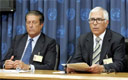 Co-chairs Mehmet
Aydin (R) and Federico Mayor
Co-chairs Mehmet
Aydin (R) and Federico Mayor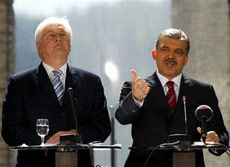
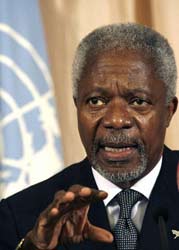

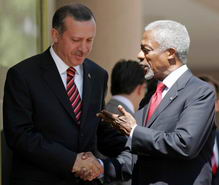

 Lübnan’a
asker gönderilmesine ilişkin tezkere 192 ret oyuna karşılık 340 evet oyuyla
TBMM’den geçti. AKP’den 6 milletvekili ret oyu verdi, biri de çekimser kaldı.
Tezkerenin geçmesiyle Türk askerine 88 yıl sonra Lübnan yolu gözüktü.
Lübnan’a
asker gönderilmesine ilişkin tezkere 192 ret oyuna karşılık 340 evet oyuyla
TBMM’den geçti. AKP’den 6 milletvekili ret oyu verdi, biri de çekimser kaldı.
Tezkerenin geçmesiyle Türk askerine 88 yıl sonra Lübnan yolu gözüktü. 

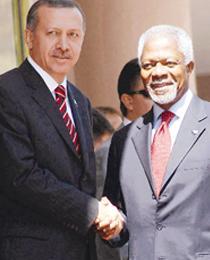 BAŞBAKAN
Tayyip Erdoğan, 1 Mart tezkeresine atıfta bulunarak, "Keşke 1 Mart’ta Irak’a
girseydik. Gitmeliydik" dedi. Erdoğan CNN Türk’ten canlı olarak yayımlanan
programda Gürkan Zengin’in sorularını yanıtlarken şunları söyledi:
BAŞBAKAN
Tayyip Erdoğan, 1 Mart tezkeresine atıfta bulunarak, "Keşke 1 Mart’ta Irak’a
girseydik. Gitmeliydik" dedi. Erdoğan CNN Türk’ten canlı olarak yayımlanan
programda Gürkan Zengin’in sorularını yanıtlarken şunları söyledi:  ANKARA 7 Eylül 2006 Milliyet


 söktükleri
kaldırım taşlarıyla barikat kuran gruptan 18' kadın 38 kişiyi gözaltına alındı.
söktükleri
kaldırım taşlarıyla barikat kuran gruptan 18' kadın 38 kişiyi gözaltına alındı.